Key takeaways
- Flying with a cat is not simply a smaller version of flying with a dog. Carrier acclimation, escape prevention and the cat’s response to environmental change deserve much more planning.
- Confirm the cat separately from the passenger booking. A ticket does not guarantee that the airline has accepted the cat on the exact flight.
- Check the actual operating carrier, aircraft limitations, every connection and the entry or transit rules that apply to the whole itinerary.
- A cabin carrier must fit both the cat and the aircraft space. The cat needs usable room to sit or stand naturally, turn and lie down without the carrier being crushed in a way that compromises ventilation.
- Start carrier acclimation before travel day. The carrier should become familiar resting space, not an object that appears only before a stressful journey.
- Airport security can be the highest escape-risk point because some jurisdictions require the cat to be removed while the carrier is screened separately.
- Plan toileting and hydration for the total door-to-door journey, not only the scheduled flight time. A secure, absorbent carrier setup is more reliable than assuming a litter tray can be used whenever needed.
- Sedation and tranquilization for air transport are discouraged by IATA. Any veterinarian-directed anxiety or nausea plan should be individualized, tested as advised by the veterinarian and checked against airline requirements.
Cats can travel successfully by air, but the difficult parts are often not the ones that first-time travellers expect. The flight itself may be only one section of a much longer period of confinement, unfamiliar smells, noise, movement and handling. A cat that is calm at home can react very differently when its territory disappears, its routine changes and the carrier is opened in a busy airport.
Current feline air-travel literature describes environmental change and loss of control or predictability as important stressors for cats. It also notes that frightened cats may freeze, attempt to flee or respond defensively, creating both welfare and escape concerns. At the same time, the evidence base is limited: there are few studies directly measuring air travel in cats, so some professional recommendations draw on broader feline behaviour research and clinical experience.[6]
This guide focuses on the planning principles that remain useful across airlines. It intentionally does not reproduce changing airline fees, weight thresholds, cabin-carrier dimensions or route restrictions. Those details belong in Pet Fieldbook’s airline policy guides and should be checked again with the operating carrier before travel.
Airline permission and legal permission to travel are separate. The airline may accept your cat while the destination or transit country requires documents you do not have; equally, a cat can satisfy government entry rules but still be ineligible for the intended flight. Build one itinerary that satisfies both systems.
1. First decide whether your cat should make the trip
Start with the individual cat rather than the airfare. Air travel may be necessary for an international move, a permanent relocation or a journey where realistic alternatives are limited. For a short holiday, the least disruptive option may sometimes be for the cat to remain in familiar surroundings with appropriate care instead.
The decision should consider physical health, age, respiratory anatomy, previous transport response, ability to remain confined, fearfulness and the total length and complexity of the journey. A 2023 review of feline air travel recommends assessing physical, mental and emotional suitability as soon as air travel is being considered, particularly for older cats or cats with health concerns.[6]
Questions worth answering before you book
- Is this journey necessary for the cat, or is there a realistic alternative?
- Can the cat tolerate the required carrier with the door securely closed for progressively longer periods?
- Has the cat shown panic, severe motion sickness, breathing difficulty or intense defensive behaviour during previous transport?
- How long is the door-to-door journey once ground transport, check-in, security, boarding, connections, immigration or veterinary clearance and onward transport are included?
- Could a direct flight meaningfully reduce handling and confinement, or does another itinerary provide a more workable arrival time or transfer process?
- What happens if the journey is extended by a delay or missed connection?
Discuss the proposed journey with your veterinarian if your cat has a chronic condition, breathing difficulty, significant travel fear, recurrent motion sickness, is very young or elderly, or you are unsure whether the cat can cope with the journey. This article is general guidance, not an individual fitness-to-fly assessment.
Short-faced cats deserve particular caution
Brachycephalic or short-faced cats can have respiratory limitations that matter during stressful transport, particularly if they would travel in the aircraft hold. The American Veterinary Medical Association notes that short-faced cats may be prone to respiratory problems and advises caution where hold travel is required.[10] Airline breed restrictions can also change, so verify the current carrier policy rather than assuming acceptance.
2. Understand how cats can travel by air
Depending on the airline, route and aircraft, a cat may travel in one of three broad arrangements. The terminology is not perfectly standardized, so ask the airline what the arrangement actually means operationally.
Cat Air Travel: Cabin, Checked Baggage and Cargo
The label matters less than the booking, handover, handling and collection process attached to it.
Not every airline offers every mode. Never use “cargo” and “checked baggage” as if they automatically describe the same process.
IATA’s Traveler’s Pet Corner notes that only small dogs and cats can generally travel in cabin and that some airlines do not allow cabin pets at all. Depending on the carrier, an animal may instead travel as special baggage in the hold or through an air-freight process.[3]
When an airline says “hold,” “checked pet,” “accompanied baggage,” “manifest cargo” or “air freight,” ask where the cat is accepted, who handles it, whether the booking is linked to your passenger ticket, where it waits, and where you collect it. Those answers reveal the real journey.
3. Before booking: verify the entire route
IATA’s July 2026 Operational Guidelines for In-Cabin Pet Transport treat pet travel as a complete process from booking through check-in, security, boarding, the flight, connections, arrival and irregular operations.[1] That is a useful planning model even when your cat will not travel in the cabin.
Confirm the cat before committing to an inflexible passenger ticket
A passenger reservation does not automatically reserve space for a cat. Airlines may cap the number of cabin pets, restrict pets on particular aircraft or routes, or require a separate service request. IATA’s operational guidance also notes that third-party booking sites may not support pet-in-cabin bookings and passengers may need to contact the airline directly.[1]
Ask for whatever reference, written acknowledgement or booking status proves that the cat has been added to the exact flight. Then reconfirm after any meaningful itinerary change.
Check the actual operating carrier
A codeshare can display one airline’s flight number while another airline operates the aircraft. Pet acceptance, carrier dimensions and handling rules need to work for the airline that actually carries the cat on each sector. On multi-carrier itineraries, IATA’s 2026 guidance calls for advance arrangements so all participating airlines accept the pet and handling remains consistent.[1]
Check every country the journey may engage
International travel can involve requirements from the origin, destination and transit countries. Whether a transit country’s import rules apply can depend on whether the cat remains airside, changes terminal, is collected and re-accepted, or formally enters the country. Government rules should be checked with the competent authority for the actual itinerary rather than copied from another traveller’s route.
For example, USDA APHIS tells U.S.-based travellers that destination countries set their own requirements and recommends starting early enough to complete any required identification, vaccinations, tests or treatments within the correct timeframes.[9] That process is a U.S.-origin example, not a universal template.
There is no single worldwide “health certificate must be issued within 10 days” rule. Some jurisdictions or airlines use short validity windows; others use different documents and timelines. Build your schedule from the current rule that applies to your origin, transit points, destination and airline.
4. Choose a carrier that fits both the cat and the aircraft
Cabin-carrier shopping often begins with an airline dimension chart. That is only half the problem. A suitable carrier must satisfy two kinds of fit at the same time:
- Cat fit: the usable internal space allows the cat to sit or stand naturally, turn around and lie in a natural position.
- Aircraft fit: the complete carrier fits the airline-approved stowage area for the assigned aircraft without being crushed in a way that compromises the cat’s space or ventilation.
IATA’s passenger guidance asks whether a dog or cat can sit erect, stand erect, turn around and lie down naturally inside the cabin container. It also warns that soft-sided carriers can compress under a seat and that blocked ventilation openings can contribute to heat buildup.[2]
Do not shop by the phrase “IATA-approved carrier”
IATA explicitly says it does not certify, approve, sell or endorse commercial dog or cat container brands or models. It publishes standards in the Live Animals Regulations; the airline determines whether the actual container presented for travel is acceptable.[2]
“IATA-approved” is a marketing phrase, not a product certification from IATA.
For a cat, security matters as much as comfort
A cabin carrier should resist escape when lifted, shifted under a seat or briefly handled during security. Check zippers, mesh panels, seams, door closures and any points a determined cat could push open. A flexible carrier can be useful where cabin dimensions are tight, but flexibility should not mean a collapsed roof, pinched ventilation or insecure openings.
IATA’s cabin guidance also requires containers to be escape-proof, clean and leak-resistant, with absorbent bedding capable of containing urine or feces.[2]
See the planned Pet Fieldbook cat travel-carrier guide for a dedicated comparison of fit, closure security, ventilation and cabin practicality.
5. Make carrier acclimation part of the travel plan
For many cats, the carrier predicts an unpleasant event because it appears only before a veterinary visit or move. FelineVMA guidance recommends keeping the carrier in the cat’s normal environment, using familiar bedding and positive associations, and allowing enough time for the cat to become comfortable with each training step.[4][5]
International Cat Care gives similar advice: use warm, familiar bedding, support the carrier from underneath to reduce instability, and create positive carrier experiences rather than introducing the carrier only at the moment of travel.[7]
Cat Carrier Acclimation: Build Familiarity in Stages
Move forward when the current step is ordinary for your cat—not because the departure date is getting closer.
Training may take days or weeks depending on the cat. The objective is calm familiarity, not forced tolerance.
Closed-door practice matters
A cat sleeping in an open carrier is a good start, but air travel requires secure confinement. Add the closed-door stage gradually. Once the cat settles with the door closed, practise lifting the carrier from underneath and moving it short distances while keeping it level.
Practise the actual travel setup
If the final carrier will contain a particular absorbent liner, familiar blanket or harness, introduce those components before travel. Do not make departure morning the first time the cat experiences the complete setup.
The goal is not excitement about the carrier. The useful skill is being able to enter, settle and remain contained while very little happens. Long stretches of pet air travel are waiting.
6. Plan for escape before you reach the airport
Escape prevention is one of the biggest ways cat air travel differs from ordinary passenger travel. The feline air-travel review notes that stressed cats may show flight reactions, avoidance or defensive behaviour and that escape can become a serious safety problem in the travel environment.[6]
Make the carrier the primary containment system
Before leaving home, check every closure. If a soft carrier uses zippers, make sure they cannot separate under pressure from inside. If you use zipper clips or another secondary closure, it should not create a snagging hazard or prevent quick access in a genuine emergency.
A well-fitted harness can provide secondary control at points where the cat must leave the carrier, but it is not a substitute for a secure carrier. FelineVMA client guidance specifically warns that a collar or harness with a leash is not a safe primary way to transport a cat.[5]
Do not introduce an unfamiliar harness at the checkpoint
If you plan to use a harness during security screening, acclimate the cat to it at home. Confirm fit before the journey and check again after the cat has been lifted or shifted. A frightened cat can reverse out of equipment that seemed secure in the living room.
Identification is a backup, not an escape-control strategy
Use whatever identification is appropriate for the trip and destination, including a microchip where required or advisable, and keep your contact details current. But identification helps after separation; it does not make opening a carrier in an unsecured space safe.
7. Health, stress and medication need separate decisions
Travel preparation can involve several different questions: Is the cat medically suitable to travel? Does the cat suffer from nausea or motion sickness? Does the cat experience fear or anxiety? And would a medication plan be compatible with air transport and the airline’s acceptance policy?
Those questions should not be collapsed into “Should I sedate my cat?”
IATA discourages sedation and tranquilization for transport
IATA’s passenger guidance advises against sedation or tranquilization for dogs and cats travelling in cabin because these drugs can reduce the animal’s ability to respond to transport stress. If such medication is administered, IATA says it should be under veterinary direction and the airline should be informed; an airline may refuse a sedated animal.[2]
The 2026 operational guidance likewise says sedation is discouraged unless prescribed by a veterinarian and describes documentation expectations where sedatives, tranquilizers or other psychoactive drugs have been administered.[1]
Anxiety management is not the same as simply making a cat sleepy
Feline veterinary guidance recognizes that some cats benefit from veterinarian-prescribed medication for fear or anxiety during transport. The feline air-travel review discusses anxiolytic strategies while emphasizing the need to avoid levels of sedation or poor coordination that could interfere with balance and normal responses.[6]
If your veterinarian recommends medication for the journey, follow that individualized plan. The review also recommends trial doses in advance for medications intended before flight so the veterinarian can assess the cat’s individual response and unwanted effects.[6] Do not copy another traveller’s dose or use a veterinary-visit protocol as an automatic air-travel protocol.
Pet Fieldbook does not provide a universal drug, dose or timing schedule for flying cats. The correct plan depends on the individual cat, health history, other medications, journey length and airline rules. If medication is being considered, involve your veterinarian early enough to assess the response before travel day.
8. Plan food, water and toileting for the total confinement period
A two-hour flight can easily become six or seven hours of carrier time after the journey to the airport, check-in, security, boarding and ground transport at the destination. A long-haul itinerary can become a full day or longer once connections and border procedures are included.
Food: avoid a one-rule-fits-all fasting schedule
IATA’s general passenger guidance suggests a light meal before travel rather than a large meal immediately before dispatch.[3] But cats vary, and health conditions can change feeding needs. If your cat has a medical condition or a journey requires unusual timing, ask your veterinarian how to manage meals rather than copying a generic fasting rule.
Water: plan access without compromising containment
Hydration should be considered across the complete journey. How water is offered differs between cabin and cargo travel and may be constrained by airline rules, security restrictions and the carrier setup. The priority is to avoid both deliberate dehydration and repeated carrier opening in unsafe places.
Toileting: build the carrier to handle an accident
IATA’s cabin guidance says the container should be able to contain urine or feces and should include absorbent bedding.[2] A practical cabin setup therefore starts with an absorbent liner sized so it does not bunch around the cat or block ventilation. Pack spare liners, waste bags and cleaning material in an accessible bag.
The feline air-travel review notes practical problems with putting a litter tray inside a transport carrier, including limited space and spillage.[6] Do not reduce the cat’s usable carrier space simply to force a litter tray into a cabin bag.
For very long journeys, identify a genuinely secure toileting option
Some airports have pet-relief areas, but IATA’s 2026 operational guidance says availability and access vary widely: facilities may be airside, landside or absent altogether.[1] Many relief areas are designed around dogs and may not provide a safe place to release a cat.
If a long itinerary may require a litter break, research the actual airport before travel. A cat carrier should only be opened where you have reliable containment—such as a fully enclosed private room or another setup you have confirmed is secure. Do not assume that a generic “pet relief area” is escape-proof.
Plan the Cat’s Confinement Time, Not Just the Flight Time
The practical welfare plan has to survive every stage between home and the final safe room.
A short scheduled flight can still create a long carrier day. Build food, hydration, absorbent bedding and contingency planning around the whole route.
9. At the airport, reduce avoidable stress before security
Airports stack stressors: unfamiliar people, rolling luggage, public-address announcements, dogs, changing temperatures, queues and sudden handling. The feline air-travel review describes this cumulative effect as stressor stacking—several stressors together can produce a greater response than one stressor alone.[6]
Arrive early enough to avoid rushing, but not so early that you add unnecessary confinement
Follow the airline’s required check-in time. Build a realistic buffer for pet acceptance and security without turning a manageable journey into extra hours in the terminal. Cargo and hold acceptance may have earlier cut-off times than passenger check-in.
Choose quieter waiting positions where the airport allows it
Keep the carrier away from direct sun, drafts and clusters of unfamiliar animals. If a partial cover helps your cat, use a light familiar cloth without blocking the carrier’s ventilation. Feline transport guidance supports reducing visual stimulation for cats that are calmer when the carrier is partially covered.[4][7]
Do not open the carrier to “comfort” a vocal cat
Meowing does not automatically mean the cat needs to be released. In an uncontrolled terminal, opening the carrier can turn ordinary distress into an escape emergency. Use calm handling, reduce stimulation where possible and keep the carrier securely closed until you reach a point where opening is required and controlled.
10. Airport security is the highest escape-risk moment
Security procedures vary by country and airport. IATA’s 2026 operational guidance explicitly notes that some jurisdictions require pets to be removed from their containers so the pet and carrier can be screened separately.[1]
That requirement collides directly with a cat’s strongest travel vulnerability: once the carrier opens, the primary containment system is gone.
Airport Security With a Cat: Build the Escape Plan First
The exact screening process varies. The containment principle does not.
Check the security authority’s current pet-screening instructions before departure.
If a familiar harness is appropriate, fit it before entering the checkpoint—not while the carrier is open.
For a high-risk cat, ask staff what controlled or private screening process is available before removing the cat.
Once the carrier has cleared screening, put the cat back inside and verify every closure before moving on.
Never put a cat through a baggage X-ray machine. Follow the local security authority’s instructions for screening the animal and the empty carrier.
U.S. example: TSA screening
In the United States, TSA currently instructs passengers with small pets to remove the pet from the carrying case, place the empty case through the X-ray machine and maintain control of the animal while moving through the checkpoint.[8] That is a U.S.-specific procedure, not a global rule.
If your cat is a serious flight risk, do not wait until the front of the queue to explain the problem. Contact the relevant security authority or airport before travel and ask what controlled or private screening options are available. Availability and procedures should be confirmed; do not assume every airport guarantees a pet-specific private room.
Before travel day, know which hand opens the carrier, how the cat is lifted, who handles the empty carrier, and how the cat goes back inside. The security queue is a poor place to discover that the harness buckle is under the cat or the carrier door cannot be reached while you are holding it.
11. Boarding and the flight: keep containment boring and predictable
IATA’s cabin guidance says dogs and cats should remain inside their travel containers during the flight, and the container should not be opened.[2] Its 2026 operational guidance also says airlines should require the pet to remain in the container and have the container safely stowed during taxi, takeoff, landing and turbulence.[1]
Before you sit down, check the under-seat space
Make sure the assigned location does not crush the carrier in a way that blocks ventilation. Do not treat “I can physically force the bag under the seat” as a successful fit. If the carrier cannot be stowed as required without compromising the cat’s usable space or airflow, raise the issue before departure.
Do not open the carrier because the cat is vocalizing
A cat may meow, shift position or remain very still. The safer response is usually to maintain secure containment, monitor what you can observe and follow crew instructions. If the cat appears acutely unwell—for example, with obvious respiratory distress, collapse or another serious change—alert the cabin crew.
Keep ventilation clear
If you use a partial cover to reduce visual stimulation, make sure air can still circulate through the carrier. Remove or reposition anything that traps heat or blocks mesh panels.
12. Long flights and connections need their own plan
A connection is not simply spare time between flights. It may add another terminal, another security process, another airline, a long wait or a new jurisdiction. IATA’s 2026 guidance advises airlines to inform passengers about pet-relief limitations and tells passengers to research transit points in advance, especially for long layovers and multi-leg journeys.[1]
Ask these questions for every connection
- Does the cat remain with you, or is there a handover process?
- If changing airlines, is the cat actually accepted by the second carrier?
- Will the cat need to pass security again?
- Would you have to enter the transit country to collect and re-check the cat?
- Is there any genuinely secure indoor space where a litter break could occur if necessary?
- How long could the cat be confined if the inbound flight is late?
- What happens if the final flight of the day is missed?
A legal passenger connection may still be a poor cat connection
Minimum connection time is designed around moving passengers, not necessarily the welfare and regulatory needs of a travelling cat. A slightly longer connection can be useful if it avoids rushing through another screening process—but a very long layover can create a different problem by extending confinement. Evaluate the actual process rather than simply selecting the shortest connection displayed.
13. If the cat travels in the hold or as cargo, the logistics change
Some airlines do not carry pets in the passenger cabin, and some cats or carriers cannot meet cabin limits. In those cases, the airline may offer checked/accompanied-baggage transport in the hold, cargo transport, or no pet service at all.
Do not frame the decision as “cabin is always safe, cargo is always unsafe.” The useful questions are more specific: Is the airline experienced with live animals? What container standard applies? Where and when is the cat accepted? How long is the ground-handling period? Are there weather restrictions? What happens at a connection? Where is the arrival facility, and when is it open?
Container requirements become more demanding
IATA’s Live Animals Regulations are the worldwide commercial-airline standard for live-animal transport, with the 2026 edition in effect from January 1, 2026.[11] For hold or cargo travel, the airline should provide the applicable container and acceptance requirements. Do not assume a cabin soft carrier is suitable for hold transport.
Plan the handover and collection facilities
Air-cargo bookings can use a different terminal from passenger departures. Collection can also occur at a cargo facility rather than baggage reclaim. IATA advises travellers shipping pets as air freight to confirm that the destination freight facility is open so the animal can be claimed.[3]
For international arrivals, also identify any customs office, veterinary border-control point, quarantine office or agent needed for release and verify operating hours.
14. Build a plan for delays, cancellations and rerouting
This is one of the biggest gaps in generic “flying with a cat” advice. The 2026 IATA operational guidelines contain a dedicated irregular-operations section because delays, cancellations, diversions and rerouting can affect both animal welfare and regulatory compliance.[1]
A delay is not only an inconvenience when a cat is confined. It can change the feeding and toileting plan, extend the effect or timing of veterinarian-prescribed medication, close an arrival inspection office, or push the cat onto a replacement flight operated by an airline that has not accepted it.
Before departure, know your fallback questions
- If the flight is cancelled, will the airline automatically preserve the pet booking when rebooking the passenger?
- Can the replacement aircraft accommodate the same carrier?
- If rerouted through another country, do different transit or entry requirements apply?
- Where can the cat remain securely contained during an extended wait?
- How will water and toileting be managed if the journey extends by several hours?
- If an overnight stay becomes necessary, is there a safe accommodation and transport plan that accepts the cat?
- Will any time-sensitive documents still be valid when the cat finally arrives?
When an airline moves you to a new flight, do not assume the pet service moved automatically. Reconfirm the cat, operating carrier, aircraft and route before leaving the desk or accepting the change in the app.
15. Arrival: keep the cat contained until the journey is actually over
The urge to open the carrier after a long flight is understandable. But the arrivals hall, baggage area, customs queue or curbside pickup zone is usually not the place.
IATA’s 2026 operational guidance notes that destination procedures may require pets to remain in secure, leak-resistant containers until customs or veterinary officials complete clearance.[1] Follow the destination authority’s instructions before releasing the cat.
Plan the first safe room
After clearance and onward transport, give the cat a quiet, escape-secure room at the final destination with water, an appropriate litter box, familiar food, hiding options and familiar-smelling items if available. Environmental familiarity matters strongly to cats, and relocation itself can remain stressful after the aircraft journey has ended.[6]
Allow the cat to decompress rather than immediately introducing unfamiliar people, animals or a large new space. Monitor eating, drinking, urination, breathing and general behaviour. Seek veterinary advice promptly if the cat appears unwell or has concerning respiratory, neurological or other signs.
16. Common mistakes when flying with a cat
- Buying the passenger ticket before confirming the cat.
- Checking only the marketing airline and not the actual operating carrier.
- Assuming cabin weight limits are the same thing as physical carrier fit.
- Buying a carrier just before departure and expecting the cat to tolerate it immediately.
- Using the phrase “IATA-approved carrier” as if IATA certifies retail products.
- Treating a harness as primary containment instead of backup control.
- Arriving at security without knowing whether the cat must leave the carrier.
- Opening the carrier in a terminal because the cat is vocalizing.
- Assuming a generic airport pet-relief area is safe for a loose cat.
- Planning around flight duration rather than total confinement time.
- Forcing a litter tray into a carrier at the expense of usable space.
- Following a universal fasting or health-certificate timing rule.
- Using an unfamiliar sedative or copying another cat’s medication plan.
- Assuming a passenger rebooking automatically preserves the pet booking.
- Opening the carrier immediately after landing before customs, veterinary clearance or a secure room.
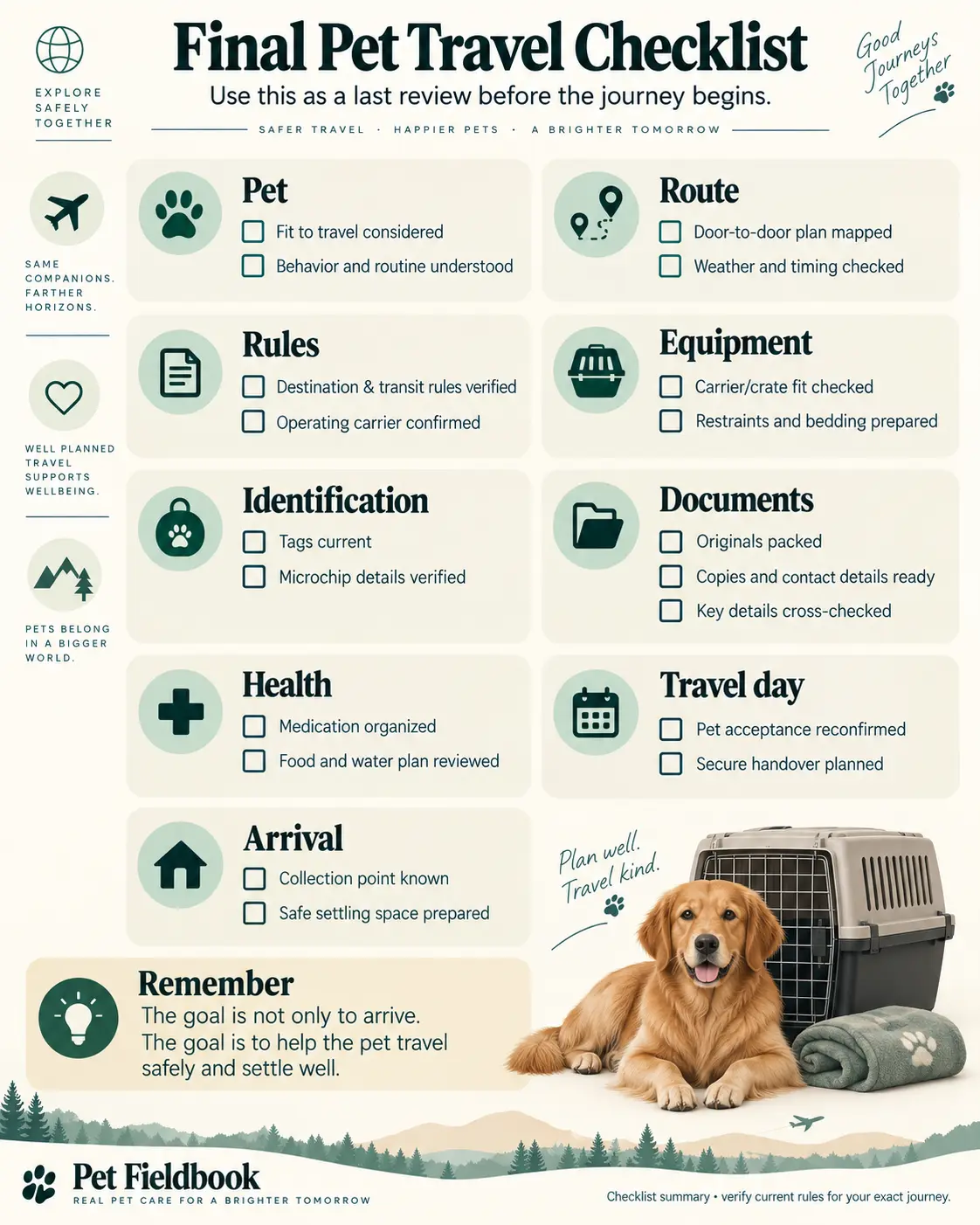
17. Flying with a cat: final checklist
- Suitability: the individual cat’s physical health, fear level and tolerance of confinement have been considered.
- Mode: cabin, checked/accompanied baggage where offered, or cargo process confirmed.
- Operating flight: airline, aircraft limitations and every sector checked.
- Pet booking: cat acceptance confirmed separately from the passenger ticket.
- Carrier: usable internal fit, airline dimensions, ventilation, closures and leak-resistant lining checked.
- Acclimation: cat has practised entering, settling, closed-door confinement, lifting and short journeys.
- Escape control: carrier closures checked; any harness or secondary control has been fitted and practised in advance.
- Documents: airline, origin, transit and destination requirements completed and cross-checked.
- Health plan: any medical, anxiety or nausea concerns discussed with the veterinarian.
- Medication: veterinarian-directed plan tested as advised; airline documentation requirements checked.
- Toileting: absorbent liner installed; spare liners, waste bags and cleaning supplies packed.
- Security: departure-airport screening process understood; controlled screening options investigated if the cat is a high escape risk.
- Connections: transfer, repeat security, transit rules and secure waiting/toileting options researched.
- Disruption: delay, cancellation, overnight and rerouting contingencies considered.
- Arrival: clearance point, facility hours, onward transport and the first secure room planned.
For the wider route, documentation and transport framework, read The Complete Guide to Travelling With Pets. For a reusable departure review, see the Pet Travel Checklist.
A good cat-flight plan keeps the cat securely contained while making the environment as predictable as the journey allows.
Flying with a cat: frequently asked questions
Can a cat travel in the airplane cabin?
Often, but not automatically. Cabin acceptance depends on the airline, route, aircraft, available pet space and the cat-and-carrier combination. Confirm the cat on the exact operating flight before relying on cabin travel.[1]
What size carrier does a cat need for flying?
There is no single universal cabin dimension. The carrier must satisfy the airline’s aircraft-specific limits while still giving the cat usable room to sit or stand naturally, turn and lie down. Check both external airline dimensions and the cat’s actual internal fit.[2]
Are there IATA-approved cat carriers?
No. IATA publishes container standards but says it does not certify, approve or endorse commercial carrier brands or models. The operating airline decides whether the container presented for travel is acceptable.[2]
Should I sedate my cat before flying?
Routine sedation or tranquilization for air transport is discouraged by IATA. If your cat needs help with fear, anxiety, nausea or another problem, discuss an individualized plan with your veterinarian and check the airline’s rules. Do not give an unfamiliar medication simply to make the cat sleepy.[1][2]
How does airport security work with a cat?
It varies by jurisdiction. Some systems require the animal and carrier to be screened separately. In the United States, TSA currently tells passengers to remove small pets from the carrier and put the empty carrier through X-ray while maintaining control of the animal.[8]
What if my cat might escape at security?
Plan before the checkpoint. Use a secure carrier as primary containment, consider a well-fitted familiar harness as secondary control where appropriate, and contact the security authority or airport beforehand to ask what controlled or private screening options are available. Do not assume a particular facility is guaranteed.
How does a cat use a litter box during a flight?
Usually the carrier should remain closed during the flight. IATA says the carrier should contain urine or feces and include absorbent bedding. For a very long journey, research whether there is a genuinely secure place during a layover where a litter break could be attempted; a generic pet-relief area may not be suitable for releasing a cat.[1][2]
How long can a cat stay in a travel carrier?
There is no responsible universal hour limit that works for every cat and journey. Consider the cat’s health, stress response, carrier fit, temperature, hydration, toileting plan and the full door-to-door duration. If the itinerary creates prolonged confinement, discuss the plan with your veterinarian and reduce avoidable transfer time where possible.
Can two cats fly in the same carrier?
Do not assume so. Airline and live-animal container rules determine what is accepted, and feline transport guidance commonly recommends individual carriers for routine transport because stress can change how cats interact.[5] Confirm the airline’s exact rule before booking.
What happens if my flight with a cat is delayed?
Reassess containment, water, toileting, medication timing, connection feasibility and any time-sensitive documents. If the airline rebooks you, reconfirm the cat on the replacement operating flight rather than assuming the pet service transferred automatically. Rerouting through another jurisdiction can also create new regulatory questions.[1]
Is cargo travel dangerous for cats?
No single label answers that question. Risk depends on the individual cat, container, airline, aircraft, ground handling, weather, route, transfers and collection process. If cabin travel is not possible, investigate the exact live-animal process rather than relying on blanket claims that cargo is always safe or always unsafe.
What documents does a cat need to fly internationally?
There is no universal document set. Requirements can include identification, rabies vaccination, laboratory testing, veterinary certificates, permits or import declarations, depending on the origin, destination, transit points and the nature of the movement. Check the competent government authorities and the operating airline for the actual route.[9]
Sources and further reading
- International Air Transport Association (IATA). Operational Guidelines for In-Cabin Pet Transport, Edition 1. Released July 15, 2026. Used for booking, multi-carrier itineraries, check-in, screening, boarding, in-flight containment, connections, arrival and irregular operations. Official source.
- International Air Transport Association (IATA). Guidance for Passengers Traveling with their Dog or Cat in the Cabin. Used for container fit, ventilation, escape resistance, absorbent bedding, acclimation and sedation guidance. Official source.
- International Air Transport Association (IATA). Traveler’s Pet Corner. Used for airline confirmation, transport modes, air-freight facility planning, feeding and sedation context. Accessed September 19, 2026. Official source.
- Feline Veterinary Medical Association (FelineVMA). 2025 Transportation of Cats in Motor Vehicles Position Statement. Used for feline transport stress, carrier acclimation and reducing visual stimulation. Professional source.
- FelineVMA / American Association of Feline Practitioners. Visiting Your Veterinarian: Getting Your Cat to the Veterinary Practice. Used for carrier training, transport containment and veterinarian-directed pre-travel medication context. Professional source.
- Rodan et al. / Journal of Feline Medicine and Surgery. Feline stress management during air travel: a multimodal approach. 2023. Used for feline stress, escape behaviour, evidence limitations, toileting considerations, medication trial principles and relocation stress. Peer-reviewed source.
- International Cat Care. Taking Your Cat to the Veterinary Clinic. Used for positive carrier experiences, familiar bedding, partial covering and supporting the carrier from underneath. Professional source.
- Transportation Security Administration (TSA). Small Pets / What Can I Bring? Used only for current U.S. security-checkpoint procedure. Official source.
- USDA Animal and Plant Health Inspection Service (APHIS). Pet Travel Process Overview. Last modified June 18, 2026. Used as a U.S.-origin example of destination-specific international documentation planning. Official source.
- American Veterinary Medical Association (AVMA). Air travel and short-nosed dogs FAQ. Includes guidance that short-faced cats may also be prone to respiratory problems, especially where hold travel is required. Professional source.
- International Air Transport Association (IATA). Live Animal Handling & Transport. Confirms the 2026 Live Animals Regulations are in effect and describes the LAR as the worldwide standard for commercial-airline live-animal transport. Official source.
Pet Fieldbook reviewed current IATA material, including the July 2026 Operational Guidelines for In-Cabin Pet Transport, alongside feline-specific professional and peer-reviewed guidance. The draft was then given a separate logistics pass focused on escape control, security screening, total confinement time, connections, cargo-facility processes and irregular operations. Airline-specific fees, weight thresholds and route restrictions are intentionally excluded from the evergreen core because they change and should be rechecked for the actual operating flight. Practical operational observations are labelled as Field Notes.