
A useful pet travel checklist starts long before you pack food, a lead or a favourite blanket. The tasks that can derail a journey—entry rules, vaccination timing, health certificates, pet reservations, carrier fit and route restrictions—often need to be solved first.
This guide gives you a reusable planning sequence for dogs and cats travelling by road or air, domestically or internationally. It deliberately avoids universal airline dimensions, certificate windows and country-entry rules because those can change by route, species, transport mode and date.
Key takeaways
- Start with the complete route and the pet’s suitability for the journey, not the ticket price.
- Treat government entry rules, airline or transport rules and accommodation rules as separate checks.
- Build time-sensitive veterinary and document requirements into a working timeline rather than relying on a generic “10-day certificate” rule.
- Confirm the pet separately from the passenger whenever a transport operator requires pet acceptance.
- Prepare the carrier, crate or road restraint early enough for fit checks and acclimation.
- Pack for the total door-to-door journey, including delays, connections, clearance and onward transport.
- Recheck changing rules close to departure and again after any material itinerary change.
1. How to use this checklist
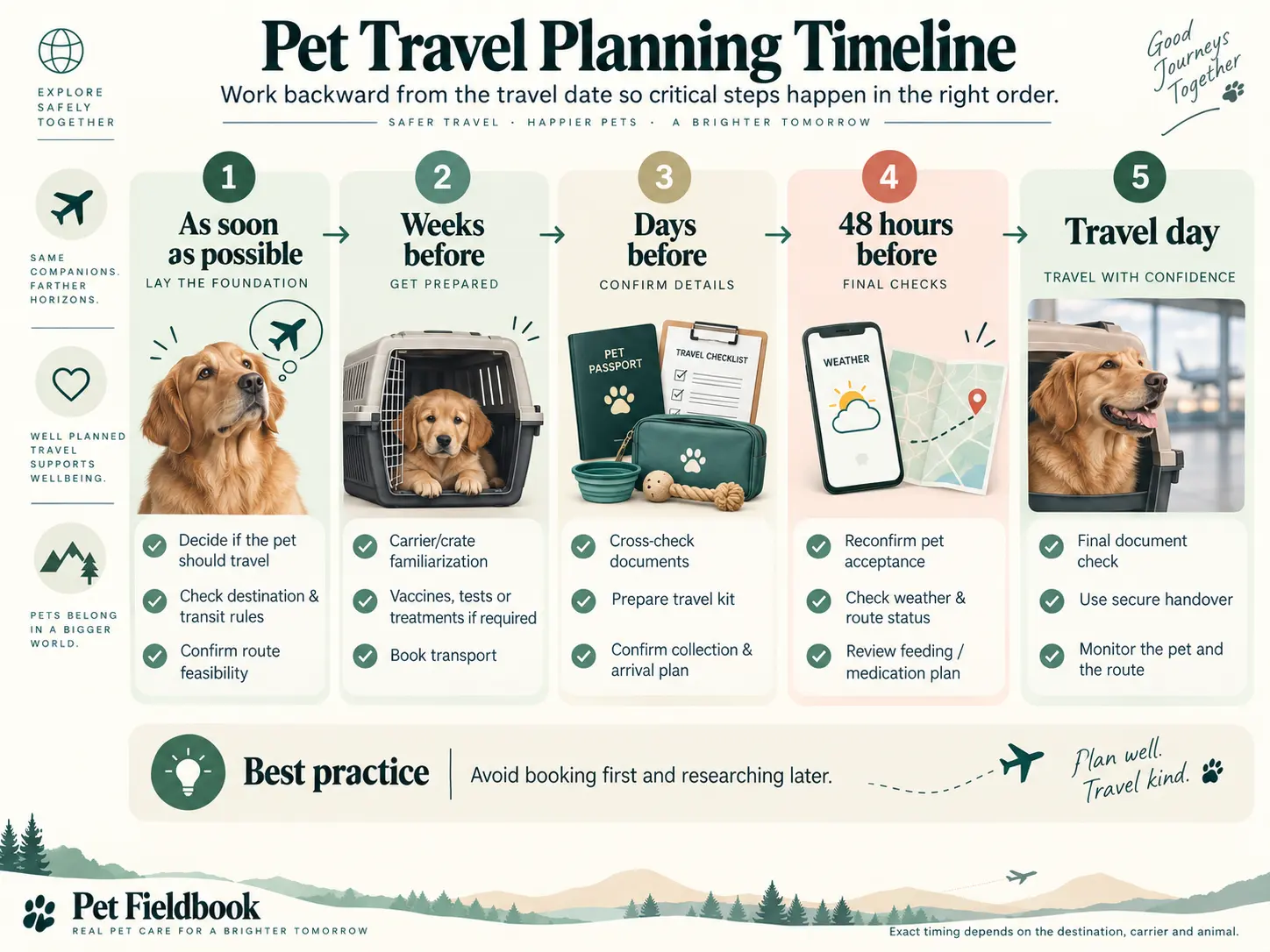
Do not try to complete every item in one sitting. Pet travel is easier to manage when you divide it into three layers:
- Requirements: what governments, carriers and accommodation providers require.
- Readiness: whether your pet, equipment and route are workable.
- Packing: what needs to be physically carried on the journey.
Start with requirements. A perfectly packed travel bag cannot fix a missing import permit, an invalid vaccination sequence or a carrier that the operating airline will not accept.
For the broader decision framework, begin with Pet Fieldbook’s Complete Guide to Travelling With Pets. If you already know you are flying, use the species-specific guides for flying with a dog or flying with a cat.
2. Before you book: decide whether the pet should make the trip
The first question is not “what should I pack?” It is whether this individual pet should travel on this particular journey.
Consider age, health, respiratory anatomy, mobility, anxiety, previous travel response, tolerance of confinement, temperature exposure and the total duration of the journey. CDC recommends planning ahead and discussing international travel with a veterinarian; its 2026 Yellow Book notes that age, species, chronic health conditions, short-nosed anatomy, time of year and transport mode can all affect planning. [6]
A short road trip with familiar stops presents a different challenge from a multi-leg international flight. If the journey is optional and likely to create substantial distress or medical risk, staying with a trusted carer may be the more appropriate plan.
If your pet has a chronic condition, breathing difficulty, a history of severe travel stress or motion sickness, is very young or elderly, or you are unsure about travel suitability, discuss the actual route and transport conditions with your veterinarian before making non-refundable arrangements.
3. Build the complete route and rule map
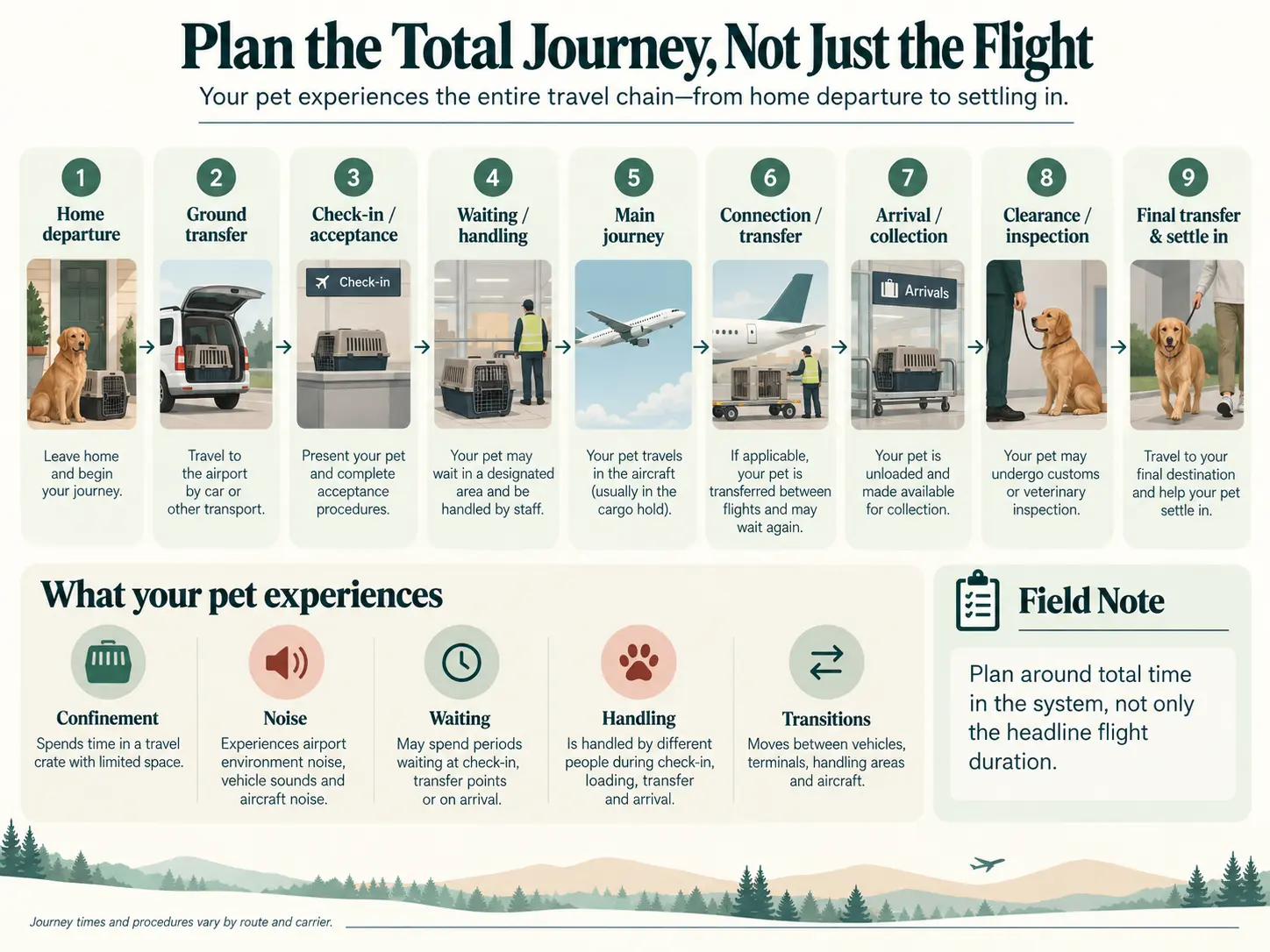
Write down the journey from the front door to the final destination. Include every country, state or province, airport, airline, connection, overnight stop, ferry, train segment and border crossing that matters.
For international travel, the destination government sets the animal-health entry requirements. USDA APHIS advises travellers to identify the destination requirements as soon as travel is being considered and to create a schedule for vaccinations, tests, treatments and certificates. It also warns that country requirements can change. [2]
Your rule map should answer:
- What rules apply at the destination?
- Do transit countries impose pet requirements even if you do not formally enter them?
- What rules apply when the pet returns home?
- Does the transport operator accept the species, breed/type, age and travel mode?
- Is the accommodation genuinely pet-friendly, and what restrictions apply?
- Are there arrival, inspection or cargo-facility opening hours that affect the route?
For air travel, also identify the actual operating carrier on every sector. A codeshare flight can display one airline’s brand while another carrier operates the aircraft and controls pet acceptance.
4. Start the veterinary and document timeline
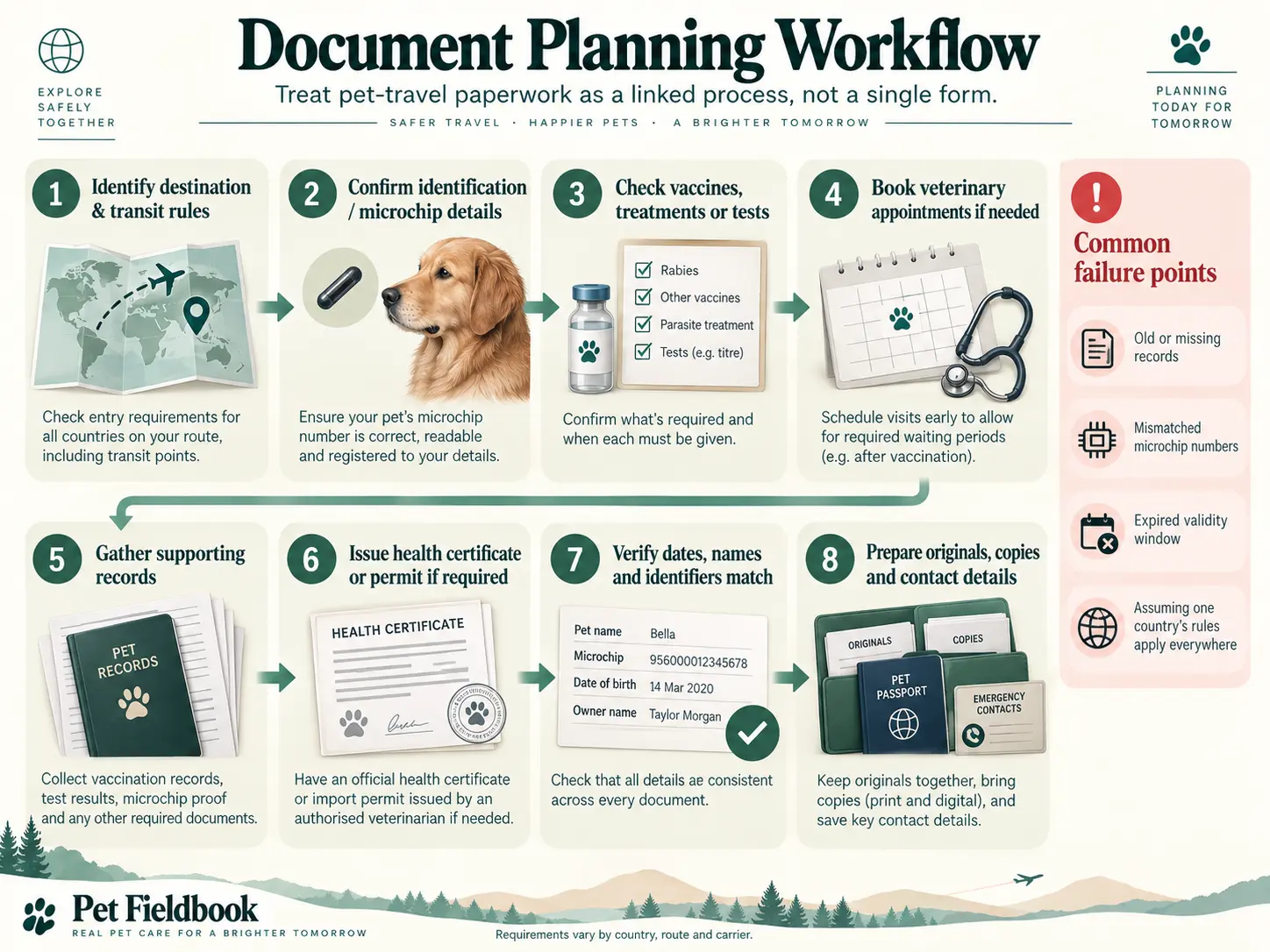
Some travel requirements can be completed quickly. Others are sequential: identification may need to come before vaccination; vaccination may need to precede a laboratory test; a test may start a waiting period; a certificate may only be valid inside a narrow travel window.
That is why a universal “see your vet 10 days before travel” rule is unreliable. USDA APHIS tells U.S. exporters to follow the destination country’s actual timeframe and notes that some countries can require vaccinations, tests or treatments well in advance. [2] CDC’s Yellow Book notes that some international destinations can require months of planning. [6]
Build a working document list
Depending on the journey, the file may include:
- microchip or identification record;
- rabies vaccination certificate;
- other vaccination records;
- laboratory test results;
- parasite-treatment record;
- veterinary or government health certificate;
- import or export permit;
- government endorsement;
- pet passport or equivalent movement document;
- airline pet-booking confirmation;
- cargo or transport document;
- owner declaration or authorisation; and
- return-entry documentation.
Not every journey requires every document. The checklist should tell you what to verify, not invent documents your route does not require.
Cross-check the identifiers
Before travel, compare the pet’s name, species, sex where recorded, date of birth or age, microchip number, vaccination dates, certificate numbers and owner details across the file.
A genuine document can still cause trouble if its microchip number does not match the chip that is scanned or if one record contains a transcription error.
Keep the authoritative requirements, appointment dates, document copies, booking references and contact details together. The goal is to avoid having one deadline in an email, another in a screenshot and a third in a veterinary record with no single view of the journey.
5. Confirm identification and ownership details
CDC’s current travel guidance recommends microchipping pets and keeping contact information current. [1] For international journeys, a microchip may also be a legal component of the entry process.
Before departure:
- scan the chip if there is any doubt that it can be read;
- confirm the number matches the travel records;
- update the registration contact information where applicable;
- make sure collar or harness identification is current if the pet safely wears one; and
- keep a recent clear photograph of the pet available.
Do not rely on one identification method alone when an unfamiliar environment increases the consequences of escape.
6. Choose and acclimate the carrier, crate or road restraint
Transport equipment should be chosen early enough to check fit and give the pet time to become familiar with it.
For air travel, IATA tells travellers to use an appropriately sized container and applies functional-space requirements for dogs and cats travelling in rigid containers. [3] For in-cabin travel, the carrier must also satisfy the operating airline’s aircraft-specific stowage rules.
For road travel, CDC recommends securing the pet rather than allowing it to roam and securing a crate so it cannot slide or shift. [1] FelineVMA specifically recommends carrier acclimation for cats and secure placement in the vehicle. [8]
Use Pet Fieldbook’s Pet Travel Carrier and Crate Guide for the complete fit and construction framework.
Practise the secured configuration
A pet that will travel behind a closed carrier door should have experience with the closed carrier, not only with walking into an open one for treats.
Build familiarity gradually where possible:
- leave the carrier accessible in a normal home area;
- add familiar bedding if appropriate;
- reward voluntary investigation and entry;
- close the door for short periods;
- increase calm confinement gradually;
- practise lifting or moving the carrier; and
- introduce short vehicle journeys if relevant.
7. Book transport and confirm the pet separately
A passenger ticket does not automatically confirm a pet.
IATA tells travellers to contact the airline and confirm that it accepts the pet on the intended day and flight, noting that airlines may restrict the number of animals. [3]
For an air journey, record:
- pet reservation or booking reference;
- operating carrier for each sector;
- whether travel is in cabin, checked/accompanied baggage where offered, or cargo/air freight;
- accepted carrier or crate dimensions and construction rules;
- check-in or cargo-acceptance location;
- required check-in time;
- route, aircraft or seasonal restrictions;
- connection handling; and
- arrival/collection location and opening hours.
If the airline changes the operating carrier, aircraft, connection, travel date or flight number, recheck the pet booking as well as the passenger itinerary.
8. Plan accommodation and the destination environment
“Pet-friendly” can mean very different things. Confirm the property’s rules directly where the consequences matter.
Check:
- species, size or number-of-pet restrictions;
- pet fees or deposits;
- whether pets can be left unattended;
- where toileting is possible;
- safe access to lifts, stairs or outdoor areas;
- nearby veterinary care; and
- how you will create a quiet decompression area after arrival.
For cats, identify a secure room where the carrier can be opened without access to an external door. For dogs, know where the first safe toilet break can happen after a long trip.
9. Build the pet travel kit
Pack for normal needs plus disruption. The exact kit depends on species, trip length, transport mode and destination.
Documents and identification
- original documents where required;
- copies or digital backups where accepted;
- transport booking confirmation;
- vaccination and medical records;
- current identification details;
- recent photograph; and
- emergency contact information.
Food and water
- enough of the pet’s normal food for the journey and a reasonable delay buffer;
- water appropriate for the journey;
- portable bowls;
- treats if useful and appropriate; and
- feeding instructions if another handler may be involved.
Avoid making an abrupt food change simply because you are travelling.
Medication and health supplies
- prescribed medication in adequate quantity;
- prescription details or veterinary instructions where useful;
- any route-appropriate parasite prevention discussed with your veterinarian;
- basic cleaning supplies; and
- a simple pet first-aid kit appropriate to the trip.
Do not experiment with an unfamiliar sedative or tranquilliser on travel day. For air travel, IATA discourages routine sedation and airlines may apply their own acceptance rules. [3]
Containment and hygiene
- lead, harness and spare restraint where appropriate;
- carrier or crate;
- absorbent liners or pads;
- waste bags;
- cat litter supplies where relevant;
- wipes or paper towels; and
- a sealable bag for soiled items.
Familiarity and comfort
A familiar blanket, small piece of bedding or other safe familiar item can help, provided it does not interfere with ventilation, fit or transport rules.
10. Road-trip checklist
Road travel removes airline rules but creates a different set of safety and logistics tasks.
CDC recommends building up to longer drives through shorter practice trips, using a harness or secured crate rather than allowing a pet to roam, and never leaving a pet alone in a parked vehicle. [1]
Before a long drive:
- secure the carrier, crate or appropriate restraint;
- check vehicle ventilation and temperature management;
- map safe stops;
- carry water and normal food;
- keep the lead or other escape-control equipment immediately accessible;
- check accommodation at overnight stops;
- locate veterinary care along remote routes where practical; and
- confirm any interstate, provincial or border requirements.
During stops
Open doors carefully. A pet that is calm at home may bolt in an unfamiliar service area. Dogs should be secured before the vehicle door opens. Cats should normally remain inside a secure carrier unless they are in a genuinely escape-proof environment.
11. Air-travel checklist
Air travel adds operator rules, airport procedures and longer periods during which the pet may remain contained.
Before departure, confirm:
- the pet is accepted on the exact operating flight;
- the travel mode is correctly recorded;
- the carrier or crate meets the current requirements;
- the pet fits the carrier appropriately;
- documents required by both airline and government are complete;
- airport acceptance location and timing are known;
- security-screening procedure is understood where relevant;
- connection handling has been confirmed; and
- the arrival collection or cargo facility will be open.
IATA’s 2026 in-cabin operational guidance treats the journey from booking through arrival and irregular operations as one continuous process, including connections and rerouting. [4]
For detailed species-specific planning, see Flying With a Dog and Flying With a Cat.
12. International-travel checklist
International travel adds legal entry and return requirements that can override an otherwise workable transport plan.
Verify from current official sources:
- destination-country entry requirements;
- transit-country requirements;
- return-home requirements;
- identification standard and sequence;
- vaccination requirements and validity;
- laboratory tests and waiting periods;
- parasite treatments;
- veterinary certificate requirements;
- government endorsement;
- import or export permits;
- pre-notification requirements;
- designated points of entry;
- quarantine or inspection requirements; and
- whether the movement qualifies as non-commercial travel.
The EU illustrates why this has to be route-specific. Current EU rules distinguish travel within the EU from entry from a non-EU country and specify their own identification, rabies and documentation conditions. [7]
The United States provides another example: current dog-entry requirements depend on travel history and vaccination circumstances, and every dog entering or returning to the U.S. requires a CDC Dog Import Form receipt. [9]
These are examples, not templates for other countries.
Plan the return before you leave
A journey can be legal outbound but difficult to reverse if return requirements were ignored. Keep the return route in the same planning file from the beginning.
13. The final 72 hours
The final days are for verification and execution—not for discovering foundational requirements.
Recheck:
- current airline or transport status;
- operating carrier and flight details;
- weather-related restrictions where relevant;
- pet booking confirmation;
- all time-sensitive documents and treatments;
- accommodation booking;
- arrival facility hours;
- local transport from the terminal or border;
- medication supply;
- emergency contacts; and
- the delay/cancellation plan.
If a route changes, ask whether the change introduces a new airline, aircraft, country, airport or arrival time that affects the pet.
Digital copies are useful, but do not assume every authority or carrier accepts them. If an official source requires an original signed or endorsed document, carry the original exactly as required. Keep critical booking references and contact details accessible even if your phone has no signal or battery.
14. Departure day
Keep the routine as ordinary as the journey allows.
Before leaving home:
- give any medication only as directed;
- check the pet’s condition;
- confirm the carrier or restraint is secured correctly;
- make sure documents are immediately accessible;
- carry enough water and journey supplies;
- give dogs an appropriate toilet opportunity;
- keep cats securely contained during loading; and
- leave enough time for the pet-specific check-in or border process.
Do not create unnecessary stress by repeatedly opening the carrier, introducing new food or testing unfamiliar calming products on the day of travel.
15. Arrival and the first hours at destination
Arrival is part of the checklist, especially after a long flight or border crossing.
First complete any required customs, veterinary inspection, quarantine, cargo collection or documentation process before treating the journey as finished.
Then prioritise:
- secure containment during the transfer from terminal to vehicle;
- water;
- a safe toilet or litter opportunity;
- the pet’s normal food when appropriate;
- prescribed medication on schedule;
- a quiet settling area; and
- observation for injury, unusual breathing, vomiting, marked weakness or other concerning changes.
Seek veterinary advice if the pet appears unwell.
16. Delay, cancellation and emergency plan
A robust checklist assumes the itinerary may fail.
IATA’s 2026 operational guidance specifically addresses delays, rerouting, prolonged confinement, temporary holding and documentation updates when a pet journey is disrupted. [4]
Before travel, know:
- who to contact if the carrier cancels or reroutes the journey;
- where the pet can safely wait;
- whether extra food, water, litter or medication is available;
- whether a replacement flight uses the same operating carrier and pet policy;
- whether rerouting introduces another jurisdiction;
- whether time-sensitive documents remain valid; and
- where emergency veterinary care is available.
For road travel, also plan what happens if the vehicle breaks down in heat, cold or a remote location.
17. Master pet travel checklist
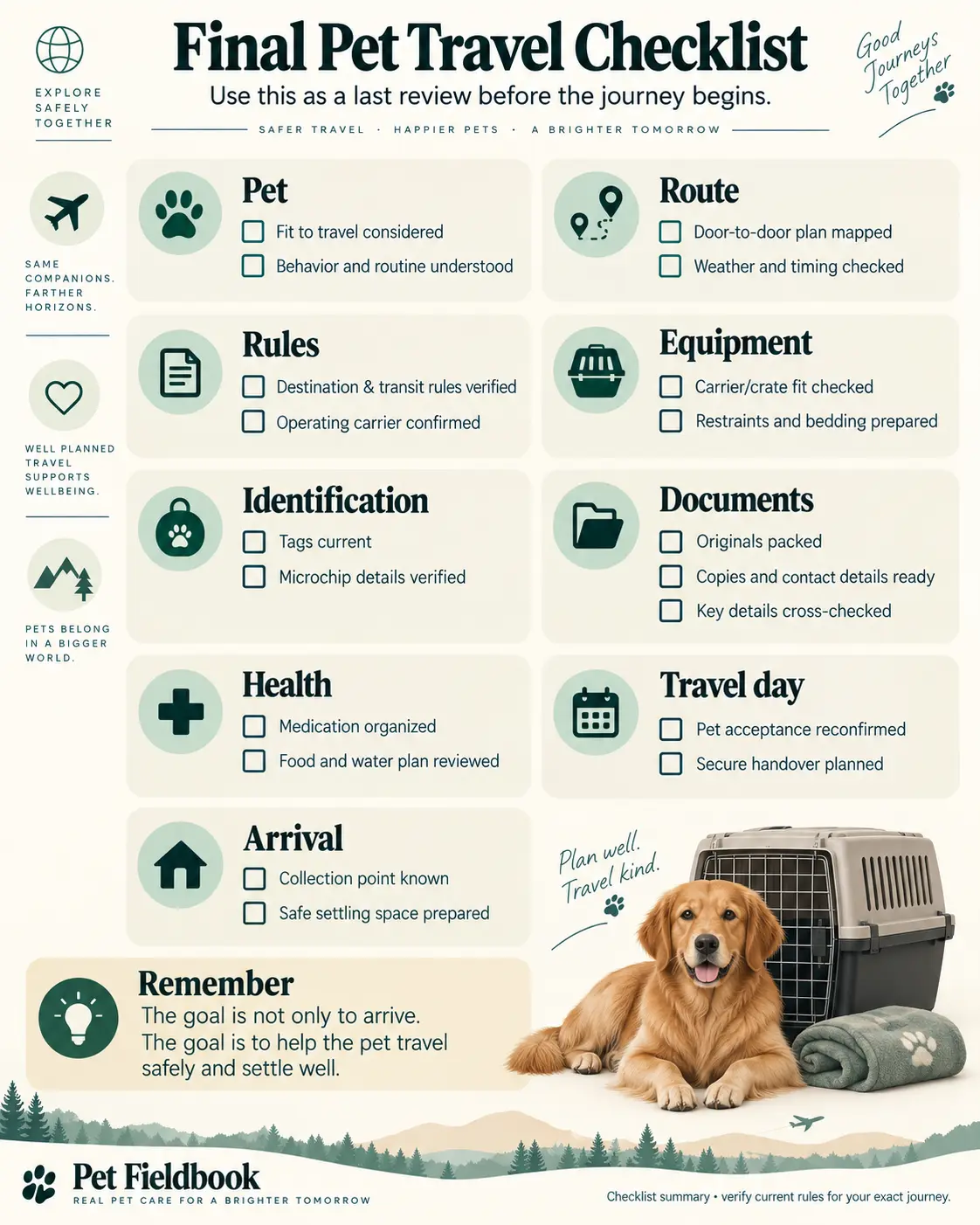
Use this as the final high-level review. Route-specific requirements still take priority.
Planning
- Decide whether the pet should make the trip.
- Map the complete route, including connections and return travel.
- Check destination and transit rules from current official sources.
- Check the transport operator’s current pet policy.
- Confirm pet-friendly accommodation and destination logistics.
Health and documents
- Discuss travel suitability with a veterinarian where appropriate.
- Verify microchip and identification details.
- Confirm required vaccinations, tests and treatments.
- Complete health certificates, permits and endorsements in the correct sequence and timeframe.
- Cross-check names, microchip numbers and dates across the document file.
- Prepare return-entry documents for international trips.
Transport equipment
- Choose the correct carrier, crate or road restraint.
- Check the pet’s physical fit.
- Check airline/vehicle requirements separately.
- Acclimate the pet to the secured travel setup.
- Prepare absorbent liners, bedding and required food/water equipment.
Booking and route
- Confirm the pet separately from the passenger where required.
- Verify the actual operating carrier.
- Record check-in or cargo-acceptance location and timing.
- Confirm connection handling.
- Confirm arrival/collection location and opening hours.
- Reconfirm after material itinerary changes.
Packing
- Required original documents and backups.
- Normal food plus a reasonable delay buffer.
- Water and portable bowls.
- Prescribed medication and instructions.
- Lead/harness and spare containment where appropriate.
- Waste bags, litter supplies or absorbent pads.
- Cleaning supplies.
- Recent pet photo and emergency contacts.
- Safe familiar comfort item if appropriate.
Final checks
- Recheck rules and transport status close to departure.
- Verify time-sensitive documents and treatments.
- Check weather and route disruptions.
- Confirm local transport and accommodation.
- Make a delay/cancellation plan.
- Keep critical documents and supplies accessible during the journey.
18. Frequently asked questions
How early should I start planning pet travel?
Start as soon as the route is reasonably known. A simple domestic road trip may need little lead time, while some international journeys require sequential vaccinations, laboratory tests, waiting periods, certificates or permits that can take weeks or months. Use the destination authority’s current requirements to build the timeline. [2][6]
Does every pet need a health certificate to travel?
No. Requirements vary by destination, species, transport operator and journey type. Check the government rules and the carrier separately.
Is a pet health certificate always valid for 10 days?
No. Some jurisdictions use a 10-day window in specific circumstances, but there is no universal global rule. Use the exact destination and carrier requirement for your route. USDA APHIS explicitly advises travellers to follow the destination country’s required timeframe. [2]
What documents should I carry when travelling with a pet?
Carry whatever the route actually requires. This may include identification or microchip records, vaccination records, health certificates, laboratory results, treatment records, permits, government endorsements, airline confirmation and return-entry documents. Some authorities require originals.
Should I carry paper copies or digital copies?
Keep digital backups, but follow the authority’s document-format rules. Do not assume a phone image or PDF can replace an original certificate when the destination requires the original signed or endorsed document.
What should be in a pet travel bag?
At minimum, think in categories: required documents, identification, normal food, water, bowls, prescribed medication, restraint or carrier equipment, hygiene supplies, waste/litter supplies, a recent pet photo and emergency contacts. Adjust for the species, journey length and transport mode.
What should I keep in carry-on luggage when flying with a pet?
Keep critical documents, medication, a small journey supply of appropriate food, hygiene supplies and items needed to manage a delay accessible to you. Follow aviation security rules for liquids and other items.
Do I need to check the pet after an airline schedule change?
Yes. Reconfirm when a change affects the operating carrier, aircraft, date, connection or route. Pet acceptance can depend on factors that do not matter to an ordinary passenger booking.
What should I check for a road trip with a pet?
Use secure restraint or a secured carrier, manage temperature and ventilation, plan safe stops, carry food/water and medication, verify accommodation and border rules where applicable, and never leave a pet unattended in a parked vehicle. [1]
What should I check when travelling internationally with a pet?
Check destination entry rules, transit requirements, return-home requirements, identification, vaccinations, tests, treatment windows, certificates, permits, endorsements, entry points and any inspection or quarantine process. Use official sources for the exact route.
What if my pet’s travel plans change at the last minute?
Recheck the legal route and the transport booking, not just the passenger ticket. A new country, airline, aircraft, connection or arrival time can change acceptance, documentation or facility availability.
Sources and further reading
- U.S. Centers for Disease Control and Prevention (CDC). Pet Travel Safety. Updated April 15, 2026. Official / professional source.
- USDA Animal and Plant Health Inspection Service (APHIS). Pet Travel Process Overview. Last modified June 18, 2026. Official / professional source.
- International Air Transport Association (IATA). Traveler’s Pet Corner. Accessed September 20, 2026. Official / professional source.
- International Air Transport Association (IATA). Operational Guidelines for In-Cabin Pet Transport. Edition 1, July 2026. Official / professional source.
- International Air Transport Association (IATA). Live Animals Regulations — Container Requirement 1. Edition 52, January 2026. Official / professional source.
- U.S. Centers for Disease Control and Prevention (CDC). Yellow Book 2026: Traveling with Pets and Service Animals. Accessed September 20, 2026. Official / professional source.
- European Commission / Your Europe. EU rules on travelling with pets and other animals in the EU. Last checked September 1, 2026. Official / professional source.
- Feline Veterinary Medical Association (FelineVMA). 2025 Transportation of Cats in Motor Vehicles Position Statement. Accessed September 20, 2026. Official / professional source.
- U.S. Centers for Disease Control and Prevention (CDC). Frequently Asked Questions on Dog Importations / CDC Dog Import Form. Current 2026 guidance. Official / professional source.
Pet Fieldbook reviewed current live search results to identify reader intent, checklist patterns and recurring misinformation, then verified substantive claims against current government, aviation-industry and professional feline sources. Changing airline dimensions, fees, breed rules, certificate windows and country-entry requirements are intentionally excluded from the evergreen core unless clearly identified as route-specific examples.