A travel carrier can look perfect on a product page and still be wrong for the journey. It may fit the airline’s published dimensions but leave too little usable room for the animal. A rigid crate may be large enough but fail because the halves are held together only by plastic clips. A soft cabin carrier may squeeze under a seat but compress so far that its ventilation panels are partly blocked. And a carrier designed for air travel is not automatically a crash-tested restraint for a car.
The useful question is therefore not “What is the best pet carrier?” It is:
What container fits this pet, this transport mode and this exact journey?
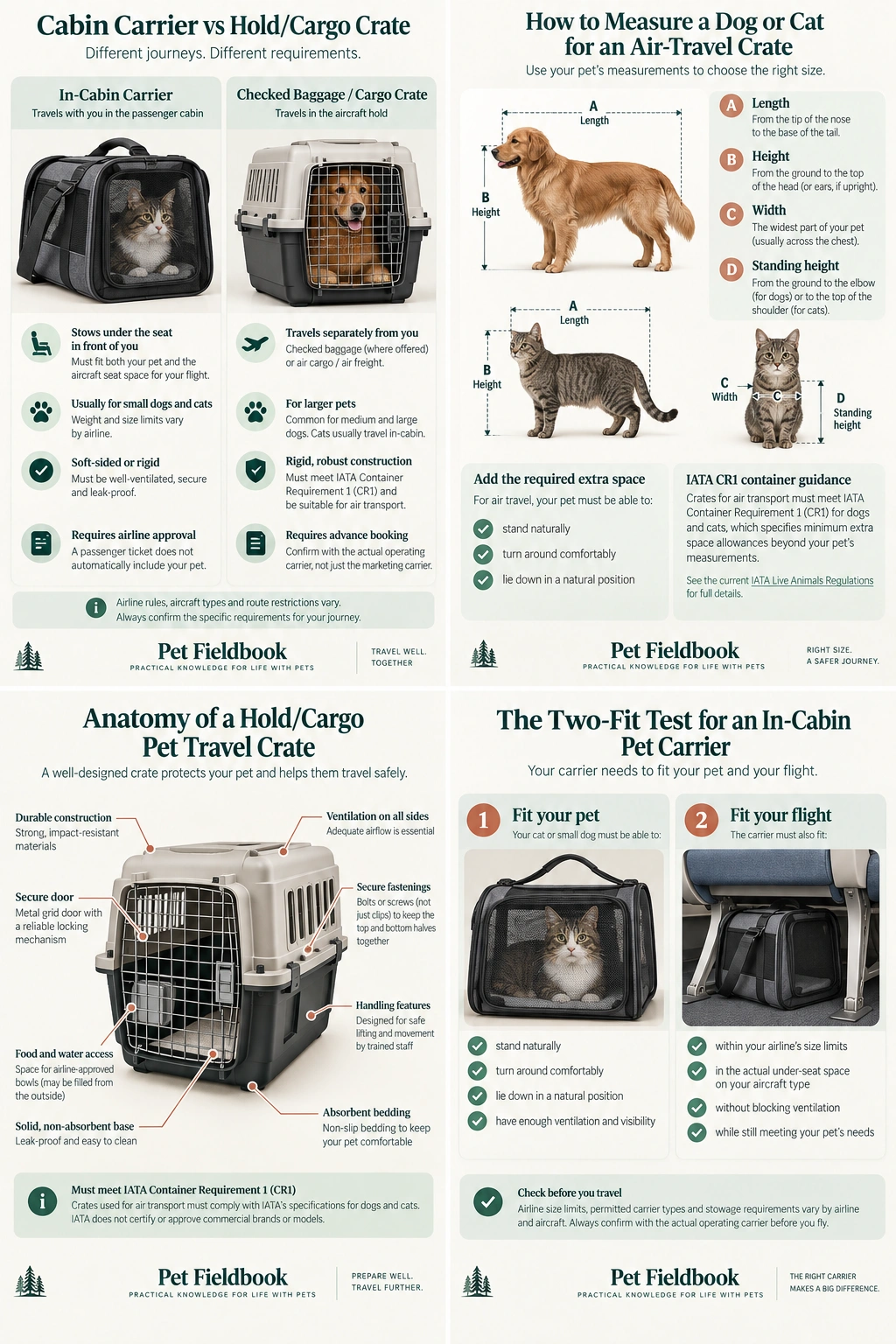
That distinction matters because cabin carriers, hold/cargo crates and road-travel restraints solve different problems. This guide explains how to choose and verify each without relying on a universal product label or a static airline-size chart.
For the broader journey-planning framework, start with The Complete Guide to Travelling With Pets. If you are already planning a flight, use this guide alongside Flying With a Dog or Flying With a Cat.
Key takeaways
- Choose by transport mode first. An under-seat cabin carrier, a rigid hold/cargo container and a crash-tested road crate are not interchangeable categories.
- Measure the individual pet. Breed, age and body weight can help describe the animal, but they do not replace actual body dimensions and a physical movement test.
- Cabin travel requires two kinds of fit. The pet must fit naturally inside the carrier, and the carrier must fit the airline’s permitted stowage space without unsafe compression.
- IATA does not certify retail carriers or crates. It publishes transport standards. The airline still decides whether the actual container presented for the journey is acceptable.
- For rigid air-transport containers, construction matters as much as size. Door security, fasteners, ventilation, leak resistance, spacers, handles and other details can determine acceptance.
- Air compliance does not prove road crashworthiness. Vehicle-restraint performance should be checked separately.
- Buy early enough to acclimate the animal. A technically correct container can still create unnecessary stress if travel day is the pet’s first experience of being confined in it.
1. Carrier, crate or kennel: what do the words mean?
Pet-travel terminology is inconsistent. One airline may call an under-seat bag a pet carrier, another may call it a container. A rigid enclosure for the aircraft hold may be called a crate, kennel, shipping container or travel container. Retailers may use all of those words interchangeably.
For practical planning, use the function rather than the label:
| Travel setup | What Pet Fieldbook means in this guide | Typical form |
|---|---|---|
| In-cabin carrier | Container that travels with the passenger in the aircraft cabin | Usually soft-sided, sometimes rigid, sized for the airline-approved stowage location |
| Hold/cargo air-transport container | Container accepted for a dog or cat travelling in the aircraft hold as accompanied baggage where offered or as cargo/freight | Usually rigid plastic, fiberglass, metal or purpose-built wood/plywood construction that meets the applicable transport requirements |
| Road-travel carrier or crate | Container used to restrain and protect the pet in a vehicle | Soft or rigid product selected for secure vehicle use; crash-test performance is a separate consideration |
The same physical product may work in more than one context, but never assume that from the marketing description alone.
A manufacturer can design a carrier around common cabin dimensions, but it cannot guarantee that the carrier will fit every aircraft, every seat or every airline policy. Likewise, a rigid crate can be designed around IATA standards and still be unsuitable for a particular animal or rejected under an airline or government variation.
2. Choose by travel mode before you shop
A common buying mistake is choosing a carrier first and trying to make the journey fit around it later. Reverse the order.
Before purchasing anything, identify:
- How the pet will travel — cabin, checked/accompanied baggage where offered, cargo/freight, car, train or ferry.
- Which operator will actually carry the pet — especially on codeshare or multi-carrier air itineraries.
- Whether the operator publishes container rules for that mode.
- Whether the country, airport, rail company or ferry adds another requirement.
- How long the total door-to-door journey will be.
A small soft carrier may be ideal for an eligible cabin pet but unusable for hold transport. A heavy-duty cargo crate may meet air-transport construction rules but be impossible to stow in a small vehicle. A vehicle carrier with excellent crash-test credentials may not meet an airline’s cabin dimensions.
In-cabin air travel
The critical constraint is usually the airline-approved stowage space. In the United States, for example, the FAA treats a cabin pet container as carry-on baggage and requires it to fit under the seat without blocking access to the aisle. Airlines add their own pet and carrier rules on top of that.[1]
Internationally, IATA’s 2026 operational guidance says cabin containers should comply with the airline’s specific requirements and IATA’s relevant CR1 standards, while fitting the permitted stowage location without compromising the animal’s space or ventilation.[2]
Hold or cargo air travel
Here the container becomes part of a live-animal handling system. The pet may be moved by trained staff, positioned with other freight and handled through separate acceptance and collection facilities. The container therefore needs structural integrity, ventilation, secure closures, handling space and other features that an ordinary fabric carrier does not provide.
IATA’s 2026 CR1 is the main global technical reference for domestic dogs and cats transported by commercial airlines, subject to airline and state variations.[3]
Road travel
Road safety is a separate problem. The fact that a carrier fits under an airline seat says nothing about how it performs in a vehicle collision. For cats, the Feline Veterinary Medical Association recommends secure carrier placement and says that if a seat belt is used, it should be used with a carrier that is crash-test certified.[4]
For any pet, treat claims such as crash tested, crash certified, airline compliant and IATA compliant as different claims that require different evidence.
3. Start with the universal fit test
Whatever the travel mode, the container first needs to fit the animal.
For air transport, IATA CR1 says each dog or cat must have enough space to stand, sit erect, lie in a natural position and turn about normally while standing.[3] That is a useful functional test even when you are choosing a non-air carrier.
The important word is naturally.
A dog should not have to crouch continuously to avoid the roof. A cat should not be wedged into a curled position because the bag technically closes. The pet should not need to twist around a fixed bowl, thick mattress or storage insert that reduces the usable space below what the animal actually needs.
Internal dimensions and external dimensions are not the same thing
Airlines normally care about the carrier’s external dimensions because the entire carrier must fit the permitted aircraft space. The animal lives inside the internal dimensions.
Padding, frame pieces, wheels, reinforcement, sloping walls and thick bases can make the usable interior meaningfully smaller than the external measurements printed on the product page.
When comparing products, therefore record both:
- the closed external length × width × height; and
- the usable internal dimensions where the manufacturer provides them.
If internal dimensions are not published, measure the actual product before relying on it for a tight-fit journey.
Weight is not a substitute for body size
Some operators use combined pet-and-carrier weight limits. Others focus primarily on carrier dimensions and physical fit. Either way, a weight threshold does not tell you whether the animal is too tall, too long or too broad to occupy the carrier naturally.
Two animals of the same weight can require very different spaces.
4. How to choose an in-cabin airline carrier
Cabin carriers have a difficult job: they need to provide enough usable space for the pet while fitting into a restricted aircraft location.
That creates the two-fit test.
Fit test 1: does the pet fit?
With the carrier closed in its travel configuration, check whether the animal can:
- stand or sit erect as required;
- turn around normally;
- lie in a natural position;
- remain clear of hard frame pieces or protrusions; and
- breathe without the face being pressed into fabric or mesh.
Do the test with the actual liner or absorbent pad you intend to use, because bedding reduces usable height.
Fit test 2: does the carrier fit the aircraft setup?
Check the operating airline’s current rules for the exact itinerary. Look for:
- maximum external carrier dimensions;
- whether soft and rigid carriers have different limits;
- any combined pet-and-carrier weight limit;
- aircraft or seat restrictions;
- whether premium/bulkhead/exit-row seats affect under-seat storage;
- whether the carrier must remain fully under the seat during taxi, takeoff and landing; and
- whether the airline imposes route or destination restrictions.
IATA’s July 2026 operational guidance says passengers should be informed of stowage limitations specific to the assigned aircraft type and that compliant containers must fit the permitted stowage location without compromising ventilation.[2]
Soft-sided versus rigid cabin carriers
IATA CR1 allows in-cabin containers to be non-rigid. That is why soft-sided carriers are common.[3]
A soft carrier can be useful when the under-seat space is slightly irregular, but flexibility should not become an excuse to crush the carrier around the animal. IATA’s passenger guidance specifically warns that soft-sided carriers may compress under the seat in ways that obstruct ventilation and contribute to heat buildup.[5]
A rigid cabin carrier may protect its internal shape better, but the lack of flexibility can make aircraft fit less forgiving. The correct choice depends on the animal, the exact permitted dimensions and the airline.
Ventilation
Ventilation needs to remain usable in the stowed position, not merely when the carrier is sitting on your floor at home.
Check whether:
- mesh panels will be pressed against a seat frame, wall or luggage;
- a privacy cover blocks too much airflow;
- the animal’s body will lie directly against the main ventilation area;
- expandable panels remain closed during flight and reduce the ventilation pattern; and
- external pockets become overfilled and cover mesh.
IATA cabin guidance asks whether a container has adequate ventilation, is escape-proof and leak-proof, and can contain urine or feces produced during travel.[5]
Closures and escape resistance
A useful cabin carrier should stay securely closed when lifted, tilted or nudged under the seat. Pay attention to:
- zipper quality;
- whether zipper pulls can be secured together;
- door or panel stiffness;
- mesh attachment points;
- seams; and
- any gap where a cat or small dog could push a nose or paw through.
For cats in particular, closure security is not a minor convenience. A determined cat can exploit surprisingly small gaps. The carrier remains the primary containment system even if the cat also wears a familiar, well-fitted harness for controlled handling at security.
Base and leak resistance
The base should remain reasonably stable when the carrier is lifted and should cope with urine, spilled water or motion sickness. IATA passenger guidance calls for a clean, leak-proof container with absorbent bedding.[5]
A removable washable liner is useful, but thick plush inserts can reduce internal height. Test the carrier with the actual travel liner rather than assuming the empty-bag fit will remain the same.
Expandable carriers
Expandable panels can provide more room when the carrier is stationary and the operator permits expansion, but the carrier still needs to comply in its closed travel configuration.
Do not size the animal based on space that disappears when the panel is zipped shut. And do not assume expansion will be allowed at the gate, in the cabin or during a connection.
Wheels and rolling frames
A rolling system can help in terminals, but it adds external dimensions, weight and hard components. If the wheels or frame must remain attached, include them in the carrier’s actual travel measurements.
For rigid CR1 hold/cargo containers, IATA says wheels must be removed or rendered inoperable.[3]
Top-opening doors
Top access can make a carrier easier to load at home and can be useful for cats. It does not replace secure side access or change airline screening rules. If a top panel exists, make sure it cannot be forced open from inside and does not weaken the structure when the carrier is lifted.
5. How to measure a dog or cat for a rigid airline crate
For dogs and cats travelling in the hold or as cargo, the 2026 IATA CR1 provides a measurement framework for estimating minimum internal container dimensions.[3]
Measure the animal standing naturally:
- A — body length: tip of nose to the base/root of the tail.
- B — elbow height: floor to the elbow joint.
- C — width: across the shoulders or the widest point of the animal, whichever is greater.
- D — standing height: floor to the top of the head or ear tip, whichever is higher.
For one animal, CR1 gives the following guidance:
Internal length = A + ½ B
Internal width = C × 2
Internal height = D + bedding
CR1 also states that snub-nosed breeds require a 10% larger container.[3]
The formula is not the final test
IATA describes the formula as guidance that may need adjustment to meet the mandatory performance requirements. If the calculation produces a container in which the animal cannot stand, sit, turn and lie naturally, the container is too small even if the arithmetic was performed correctly.[3]
This is particularly important for animals with:
- erect ears;
- unusually long bodies;
- deep chests;
- broad shoulders;
- thick bedding requirements; or
- body proportions that do not fit neatly into a standard retail crate size.
Measure the animal, not the breed chart
Breed charts are useful only as rough shopping filters. A Labrador, Maine Coon, domestic shorthair, mixed-breed dog or “Indie” can vary substantially in real dimensions.
Measure the animal that will actually travel, then compare those numbers with the internal dimensions of the actual crate model.
6. Hold/cargo crate construction: what to inspect
A correct size does not rescue a structurally unsuitable crate. The 2026 CR1 includes detailed construction and handling requirements.[3]
Rigid materials
CR1 lists fiberglass, metal, rigid plastics, welded wire mesh components, solid wood and plywood among suitable materials, subject to its detailed construction rules and operator variations. Containers made entirely from welded wire mesh or other wire mesh are not suitable for air transport.[3]
Many pet travellers use a two-piece rigid plastic kennel, but “hard plastic” alone does not prove compliance.
Smooth, animal-safe interior
The inside should not have projections, sharp edges or accessible components that the animal could bite or scratch in a way that compromises the container. Openings need to be nose- and paw-proof.[3]
CR1 specifies maximum opening sizes of 25 × 25 mm for dogs and 19 × 19 mm for cats, with smaller openings used when needed to remain nose- and paw-proof.[3]
Secure top-and-bottom fasteners
For rigid plastic containers made from upper and lower halves, CR1 says the sections must be securely bolted together. Plastic clips must not be the only fasteners holding the halves together; metal nuts and bolts in every hole are recommended.[3]
This is one of the easiest retail-crate problems to miss because many household kennels are designed for convenience rather than air transport.
Door security
The door needs to be strong enough that the animal cannot bend or distort it. Where doors use locking pins, CR1 requires the pins to engage the container by at least 1.6 cm. For rigid plastic containers, CR1 also recommends additional removable fasteners such as cable ties at the four corners of the door frame, chosen so they do not injure the animal or handlers.[3]
Do not improvise a permanent lock that prevents authorised staff from opening the crate in an emergency.
Floor
The floor must be solid and leak-proof.[3] Add suitable absorbent bedding without making the surface dangerously slippery or reducing the standing height below the required fit.
Ventilation
The 2026 CR1 says the total ventilated area must be at least 16% of the total surface area of the four sides, with ventilation on all four sides. Openings on the sides and back are positioned over the upper two-thirds, and one end of a rigid container—often the door—uses welded wire mesh under the CR1 construction system.[3]
Do not tape over ventilation holes to attach documents, decorations or labels.
Spacers and handles
CR1 requires spacers along both long sides and the back of the container so that adjacent freight cannot block ventilation. Suitable handles or handholds allow handlers to move the container without putting hands close to the animal.[3]
Wheels
If the container has wheels, CR1 says they must be removed or rendered inoperable.[3]
Bedding, food and water
CR1 requires absorbent bedding suitable for the species. For the hold/cargo system, it also sets requirements for water and food containers, including an internal water container that can be filled from outside without opening the crate.[3]
This is different from the in-cabin exception, where CR1 states that food and water containers are not required as part of the cabin container specification.[3]
Always confirm the airline’s current instructions for what should be installed, attached or packed with the crate.
Labels and documents
IATA’s public CR1 extract includes live-animal and orientation labelling requirements for live-animal consignments.[3] U.S. USDA training material likewise instructs airport personnel to inspect routing information, feeding/watering information and document pouches on air-travel kennels.[6]
The exact document set depends on the journey. Do not cover vents with labels or paperwork.
7. Can two pets share one air-travel container?
Sometimes, but never assume they should.
The 2026 IATA CR1 says a maximum of two adult animals of comparable size, up to 14 kg each, that are compatible in size and accustomed to cohabiting may be shipped in the same enclosure. Animals over 14 kg must be crated individually. It also provides conditions for certain puppies or kittens travelling together.[3]
At the same time, IATA warns that animals can become stressed or aggressive during air travel even if they normally share a household.[7]
There can also be stricter national or airline rules.
For a shared container, CR1 changes the width calculation:
- two animals: C × 3;
- three animals: C × 4;
while length and height are determined in the same manner.[3]
Treat these as regulatory limits and calculation guidance, not as a recommendation that two pets will be happier together.
8. There is no universal “IATA-approved” pet carrier
This phrase appears constantly in product listings, but it implies a certification system that IATA explicitly says it does not operate.
In the 2026 CR1, IATA states that it does not certify, approve, endorse or sell any particular pet-container manufacturer, brand, make or model.[3]
Its passenger guidance says the same thing for commercial dog and cat travel/shipping containers.[5]
A more accurate description is:
- designed to meet IATA CR1 requirements, or
- IATA-compliant when correctly sized/configured for the animal and accepted by the carrier.
Even that does not guarantee airline acceptance, because the airline may impose stricter requirements, the route may have a state/operator variation, or the actual container presented at check-in may be too small, damaged or incorrectly configured.
What to ask a seller instead
Instead of “Is this IATA approved?” ask for specifics:
- What are the usable internal dimensions?
- What are the closed external dimensions?
- What materials and fasteners are used?
- How does the door lock?
- Where are the ventilation openings?
- Can wheels be removed?
- Are replacement metal bolts available?
- Can food/water containers be installed as required?
- Which exact standard is the manufacturer claiming to meet?
A precise answer is more valuable than a logo or marketing badge.
9. Verify the exact airline and journey before relying on the carrier
A carrier can be technically good and still be wrong for a particular flight.
For cabin travel, IATA’s 2026 operational guidance says airlines should communicate aircraft-specific stowage limits and verify container compliance at check-in. Gate staff should also verify security, ventilation, size and stowage fit.[2]
The FAA similarly advises travellers to contact the airline for its specific cabin-pet policy because airlines decide whether and how pets are accepted in the passenger cabin.[1]
Before finalising a purchase, verify:
- the actual operating airline on every sector;
- cabin versus hold/cargo booking method;
- current maximum carrier dimensions;
- whether a soft or rigid carrier is accepted for that mode;
- pet and carrier weight rules, if any;
- aircraft/seat limitations;
- whether the airline has its own crate-hardware or breed rules;
- state or destination variations;
- connection requirements; and
- the final acceptance location and procedure.
Recheck after itinerary changes
If the airline changes the aircraft, operating carrier or routing, recheck the carrier. Under-seat space and live-animal acceptance can change with the new setup even if the passenger booking remains valid.
10. An air-travel carrier is not automatically a safe car carrier
This distinction is easy to miss because many products are marketed simply as “travel carriers.”
Air transport standards primarily address containment, ventilation, animal space, handling and aircraft operations. Vehicle crashworthiness asks a different question: how does the restraint system perform under collision forces?
The Feline Veterinary Medical Association’s 2025 position statement recommends placing cat carriers securely on the floor behind the driver or passenger seat and states that, if seat belts are used, they should only be used with carriers that are crash-test certified.[4]
The Center for Pet Safety publishes independent certification results for pet travel carriers and crates designed for vehicle use.[8]
That does not mean every pet owner needs one specific brand. It means the buying logic should be mode-specific:
- airline-compliant is not the same as crash-test certified;
- a seat-belt loop on a carrier does not, by itself, prove crash performance;
- a heavy rigid air crate may be strong but still need an appropriate vehicle-securement system; and
- a soft vehicle carrier may be crash certified but too large or structured differently for the airline’s under-seat limits.
If one product will be used for both road and air travel, verify both sets of requirements independently.
11. Acclimation is part of choosing the carrier
The purchase is not complete when the carrier arrives.
IATA’s Traveler’s Pet Corner recommends introducing dogs and cats to the travel container weeks or months before the journey and getting them accustomed to confinement.[7] Its July 2026 in-cabin operational guidance likewise tells airlines to provide passengers with pre-travel information on acclimating pets to their containers.[2]
For cats, FelineVMA also emphasizes carrier acclimation as part of transport welfare.[4]
A useful progression
Depending on the animal, preparation can move through stages:
- Leave the carrier open in a familiar area.
- Add familiar bedding or another appropriate familiar cue.
- Reward voluntary investigation and entry.
- Feed treats or meals near or inside it where appropriate.
- Close the door briefly, then reopen before the animal becomes highly distressed.
- Increase closed-door time gradually.
- Practise lifting and carrying.
- Practise short vehicle movements or other relevant transitions.
- Rehearse the actual travel liner and secured configuration.
The goal is not to make the carrier exciting. It is to make confinement and movement more predictable.
Do not wait until the final week if the animal is fearful
A pet with a long history of carrier fear may need a slower plan and veterinary or behaviour-professional support. Buying a technically superior carrier does not automatically solve a learned fear response.
12. Features worth paying for—and features that do not prove compliance
Good design can make travel easier, but separate useful features from compliance claims.
Useful features for many travellers
Secure closures. Zippers, latches and doors should stay closed during lifting and movement.
Stable base. The animal should not slide or sag dramatically when the carrier is carried.
Washable or replaceable liner. Useful after urine, feces, spilled water or motion sickness.
Accessible ventilation. Mesh or openings should remain clear when the carrier is closed and stowed.
Comfortable handles. A secure grip reduces tilting and rough movement.
Multiple access points. Can make loading easier, especially for cats, provided every opening is escape-resistant.
Simple interior. Fewer loops, dangling straps or hard objects reduce entanglement and impact risks.
Features that need context
Expandable sides: helpful during stationary waits only if the space is secure and the operator permits use; irrelevant to closed travel fit.
Privacy covers: can reduce visual stimulation for some animals but must not obstruct ventilation.
Internal tethers: can create an entanglement hazard if used incorrectly; do not rely on one as the primary containment system inside a closed carrier.
Wheels: convenient in terminals but add size and may need to be removed or disabled for certain transport systems.
Storage pockets: useful until overfilled pockets block ventilation or push the carrier beyond the permitted dimensions.
“TSA approved”: airport screening agencies generally do not certify a specific retail carrier as a universal pet-travel product. Check the security procedure and airline policy instead.
“Airline approved”: treat as marketing shorthand unless the seller identifies the exact requirements and airlines involved.
13. The Pet Fieldbook carrier/crate buying process
Use this sequence instead of shopping by appearance or reviews alone.
Step 1: define the travel mode
Cabin, hold/accompanied baggage, cargo/freight, car, rail or ferry.
Step 2: collect current operator rules
Use the operating airline, railway, ferry or other transport provider’s current policy. For air travel, note the exact aircraft/seat restrictions where available.
Step 3: measure the animal
For a rigid air crate, take the IATA A/B/C/D measurements. For a cabin carrier, measure body length, natural sitting/standing height and width, then physically test the animal in the carrier.
Step 4: shortlist by usable space—not brand name
Compare internal dimensions first, then external limits and construction.
Step 5: inspect the physical product
Check closures, seams, bolts, door, ventilation, floor, handles and any required bowls or labels. Do not assume the online listing matches the actual item delivered.
Step 6: perform the closed-carrier movement test
The pet needs to fit in the actual travel configuration, with the liner installed and expandable panels closed if that is how the carrier must travel.
Step 7: verify the exact journey
Confirm the product against the operating airline and route. For road use, verify crash-test or securement claims separately.
Step 8: start acclimation
Do not pack the carrier away until departure day.
Step 9: recheck shortly before travel
Policies change, aircraft change and animals grow. Puppies and kittens can outgrow a carefully selected carrier quickly.
14. Common carrier and crate mistakes
- Buying by pet weight alone.
- Using the product’s external dimensions as if they were usable internal dimensions.
- Choosing a cabin carrier that fits the seat only when heavily crushed.
- Blocking ventilation with a blanket, document pouch or overfilled pocket.
- Assuming a soft-sided cabin carrier is acceptable for hold/cargo transport.
- Using a household plastic kennel whose halves are held together only by plastic clips for a journey that requires CR1-style secure bolting.
- Sizing from a breed chart without measuring the actual animal.
- Forgetting ear height when measuring a dog or cat with erect ears.
- Treating “IATA approved” as proof that IATA certified the product.
- Assuming compliance with IATA means every airline must accept the crate.
- Assuming airline compliance means the carrier is crashworthy in a car.
- Opening a carrier in an unsecured area to “give the pet a break.”
- Adding thick bedding that removes required standing height.
- Installing toys, bowls or accessories that reduce movement space or create hazards.
- Buying the carrier immediately before departure, leaving no acclimation time.
- Failing to recheck after an aircraft, route or operating-carrier change.
15. Final pet travel carrier / crate checklist
Fit
- Pet measured rather than sized by breed or weight alone.
- Pet can stand/sit as required, turn normally and lie naturally in the closed travel configuration.
- Bedding and fixed accessories are included when checking usable space.
Cabin carrier
- Closed external dimensions checked against the operating airline’s current rules.
- Under-seat or other required stowage location confirmed.
- Soft-sided compression will not obstruct ventilation or force the carrier onto the animal.
- Closures are secure and escape-resistant.
- Base is stable and reasonably leak-resistant.
Hold/cargo air container
- Correct rigid construction confirmed for the airline and route.
- Upper and lower halves securely fastened as required.
- Door and locking system inspected.
- Ventilation and nose/paw-proof openings checked.
- Floor is solid and leak-proof.
- Wheels removed or rendered inoperable where required.
- Spacers and handling points present where required.
- Bedding, food/water equipment and labels prepared to the applicable standard and airline instructions.
Road travel
- Vehicle placement and securement planned.
- Crash-test certification/performance checked separately where relevant.
- Airline marketing claims are not being used as evidence of crashworthiness.
Before departure
- Pet acclimated to the actual carrier/crate.
- Actual operating carrier and route rechecked.
- Carrier reinspected for damage, loose hardware or worn zippers.
- Pet has not outgrown the container.
- Contingency plan exists if the airline rejects the container at check-in.
16. Frequently asked questions
What size pet carrier do I need?
The correct size is the smallest carrier that still meets the animal’s functional-space requirements and the transport operator’s limits. For air travel, the pet should be able to stand or sit erect as required, turn normally and lie naturally. For rigid hold/cargo crates, use the current IATA measurement guidance and then confirm that the physical movement test still works.[3]
How do I measure my dog or cat for an IATA air-travel crate?
The 2026 IATA CR1 uses four measurements: nose to tail base (A), floor to elbow (B), shoulder or widest body width (C), and floor to the top of the head or ear tips (D). For one animal, the guidance is internal length A + ½B, width C × 2, and height D + bedding. The formula may need to be increased if the animal cannot meet the mandatory movement requirements.[3]
Is there an IATA-approved pet carrier?
Not in the certification sense. IATA explicitly says it does not certify, approve or endorse individual commercial pet-container brands or models. It publishes standards; the airline assesses the actual container and can impose additional requirements.[3][5]
Can a soft carrier be slightly bigger than the airline limit because it compresses?
Do not assume so. Some airlines distinguish between soft and hard carrier dimensions or tolerate limited flexibility, but the carrier still has to fit the required space and protect the animal’s usable room and ventilation. IATA specifically warns that excessive compression of a soft carrier can block ventilation.[5] Use the operating airline’s current policy for the exact flight.
Is a soft-sided carrier better for cabin travel?
Not universally. Soft carriers can adapt to irregular under-seat spaces, while rigid carriers preserve their shape. The better option is the one that gives the pet sufficient usable space, remains secure and ventilated, and complies with the airline’s exact limits.
Can I use the same carrier for air travel and car travel?
Possibly, but verify the two uses separately. Airline compliance does not prove road crashworthiness. If a product will be restrained by a seat belt or other vehicle system, use evidence relevant to vehicle safety rather than relying on an “airline approved” label.[4][8]
Does an airline crate need metal bolts?
For two-piece rigid plastic air-transport containers, IATA CR1 says the top and bottom must be securely bolted together; plastic clips must not be the only fasteners, and metal nuts and bolts in every hole are recommended.[3] Check the operating airline’s current rules because it may be more specific.
Can I put a blanket in the pet carrier?
Suitable bedding can improve comfort and absorb accidents, but it must not remove required standing space, block ventilation or create another hazard. For hold/cargo CR1 transport, absorbent bedding is required.[3] Use a thin, stable setup appropriate to the animal and journey.
Can two cats or two dogs share one airline crate?
IATA CR1 permits certain compatible animals to share under defined age, weight, size and cohabitation conditions, but stricter airline or national rules may apply, and travel stress can change how animals interact. Do not assume that two household companions should share.[3][7]
Who decides whether the carrier is accepted at the airport?
The airline applies its own policy and the relevant transport standards. IATA’s 2026 operational guidance tells trained staff to inspect container compliance at check-in and boarding, and non-compliance can lead to denied boarding.[2]
When should I buy the carrier before travel?
As early as practical once the travel mode and likely size are known. IATA recommends familiarising dogs and cats with the travel container weeks or months before departure where possible.[7] Growing puppies and kittens should be measured again near travel because they can outgrow the original choice.
Sources and further reading
- Federal Aviation Administration (FAA). Flying with Pets. Last updated December 4, 2025; accessed September 19, 2026. Official / primary source.
- International Air Transport Association (IATA). Operational Guidelines for In-Cabin Pet Transport. Edition 1, released July 15, 2026. Official / primary source.
- International Air Transport Association (IATA). Live Animals Regulations — Container Requirement 1. Edition 52, January 2026. Official / primary source.
- Feline Veterinary Medical Association (FelineVMA). 2025 Transportation of Cats in Motor Vehicles Position Statement. Accessed September 19, 2026. Official / primary source.
- International Air Transport Association (IATA). Guidance for Passengers Traveling with their Dog or Cat in the Cabin. Accessed September 19, 2026. Official / primary source.
- USDA Animal and Plant Health Inspection Service (APHIS). Pets on Planes Lesson 1: Preparing and Receiving Pets for Air Travel. Last modified January 25, 2026. Official / primary source.
- International Air Transport Association (IATA). Traveler’s Pet Corner. Accessed September 19, 2026. Official / primary source.
- Center for Pet Safety. CPS Certified Products. Accessed September 19, 2026. Official / primary source.
- City of London / Heathrow Animal Reception Centre. Air Travel Container Requirements. Updated August 14, 2025; accessed September 19, 2026. Official / primary source.
Pet Fieldbook reviewed current live search results to identify reader intent, commercial patterns and common misinformation, then checked technical claims against IATA’s 2026 Live Animals Regulations public CR1 extract, IATA’s July 2026 in-cabin operational guidance, aviation-government guidance and professional feline and vehicle-safety sources. Changing airline dimensions, weight limits, fees, breed rules and route restrictions are intentionally excluded from the evergreen core and should be verified on the operating airline’s current policy page.