Key takeaways
- Confirm that your dog is suitable for the proposed flight before you build the itinerary around air travel.
- “Flying with a dog” can mean in-cabin travel, checked/accompanied-baggage arrangements where offered, or air cargo/air freight. The booking and handover process can be different for each.
- A passenger ticket does not automatically confirm space for the dog. Pet acceptance should be confirmed for the actual operating flight.
- For cabin travel, physical fit matters—not only the dog’s weight. The dog and carrier must meet the airline’s rules and fit the available under-seat space.
- For hold or cargo travel, crate fit, construction, ventilation and carrier-specific acceptance requirements need to be checked carefully.
- International and transit rules are separate from the airline’s pet policy. Both sets of requirements must work for the same itinerary.
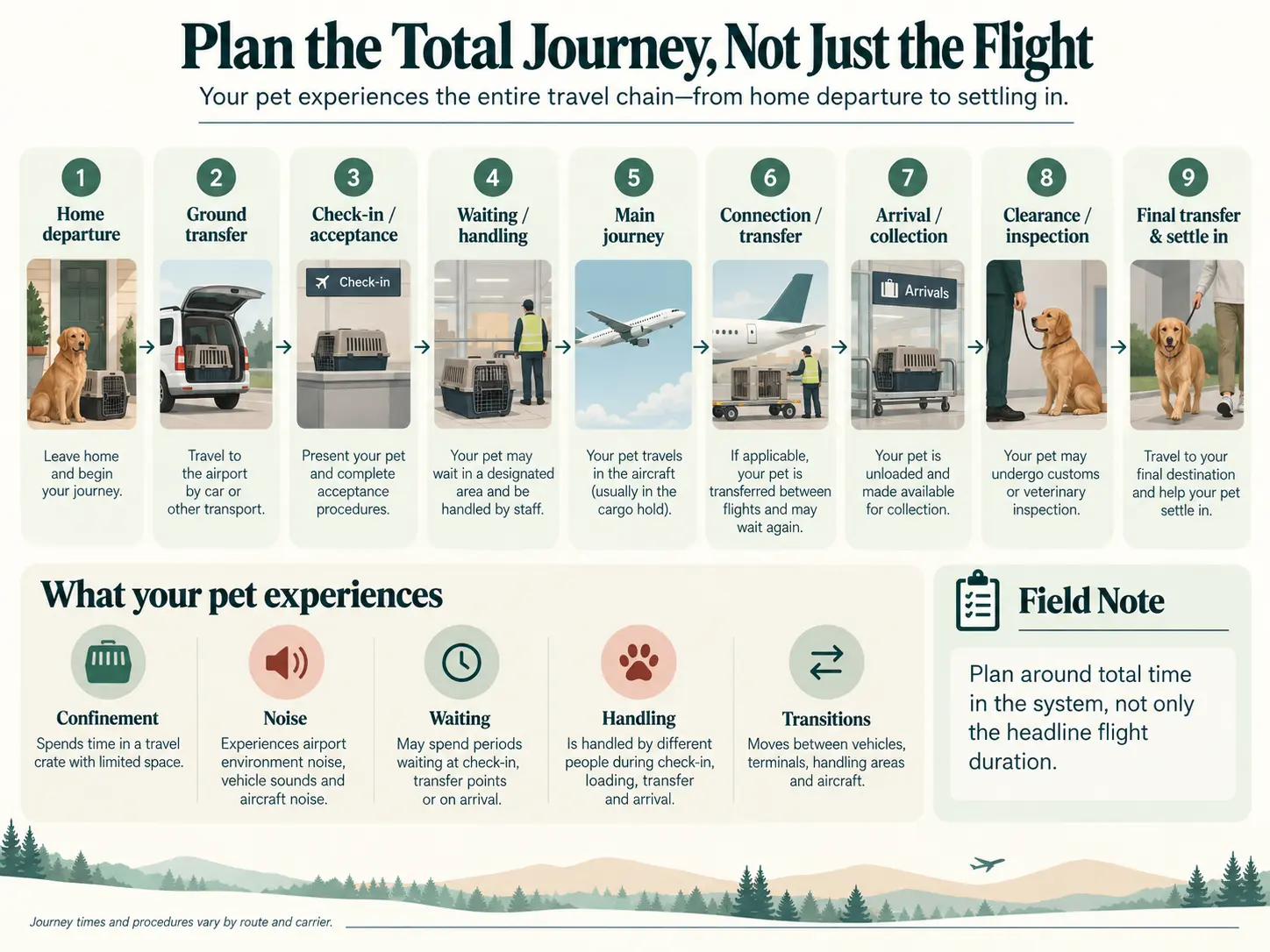
- Plan around the total journey: ground transport, check-in, handling, connections, collection and clearance can add substantial time beyond the scheduled flight.
Flying with a dog is often described as a simple choice between “cabin” and “cargo.” In practice, successful air travel depends on a chain of smaller decisions: whether the dog is suitable for the journey, which transport arrangement the airline actually offers, whether the carrier or crate fits both the dog and the aircraft requirements, whether the dog is accepted on the exact flight, and what happens during check-in, handling, connections and arrival.
This guide explains the evergreen planning framework. It does not attempt to reproduce every airline’s current weight limit, carrier dimension, fee, breed restriction or route policy. Those rules change, sometimes by aircraft and season, and belong in Pet Fieldbook’s airline policy guides and on the operating airline’s own current website.
Airline acceptance and government entry permission are separate things. A dog can meet the airline’s pet rules but fail destination requirements—or be legally eligible to enter the country but not be accepted on the intended flight. Check both before committing to an inflexible itinerary.
1. Should your dog fly?
Start with the individual dog, not the airline timetable. Air travel may be practical for a long-distance move or unavoidable international journey, but it is not automatically the best option for every dog or every trip.
Consider the dog’s age, health, respiratory anatomy, anxiety level, previous travel experience, tolerance of confinement and the total journey conditions. IATA’s current passenger guidance says sick, injured or debilitated animals may not be suitable for air travel and advises travellers to check health, age, breed restrictions and documentation before the journey.[1]
Questions to ask before choosing air travel
- Is the journey necessary, or is there a realistic road or care-at-home alternative?
- Can the dog remain safely and comfortably in the required carrier or crate for the total journey?
- Does the dog have a medical or behavioural issue that could make transport more difficult?
- Is the route direct, or does it involve transfers, long waits or climate extremes?
- Does the airline accept this dog, this transport mode and this route?
- Can the destination and transit requirements be completed in time?
If your dog has breathing difficulty, a chronic medical condition, significant travel anxiety, a history of motion sickness, is very young or elderly, or you are simply unsure whether the dog is suited to the proposed journey, discuss the flight with your veterinarian before making firm arrangements. This article provides general travel information, not an individual fitness-to-fly assessment.
Short-nosed dogs need extra attention
IATA specifically warns that transport of snub-nosed dogs in hot seasons is not recommended because these dogs can have difficulty maintaining normal body temperature in hot weather.[2] Airlines may also impose breed-specific restrictions. Do not assume that a dog being accepted by one carrier or on one route means it will be accepted by another.
2. Understand how dogs can travel by air
The terms used by airlines are not perfectly consistent, which is one reason pet owners become confused. Depending on the carrier, route and aircraft, a dog may travel in one of three broad ways:
| Arrangement | Typical setup | What changes operationally |
|---|---|---|
| In cabin | Small dog in a carrier that fits in the airline-approved passenger space, usually under the seat | The dog travels with the passenger; cabin limits, carrier fit and security-screening procedures matter |
| Checked / accompanied baggage | Dog travels in an approved crate in the aircraft hold on the passenger’s journey, where the airline offers this service | Check-in, crate acceptance, weight limits and collection procedures can differ from cabin travel |
| Air cargo / air freight | Dog is booked through the airline’s cargo or live-animal process, sometimes separately from the passenger booking | Different booking references, acceptance terminals, cut-off times, collection points, facility hours and sometimes a shipper may be involved |
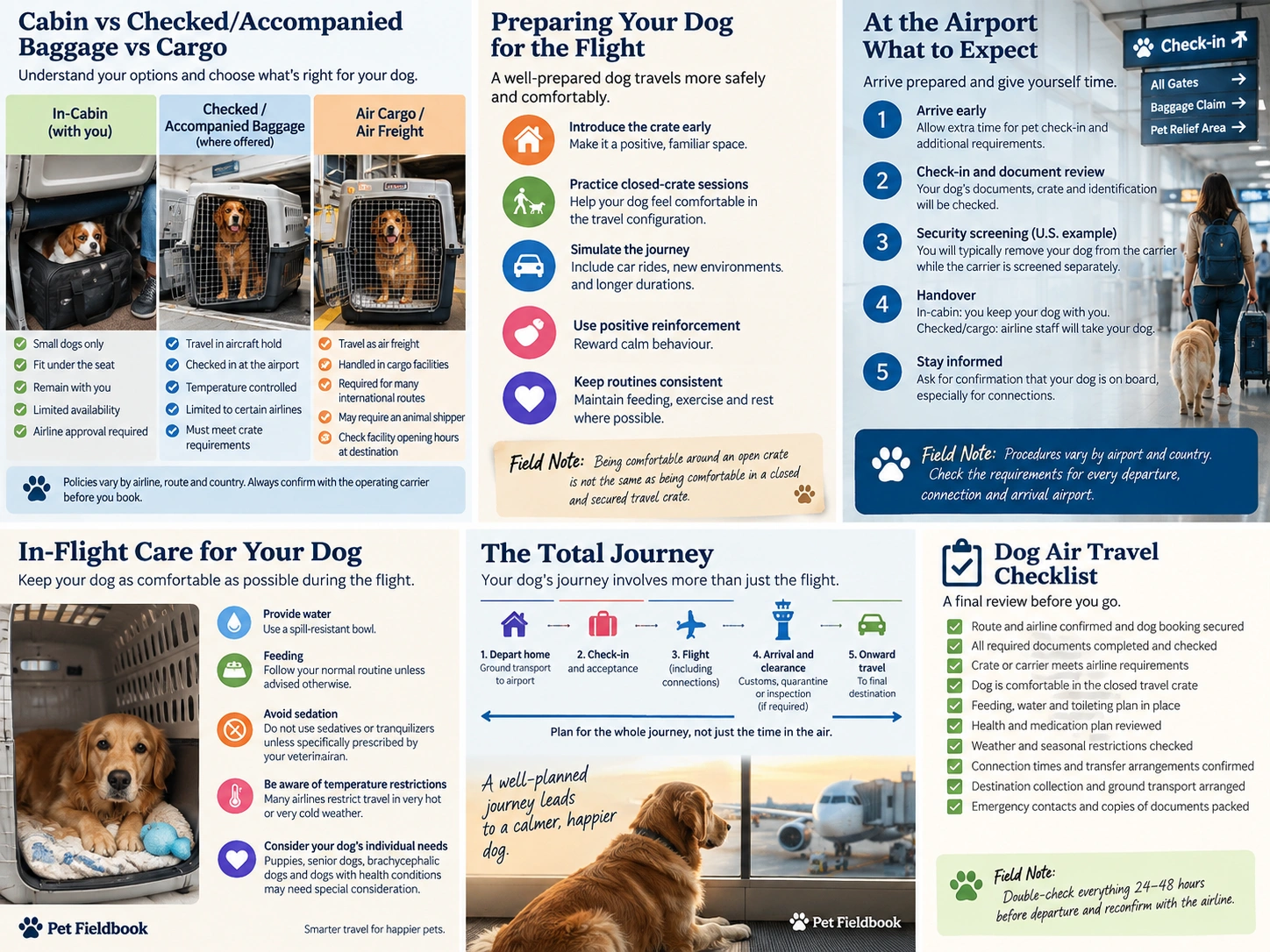
Not every airline offers all three arrangements. IATA notes that some airlines do not permit pets in the cabin, some may carry them as special baggage in a heated and ventilated hold, and some journeys may need an animal shipper or cargo process.[2]
Before comparing prices, ask the airline exactly how your dog would be booked, handed over and collected. “Cargo,” “hold,” “checked baggage,” “excess baggage” and “air freight” can describe different operational processes. The practical difference matters more than the label.
3. Choose the route before you choose the cheapest ticket
For pet travel, the best passenger fare is not necessarily the best pet itinerary. A route that looks convenient on a booking website may be unusable because the operating carrier does not accept dogs, the aircraft cannot accommodate the required crate, the connection station cannot handle the transfer, or the arrival facility is closed when the dog lands.
Confirm the operating carrier
Codeshare itineraries can display one airline’s flight number while another airline physically operates the aircraft. Pet rules usually need to be checked against the carrier that actually handles the animal on each sector. Confirm the operating carrier, not only the marketing airline.
Confirm the dog separately from the passenger
IATA advises travellers to contact the airline to confirm that it accepts the pet on the preferred day and flight and notes that airlines can limit the number of animals on a flight. Its current guidance also says to reconfirm before departure.[2] The FAA likewise stresses that airlines decide their own passenger-cabin pet policies and that travellers should contact the carrier for its specific procedures.[4]
Do not assume that purchasing the passenger ticket reserves space for the dog. Ask for the pet-booking confirmation, reference or written acknowledgement that applies to the actual flight. This is particularly important where cabin-pet numbers are capped or live-animal acceptance is handled through a separate cargo system.
Direct routes can simplify the journey—but “direct” is not the only question
Fewer transfers usually mean fewer handovers and less opportunity for delay, but route quality also depends on aircraft, season, ground handling, facility hours and the dog’s needs. A technically nonstop flight with poor timing or unsuitable conditions is not automatically better than every itinerary with a connection.
If the airline changes the flight number, operating carrier, aircraft, connection or travel date, reconfirm the dog as well as the passenger itinerary. A schedule change that looks minor to a passenger can affect pet acceptance, available crate space, transfer handling or seasonal restrictions.
4. Get the carrier or crate right
Carrier fit is one of the most common points of confusion, especially for dogs near the boundary between in-cabin and hold travel. A published weight limit does not guarantee that a dog physically fits the required carrier. Conversely, an airline may focus more on under-seat dimensions and the animal’s fit than on a simple weight threshold.
For dogs travelling in cabin
FAA rules in the United States treat an in-cabin pet carrier as carry-on baggage and require it to be small enough to fit under the seat without blocking access to the aisle.[4] IATA’s cabin guidance adds that only very small dogs and cats can typically fit in the limited under-seat space and asks whether the dog can sit erect, stand erect, turn around and lie in a natural position inside the carrier.[1]
Soft-sided carriers can compress under a seat, but IATA warns that compression of ventilation openings can reduce airflow and contribute to heat buildup.[1] This is why “the bag technically squeezes under the seat” is not the same as “the carrier works well for the dog.”
Owners often focus on the airline’s published weight limit, but cabin travel can still fail if the dog is too tall or long to remain naturally positioned in the permitted carrier. Check the dog’s actual body dimensions and the carrier’s usable internal space—not only the combined weight.
For dogs travelling in the hold or as cargo
IATA Container Requirement 1 requires enough space for the dog to stand and sit erect, turn normally while standing and lie in a natural position. The 2026 standard also provides a measurement formula for approximate minimum internal dimensions and adds that the mandatory performance requirements still control if the formula alone produces an inadequate fit.[3]
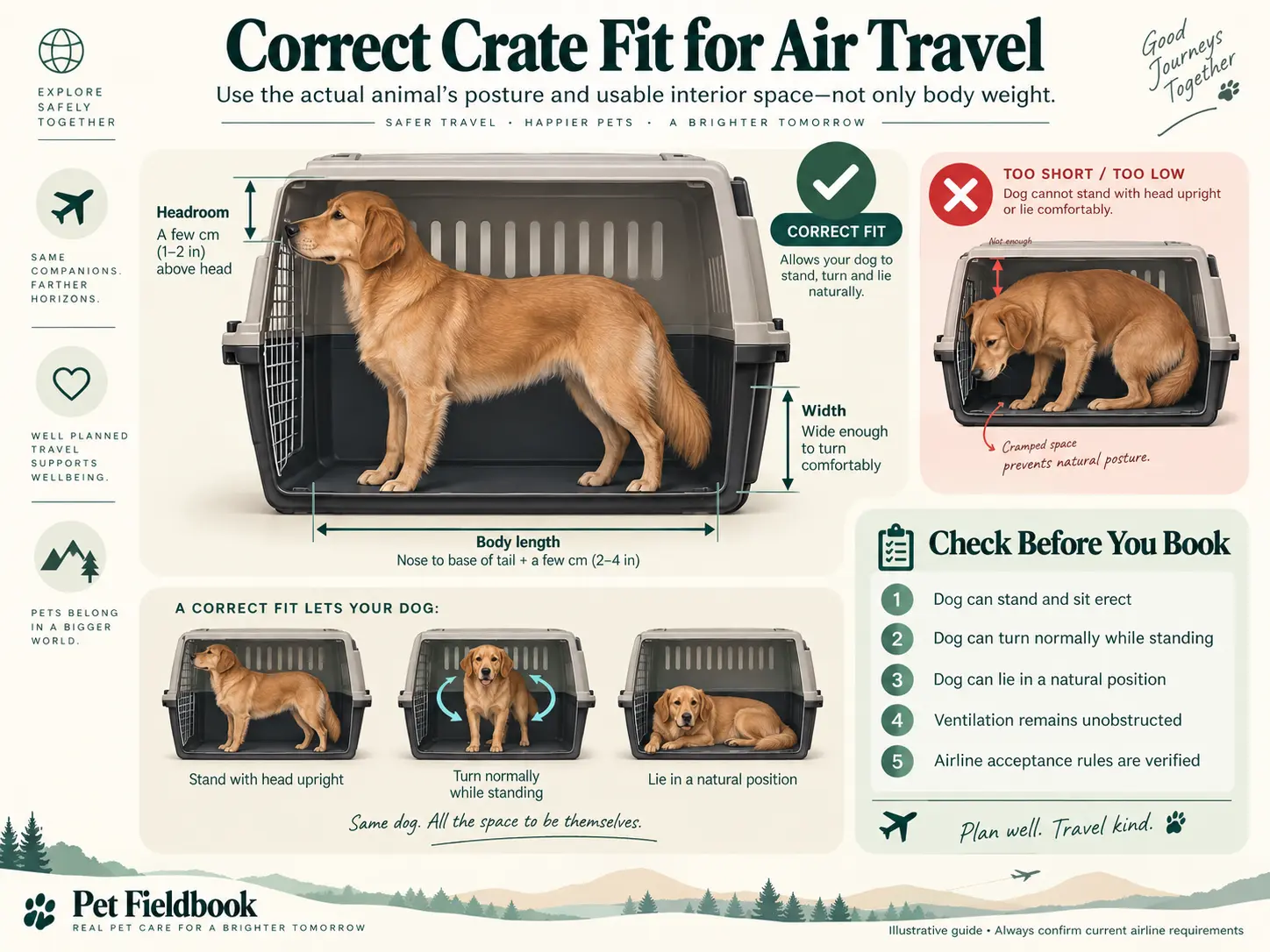
IATA also makes an important distinction that many websites blur: it does not certify or approve particular commercial pet-container brands or models. It publishes standards. The airline or handling staff determine whether the actual container presented for travel is acceptable.[3]
See Pet Fieldbook’s planned dog travel-crate guide for the full measurement and construction process.
5. Prepare the dog for the travel setup
Buying the correct crate is only part of preparation. The dog should ideally encounter the carrier or crate well before the flight. IATA recommends introducing dogs and cats to the travel container weeks or months before departure and getting them accustomed to confinement.[2]
Build familiarity in stages
Depending on the dog, useful preparation may include leaving the carrier accessible at home, rewarding voluntary entry, using familiar bedding where permitted, feeding calmly near or inside it, closing the door for gradually longer periods, and practising calm confinement without immediately turning every crate session into a trip.
For a dog that will travel in a closed crate, comfort around an open crate is not enough. The dog should also have experience with the secured travel configuration.
The goal is not to make the dog excited about the crate. It is to make the travel setup ordinary. Calmly waiting in a secured carrier, being moved short distances and settling after the door closes can be more useful preparation than simply teaching the dog to enter for a treat.
Prepare for handling and transitions
Air travel can involve car travel, busy terminals, check-in counters, security screening, unfamiliar handlers and an unfamiliar arrival environment. Secure transitions matter. Before opening a carrier or crate, know how the dog will remain controlled and what restraint is appropriate for that location.
6. Separate airline documents from destination documents
There is no single universal “dog flight document.” Requirements depend on the airline, the origin, destination, transit points and the dog’s circumstances.
International travel may involve identification, vaccination records, laboratory results, veterinary certificates, permits or other forms. USDA APHIS emphasizes that destination countries set their own requirements and recommends starting early enough to complete required vaccinations, tests or treatments within the specified timeframe.[5]
For a useful example of how route details matter, CDC’s current U.S. dog-import guidance shows that requirements can depend on where the dog has been during the previous six months, where it was vaccinated, how it travels and where a layover occurs.[6] That is a U.S.-specific system, not a global template—but it demonstrates why transit points cannot be ignored.
Do not use a universal “10-day certificate” rule
Some airlines or destinations require recent health certificates, but validity windows vary. FAA notes that airlines may require a recently issued health certificate for cabin pets, while USDA APHIS says destination-country health-certificate requirements and timing differ by country.[4][5]
Before travel day, compare the dog’s name, microchip number, vaccination dates, laboratory results, permit details and certificate information across every record. A genuine document can still create an operational problem if a key identifier does not match the rest of the file.
7. Know what happens at the airport
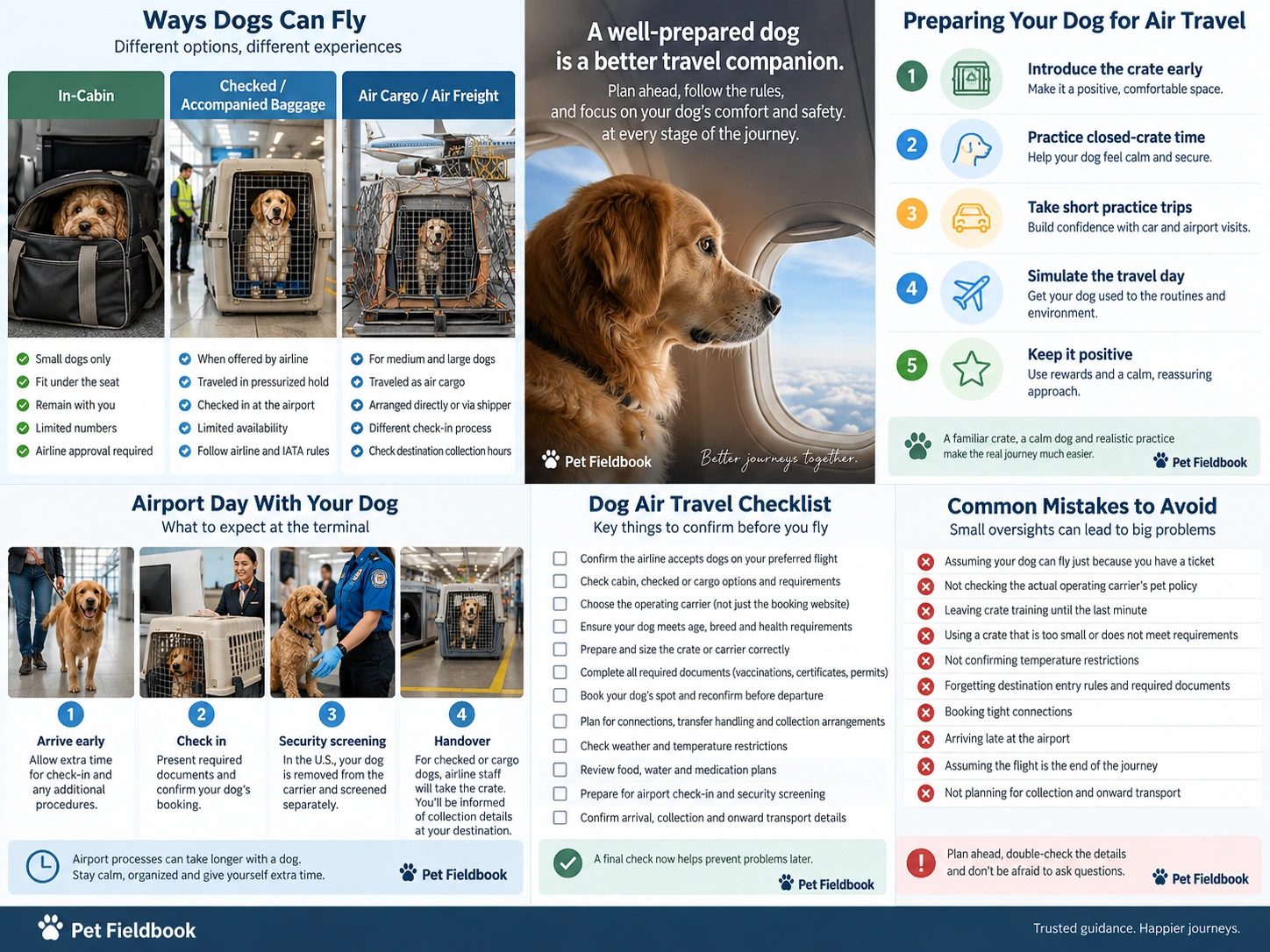
The airport process depends heavily on how the dog is travelling. Ask the airline where to go, how early to arrive, what documents to present, and where the dog will be accepted.
In-cabin dogs
For U.S. TSA screening, small pets must be removed from their carrying case; the empty case is screened separately, and the traveller maintains control of the pet through the checkpoint.[7] Procedures differ by country and airport, so use the relevant security authority for your departure point.
This is an escape-risk moment. If your dog is nervous or likely to bolt, plan the restraint method before you reach security rather than improvising while the carrier is open.
Dogs travelling in the hold or as cargo
IATA advises travellers to find out the required check-in time. For dogs travelling in the hold, acceptance may occur earlier so the animal can be moved to the appropriate handling area before departure.[2] Air-cargo bookings may use a different terminal or acceptance facility from the passenger check-in area.
At acceptance, staff may inspect the crate, documents, labels and dog. Cargo bookings may also involve a separate transport document or air waybill. Do not leave final crate assembly, missing hardware, unclear contact details or document inconsistencies to the airport.
Walk and toilet before handover where appropriate
IATA recommends taking a dog for a walk before leaving for the airport and again before check-in.[2] The exact practical opportunity depends on the airport and the airline’s acceptance timing.
8. Treat connections and weather as part of the pet itinerary
Connections are not empty time between flights. They can involve unloading, movement between facilities, waiting, another aircraft and possibly another airline. IATA tells pet owners to consider intermediate stations and participating airlines when arranging air transport.[2]
Passenger connection time is not the same as live-animal transfer time
A legal passenger connection may still be a poor pet connection if the animal needs to move between terminals, carriers or handling facilities. Confirm whether the station can handle the dog and what happens during a delay.
When two different airlines are involved, do not assume the dog will transfer between them simply because the passenger and baggage are through-ticketed. Confirm whether the airlines accept live-animal transfers between one another at that airport, or whether collection and re-acceptance is required.
For cargo arrivals, check facility hours
IATA advises air-freight travellers to confirm that the destination freight facility is open so the animal can be claimed.[2] Also check any customs, veterinary inspection, quarantine or agent office needed for release.
Weather can change acceptance
Airlines may restrict animal transport because of heat, cold or other operating conditions. IATA specifically cautions against transporting snub-nosed dogs in hot seasons.[2] Treat temperature restrictions as current airline/route information rather than copying a universal temperature threshold from another website.
9. Food, water and medication need a journey-specific plan
Food
IATA’s current guidance includes a light meal before tendering the animal to the carrier, but the exact feeding approach should consider the dog, route and any health needs.[2] Avoid importing one generic feeding rule into every journey.
Water
Hydration remains part of the entire plan. For crate transport, the airline’s live-animal requirements govern the equipment and access arrangements. For cabin dogs, the practical approach is different. In either case, do not deliberately dehydrate the dog simply to reduce toileting.
Sedatives and tranquilizers
IATA has a longstanding policy of discouraging sedatives and tranquilizers for animals transported by air because of potential adverse effects. Its current guidance says that if sedation or tranquilization is medically justified for the journey, it should be under veterinary direction, with the airline informed as required.[2][3]
This does not mean every veterinarian-directed anxiety plan is identical to heavy sedation. If your dog struggles with travel anxiety, motion sickness or another condition, discuss the actual flight environment with your veterinarian rather than choosing a medication based on generic internet advice.
10. Plan collection before departure
The dog’s journey does not end when the aircraft lands. Depending on how the dog travelled, collection may be at passenger baggage, a special-oversize area, a cargo terminal or another live-animal facility. International arrivals may also involve customs, animal-health inspection or other clearance.
Before departure, know:
- who is responsible for collection;
- which terminal or facility is used;
- its opening hours;
- which documents are needed for release;
- how the dog will travel from the airport to the final destination; and
- where the dog can be safely released, watered and toileted.
Once the dog is safely out of the transport system, give it time to settle and observe for unusual breathing, weakness, vomiting, injury, marked distress or other concerning changes. Seek veterinary care if the dog appears unwell.
11. Common mistakes when flying with a dog
- Booking the passenger before confirming the dog.
- Assuming a cabin weight limit guarantees physical carrier fit.
- Using “IATA-approved crate” as if it were a product certification.
- Checking the marketing airline instead of the operating carrier.
- Ignoring transit-country rules on an international itinerary.
- Buying a crate too late for meaningful familiarization.
- Planning around flight duration instead of total journey time.
- Assuming a passenger connection is automatically workable for a live animal.
- Ignoring weather or seasonal restrictions.
- Failing to check cargo-terminal or inspection-office opening hours.
- Opening a carrier in an unsecured area without an escape-control plan.
- Using a universal health-certificate timing rule.
- Trying an unfamiliar sedative or tranquillizer without veterinary direction.
12. Flying with a dog: final checklist
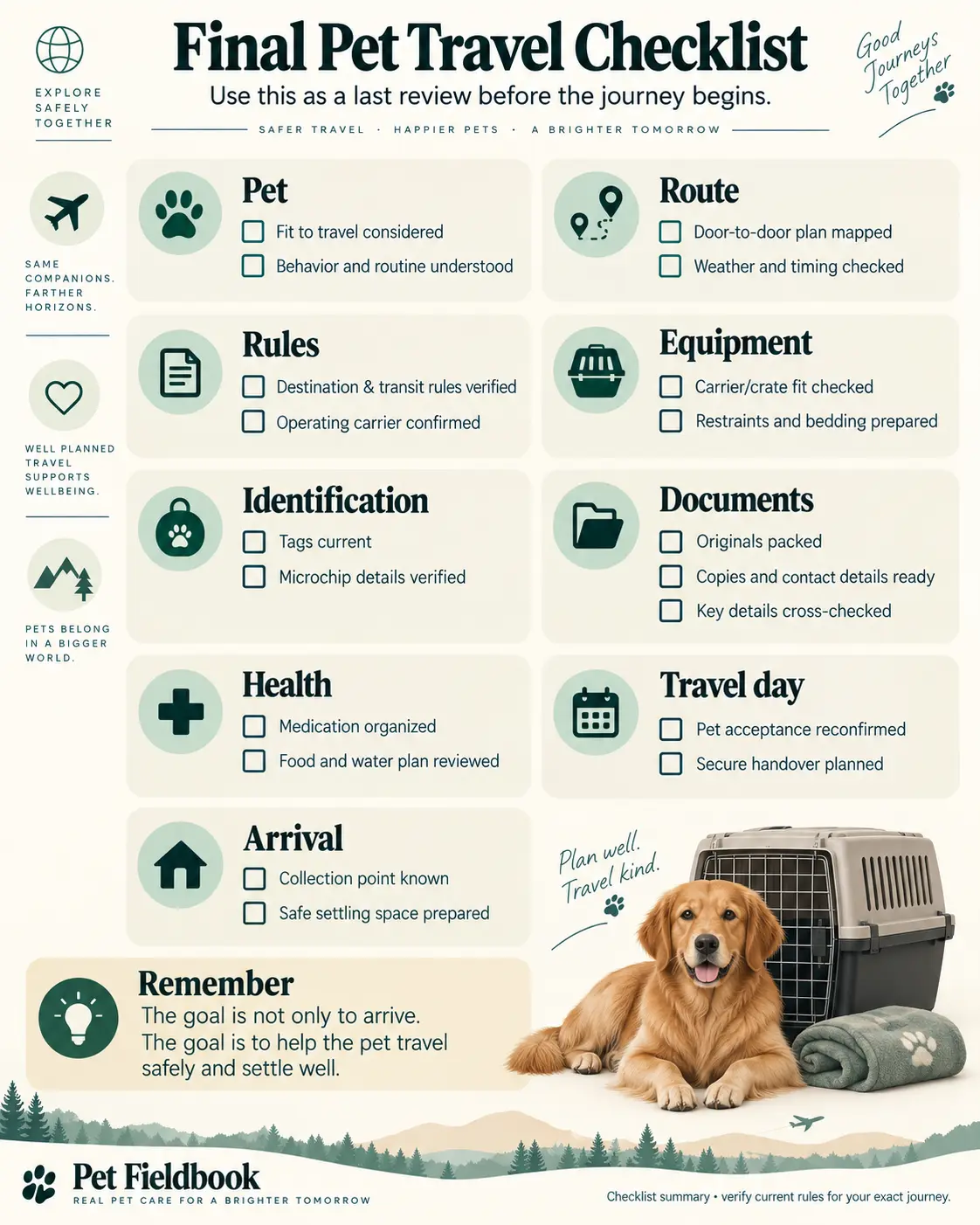
- Dog: suitability for air travel considered.
- Mode: cabin, checked/accompanied baggage or cargo process confirmed.
- Flight: operating carrier and exact sectors verified.
- Pet booking: dog acceptance confirmed separately from passenger ticketing.
- Carrier/crate: actual dog fit checked; airline construction and size rules verified.
- Familiarization: dog has practised calm confinement in the secured travel setup.
- Documents: airline, destination and transit requirements completed and cross-checked.
- Weather: current route restrictions checked close to departure.
- Airport: acceptance location and check-in time known.
- Connections: live-animal transfer process confirmed, including any change of airline.
- Changes: dog acceptance rechecked after any material itinerary, aircraft or operating-carrier change.
- Arrival: collection point, facility hours and clearance process known.
- Contingency: plan exists for delay, cancellation or missed connection.
For the broader planning framework, return to The Complete Guide to Travelling With Pets. For a reusable departure checklist, see the Pet Travel Checklist.
A good dog-flight plan does not begin with “Which airline is cheapest?” It begins with “What journey can this dog complete safely and realistically?”
Sources and further reading
- International Air Transport Association (IATA). Guidance for Passengers Traveling with their Dog or Cat in the Cabin. Current guidance accessed September 19, 2026. Official source.
- International Air Transport Association (IATA). Traveler’s Pet Corner. Accessed September 19, 2026. Official source.
- International Air Transport Association (IATA). Live Animals Regulations — Container Requirement 1, Edition 52, January 2026. Official source.
- Federal Aviation Administration (FAA). Flying with Pets. Used for U.S. passenger-cabin framework and the principle that airlines set their own pet policies. Official source.
- USDA Animal and Plant Health Inspection Service (APHIS). Pet Travel Process Overview. Last modified June 18, 2026. Used as a U.S.-origin example of destination-specific international planning. Official source.
- Centers for Disease Control and Prevention (CDC). Current U.S. dog-import and layover guidance. Used as a jurisdiction-specific example showing why origin, vaccination status, route and layover details matter. Official source.
- Transportation Security Administration (TSA). Small Pets / Security Screening Guidance. Used only for U.S. security-checkpoint procedures. Official source.
- U.S. Department of Transportation (DOT). Air Travel Consumer Reports / Animal Incident Reporting. DOT publishes incident reports for covered U.S. carriers; these are useful context but are not presented here as a universal route-level safety score. Official source.
Pet Fieldbook reviewed current official aviation, government and transport sources alongside live search results, reader questions and an internal air-travel logistics pass. Airline-specific fees, weight thresholds, breed lists and route restrictions are intentionally excluded from the evergreen core because they change and should be verified on the operating airline’s current policy page. Practical observations are labelled as Field Notes.