Pet travel paperwork becomes confusing when every certificate, vaccination record, permit and airline form is treated as a separate task. In reality, the documents usually form a dependency chain. One step may have to happen before the next one can legally count.
A microchip may need to be recorded before a rabies vaccination. A vaccination may need to be valid before a blood test is taken. A laboratory result may be needed before an import permit can be issued. A final veterinary examination may have to occur within a route-specific window before an official health certificate is signed. And the airline may still require paperwork that is separate from the destination government’s entry documents.
That is why there is no reliable universal answer to “Which documents does my pet need?” The correct answer depends on the pet, species, origin, transit points, destination, travel mode, ownership arrangement and return journey.
This guide explains what the main types of pet travel documents do, how they fit together, and how to build a paperwork plan without relying on a generic “10-day certificate” rule.
Treat pet travel paperwork as a route-specific sequence of evidence, not as a universal stack of forms.
Key takeaways
- The destination authority determines the legal entry requirements; the airline determines its own transport requirements.
- A health certificate is not the same thing as a veterinary examination, government endorsement, import permit or airline form.
- There is no single worldwide health certificate and no universal validity window.
- “Pet passport” can describe a specific official document, such as an EU pet passport. It should not automatically be used as a generic name for a folder of records.
- Identification, vaccination, testing and certificate steps may have to happen in a particular order.
- Microchip numbers, dates, owner details and test information should match across every relevant document.
- Transit countries can matter even when the passenger does not intend to leave the airport.
- The return trip may create requirements that must be completed before the outbound journey begins.
- Do not assume a photograph or PDF on a phone will replace an original or printed document. Format requirements vary.
- Recheck current official requirements shortly before travel because pet-import rules and certificate models can change.
1. Start with the route, not the certificate
Before booking veterinary appointments, define the actual movement you are planning.
Record:
- the species and number of pets;
- the country or jurisdiction of origin;
- every transit country;
- the destination country;
- the intended arrival airport, seaport or land crossing;
- whether the pet travels with the owner, with an authorised person or separately;
- whether ownership is changing;
- whether the trip is temporary or permanent; and
- where the pet will travel next, including the return journey.
These details can change which legal framework applies.
For example, the European Union’s non-commercial pet-movement rules are tied not only to the animal but also to the relationship between the pet’s movement and the owner’s movement. Great Britain uses different pet-travel documents depending on the country of origin. Australia divides import pathways by country group and applies different preparation steps. New Zealand’s 2026 import system uses its own eligibility, permit, certification and quarantine framework.
The first task is therefore not “find a vet who issues travel certificates.” It is:
Identify the official rules that apply to this exact movement.
For international travel, start with the destination government’s animal-health, agriculture, veterinary or biosecurity authority. Then check the export authority in the origin country and the operating carrier.
2. Understand the document layers
Not every trip uses every document below, but most pet-travel files are built from several of these layers.
| Document or record | What it generally proves | Typical issuer or source |
|---|---|---|
| Microchip / identification record | Which animal the paperwork belongs to | Veterinarian, implanter or registry |
| Vaccination certificate | Vaccine product, date, validity and animal identity | Veterinarian |
| Laboratory report | Result of a required diagnostic or antibody test | Approved/recognised laboratory |
| Treatment record | Required parasite or other treatment was given in the correct window | Veterinarian |
| Veterinary health certificate | Required health, identity, vaccination, test and treatment statements | Authorised/accredited/official veterinarian, depending on route |
| Government endorsement | Competent authority validates or countersigns the required certificate | Government veterinary authority |
| Import permit / licence / NOC | Destination has authorised import under specified conditions | Destination authority |
| Owner declaration | Confirms non-commercial movement, ownership or travel relationship | Owner / authorised person |
| Airline health form | Satisfies the carrier’s own boarding/acceptance rules | Veterinarian / airline |
| Air waybill or cargo document | Records air-freight shipment and handling | Airline / cargo agent |
| Customs or arrival declaration | Supports border, customs or biosecurity clearance | Traveller / broker / government system |
| Return-entry form | Supports readmission to the home country | Home-country authority |
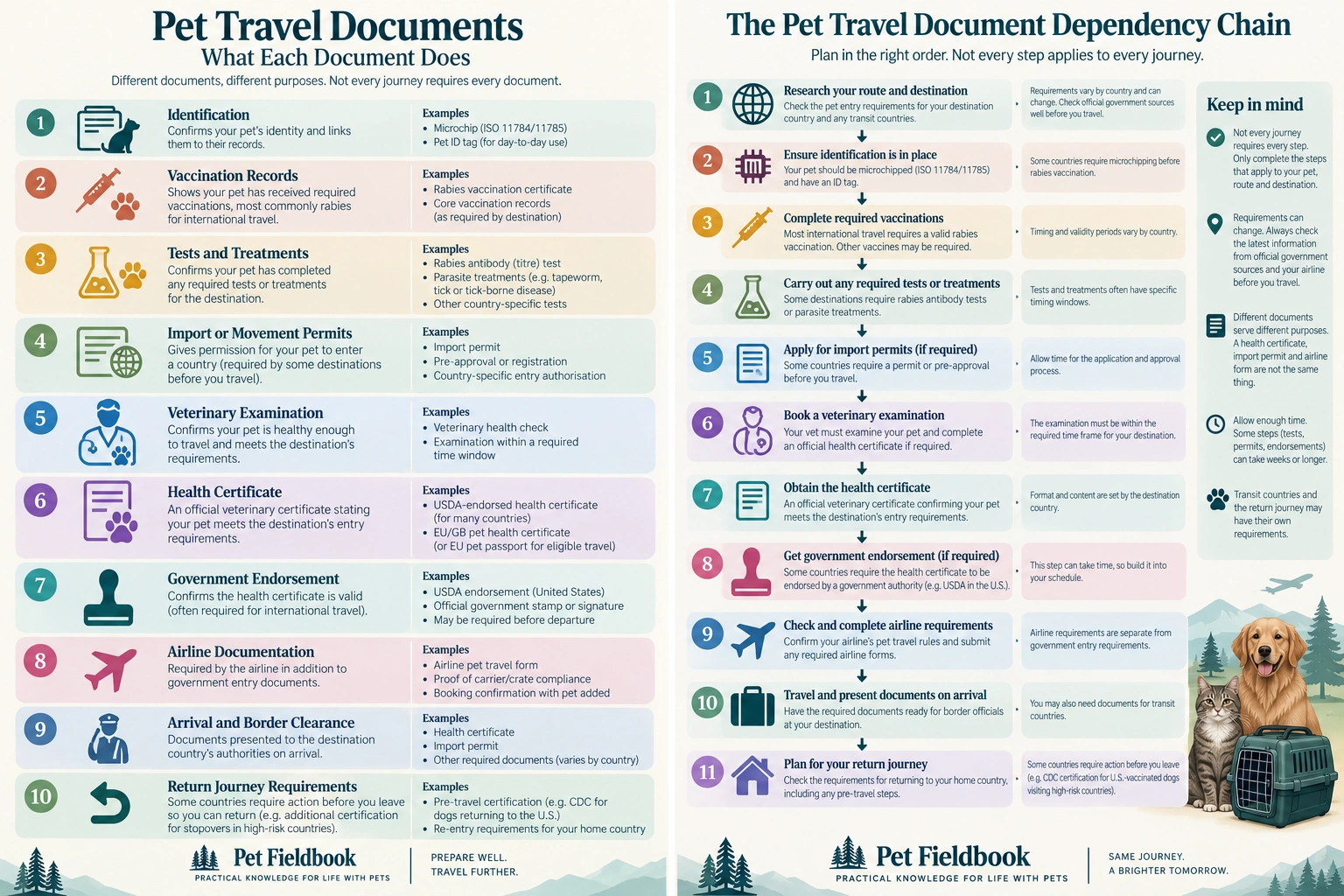
The important point is that these documents perform different jobs.
A government health certificate may satisfy the destination but not the airline. An airline’s “fit to fly” form may satisfy the carrier but have no legal value at the border. A rabies certificate may be valid medically but not count for a particular travel scheme if the required identification sequence was not followed.
3. Health certificate, veterinary exam and “fit to fly” are not the same thing
The phrase health certificate is used widely, but it can refer to different legal instruments.
USDA APHIS notes that health certificates may also be called international health certificates, veterinary health certificates, veterinary certificates or export certificates. The destination country determines which form is required.
A health certificate typically does more than say “this pet looks healthy.” Depending on the route, it may certify:
- identity and microchip number;
- age or date of birth;
- clinical examination;
- rabies vaccination;
- other vaccinations;
- laboratory results;
- parasite treatments;
- freedom from specified clinical signs;
- compliance with import conditions; and
- fitness for the intended movement.
A separate veterinary examination may be one of the events required before the certificate can be issued.
A fit-to-fly letter or airline health form, where required, may be a transport document requested by the carrier. It should not automatically be treated as the legal import certificate.
Issued versus endorsed
This distinction matters.
In some systems, a private veterinarian examines the animal and completes the required certificate. A government veterinary authority then endorses that certificate, confirming that the document and supporting evidence meet the destination’s agreed requirements.
In the United States, USDA APHIS describes this as the veterinarian issuing the health certificate and APHIS endorsing it when endorsement is required. Other countries use different titles—such as official veterinarian, government veterinarian or competent authority—but the principle is similar.
“Who completes this certificate?” and “Who, if anyone, must endorse or countersign it?” Do not assume the same person performs both functions.
4. There is no universal 10-day rule
A common internet shortcut says that pets need a health certificate “within 10 days of travel.” That is not a global rule.
Some routes do use a 10-day window. For example, current EU rules for many non-EU arrivals give the animal health certificate a defined entry-validity period from the date of issue. Great Britain has its own certificate-validity rules. Australia uses different pre-export and endorsement windows depending on the import pathway. Airlines can impose separate health-certificate timing as a condition of carriage.
So the correct question is not:
“Is the certificate less than 10 days old?”
It is:
“Is this specific certificate valid for this specific arrival, under both destination and carrier rules?”
When planning, record the exact trigger for every deadline. A rule may count backward from:
- departure;
- export;
- arrival;
- certificate issue;
- veterinary examination;
- blood sampling;
- laboratory receipt of a sample; or
- treatment administration.
Those are not interchangeable dates.
5. What a pet passport actually is
“Pet passport” is one of the most misused terms in pet travel.
An official pet passport
Some jurisdictions issue a legally defined pet passport. The EU pet passport is the clearest example. It is an official identification document for dogs, cats and ferrets and records information such as the animal’s identity and rabies vaccination status. When its underlying entries remain valid, the passport can support qualifying movements under the relevant legal framework.
Not every country issues an EU-style pet passport, and a veterinarian outside the relevant system cannot simply create one because a traveller asks for a “pet passport.”
A travel document folder
Commercial websites sometimes use “pet passport” informally to mean the complete collection of a pet’s records: microchip certificate, vaccination records, health certificate, permits and laboratory reports.
For clarity, Pet Fieldbook calls that a travel document file rather than a passport.
If a destination says “passport,” verify whether it means a specific government-recognised passport, not just an organised folder.
6. Identification: the microchip number often becomes the document anchor
For many international dog and cat movements, the microchip number is the identifier that connects the animal to the paperwork.
Depending on the destination, the record may need to show:
- the microchip number;
- date of implantation or reading;
- location of the chip;
- chip standard or readability; and
- the veterinarian’s certification.
The critical practical issue is consistency.
If the chip number on the health certificate differs from the laboratory report or vaccination record—even by one digit—the border authority may not be able to establish that the documents belong to the animal presented.
Australia’s current guidance explicitly warns travellers to ensure the microchip number and test details match across its required rabies documents. Great Britain likewise requires the identification information to be correctly recorded in the relevant travel document.
Scan the chip before final paperwork
A useful pre-certificate step is to have the chip scanned and compare the number with the records that will be used for travel.
Do this before the final paperwork window if possible. Discovering an unreadable chip or transcription error at the certificate appointment can be much harder to solve without disrupting the travel sequence.
7. Vaccination certificates: sequence can determine whether a vaccine counts
A valid medical vaccination is not automatically a valid travel vaccination under every legal scheme.
Some pet-travel systems require the animal to be identified before, or at the same time as, the rabies vaccination used for travel.
Great Britain, for example, requires dogs, cats and ferrets to be microchipped before or at the same time as the rabies vaccination. If that sequence is not met, the animal may need to be vaccinated again for travel purposes.
This is why the document plan should capture:
- microchip/identity event;
- vaccination date;
- date the vaccination becomes valid for travel;
- vaccination expiry date; and
- any later test that depends on that vaccination.
Do not rely only on a reminder that says “rabies up to date.” The travel authority may care about the exact date, vaccine validity and its relationship to identification.
8. Laboratory tests and treatment records can create long lead times
Some destinations require laboratory testing before entry. A rabies antibody titre test is a common example, but the exact requirement depends on origin and destination.
The sequence can include:
vaccination → waiting period → blood draw → recognised laboratory → result → additional waiting period → permit/certificate eligibility.
Australia’s Group 3 pathways illustrate how consequential this can be: the rabies neutralising antibody titre test and associated waiting period are central parts of the import timeline, and the resulting documents feed into permit and final export steps.
Great Britain requires a rabies blood test for some movements from countries that fall outside specified categories, with its own sampling and waiting rules.
Treatment records can also be time-sensitive. Some routes require parasite treatment within a narrow period before arrival, and the veterinarian must record it in the correct travel document.
The practical lesson is simple:
Never schedule the final health certificate before mapping the tests and treatments that the certificate must certify.
9. Government endorsement: when a signature is not enough
A certificate signed by a veterinarian may still be incomplete if the destination requires government validation.
The terminology varies:
- endorsement;
- countersignature;
- official veterinary certification;
- government stamp or seal;
- competent-authority approval.
In the United States, USDA APHIS uses VEHCS to support the creation, submission and endorsement of many international export health certificates. Some destinations accept digitally endorsed certificates; others require printed or physical documents.
Other exporting countries have their own competent authorities and procedures. Canada, for example, uses CFIA veterinary certification/endorsement for applicable exports.
Build government-office time into the itinerary
Endorsement is not merely a formality to leave until the airport.
Check:
- whether an appointment is required;
- whether submission is electronic or physical;
- whether original papers must be mailed or collected;
- whether fees apply;
- office opening days;
- weekends and public holidays; and
- how much of the certificate’s validity window remains after endorsement.
A perfectly prepared certificate can still become unusable if the traveller cannot obtain the required endorsement before the travel window closes.
10. Import permits, licences, NOCs and advance approvals
Some destinations require approval before the pet travels.
The document may be called an:
- import permit;
- import licence;
- authorisation;
- no objection certificate (NOC);
- sanitary permit; or
- biosecurity permit.
Do not assume these are interchangeable terms.
Australia requires import permits for many dog and cat movements, with eligibility and supporting documentation depending on the country group. New Zealand’s current system also uses import permits for relevant categories. India’s import process can involve AQCS and, depending on the traveller’s circumstances, additional approvals.
The permit itself may contain conditions that later documents must satisfy. Read the issued permit rather than relying only on the application checklist.
When an import permit is issued, compare every remaining veterinary and transport step against the conditions printed on that permit. Do not assume the pre-application summary contains every final requirement.
11. Airline forms are another layer
Airlines are transport operators, not border authorities.
IATA advises travellers to check the specific airline’s procedures, and its Traveler’s Pet Corner notes that airlines commonly require health documentation for animals they transport. But the airline’s paperwork does not replace the destination’s legal requirements.
Possible airline documents include:
- pet reservation confirmation;
- airline health declaration;
- breed or age declaration;
- acclimation or temperature documentation where applicable;
- shipper’s declaration;
- cargo booking documents;
- air waybill; and
- carrier/crate acceptance records.
Some airlines may accept the destination health certificate; others may ask for a separate form or a different exam window.
This is one reason Pet Fieldbook keeps airline-specific rules out of evergreen general articles. Confirm the current operating carrier and the pet’s exact booking mode.
12. Transit-country paperwork: “I am not leaving the airport” is not enough
A transit stop can affect pet-travel requirements.
Questions to verify include:
- Does the country regulate pets remaining in international transit?
- Does the animal leave the aircraft or secure transit area?
- Is the pet transferred between airlines?
- Does collection and re-checking require formal entry?
- Is a transit permit needed?
- Does the route pass through a rabies-risk category that affects the destination or return journey?
IATA specifically advises travellers to check requirements for countries they connect through, not only the final destination.
Never infer transit rules from the passenger’s visa status. The pet can be subject to animal-health rules that operate differently from immigration rules for people.
13. Plan the return journey before you leave
One of the most expensive paperwork mistakes is completing everything required to enter the destination while ignoring what will be required to go home.
Return-entry rules may depend on where the pet has been during the trip, not just where it departs from on the final day.
A current U.S. example illustrates why this matters. CDC requires all dogs entering the United States to have a CDC Dog Import Form receipt. Dogs that have been in countries classified as high risk for dog rabies can face additional documentation requirements. For certain U.S.-vaccinated dogs, the required Certification of U.S.-Issued Rabies Vaccination must be completed before the dog leaves the United States; it cannot simply be created after the trip has begun.
That is not a universal dog-travel rule. It is an example of a return requirement that can reach backward in time.
Before departure, check:
- the home country’s re-entry rules;
- whether travel through a particular country changes those rules;
- whether any return form must be issued before leaving home;
- whether vaccination continuity must be maintained abroad; and
- whether the return airline has separate requirements.
14. Digital versus original documents
Do not assume that because a certificate was created electronically, a phone screenshot is acceptable at every stage.
Possible requirements include:
- original wet-ink certificate;
- officially endorsed paper certificate;
- printed digitally endorsed certificate;
- electronic certificate accessible in a government system;
- original laboratory report;
- certified translation; or
- multiple physical copies.
USDA VEHCS supports electronic issuance and endorsement workflows, but destination acceptance of digital endorsement varies. Australia’s current import instructions for some pathways specify original document requirements and official endorsement details.
A safe document plan records format as well as name.
Create a column in your checklist for:
- original required?
- print required?
- digital copy accepted?
- number of copies?
- certified translation required?
Keep secure digital backups even when originals are mandatory, but do not treat backups as substitutes unless the authority says they are accepted.
15. Build the document timeline backward from arrival
A strong document plan has two layers:

Long-lead requirements
These may begin months before travel:
- microchip implantation or verification;
- rabies vaccination;
- booster timing;
- blood tests;
- waiting periods;
- import permit applications;
- quarantine reservations;
- official identity checks; and
- destination eligibility.
Short-window requirements
These may happen close to departure or arrival:
- final clinical examination;
- parasite treatment;
- health certificate issue;
- government endorsement;
- airline reconfirmation; and
- arrival declarations.
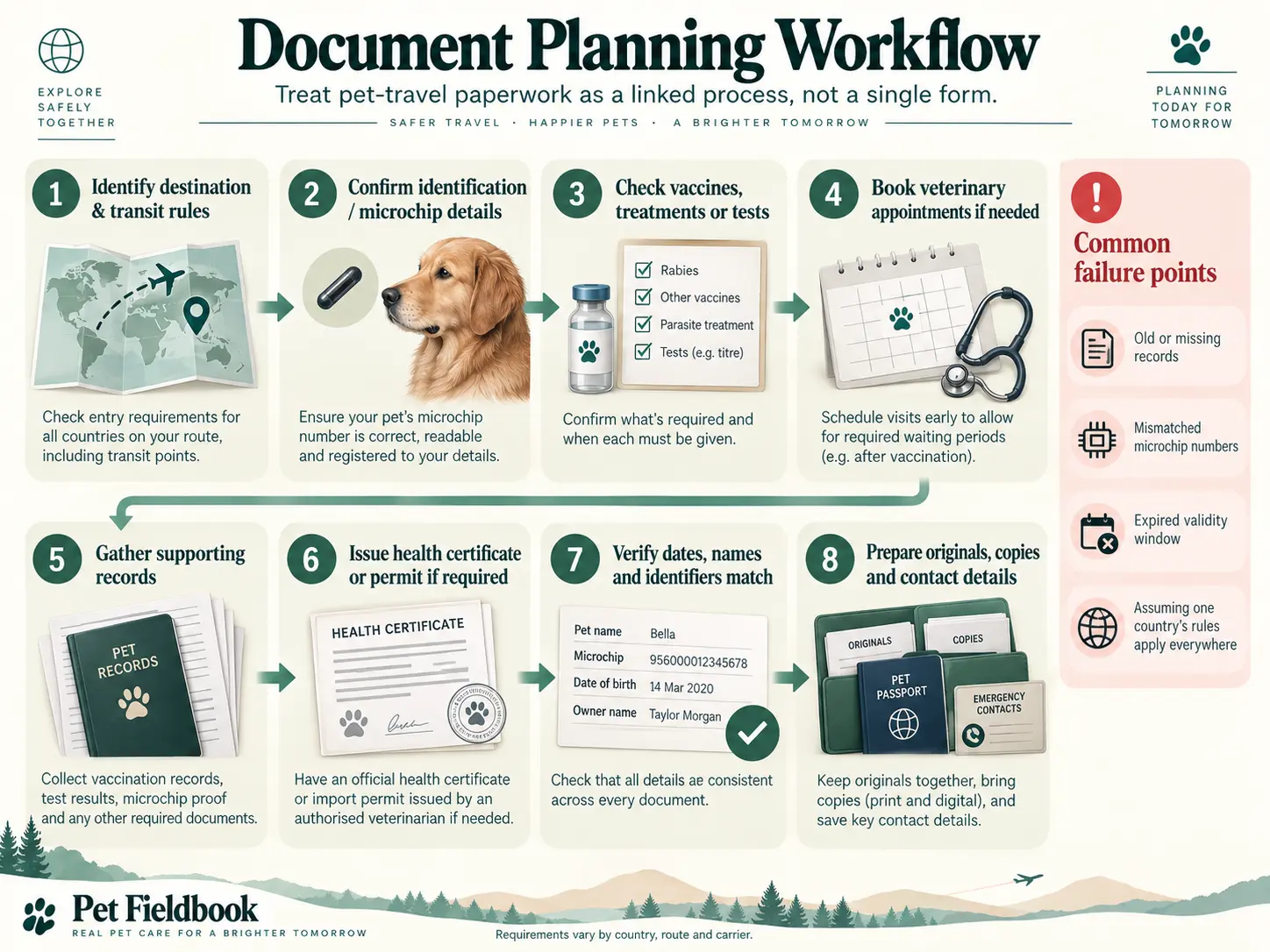
Do not schedule these from memory. For each requirement, record:
| Requirement | Must happen after | Must happen before | Issuer | Evidence needed |
|---|---|---|---|---|
| Microchip verification | — | Route-dependent vaccination/test step | Vet/authority | Chip record |
| Rabies vaccination | Identification where required | Test/certificate/travel-validity date | Vet | Vaccination certificate |
| Laboratory test | Required vaccination/wait | Permit or travel deadline | Approved lab | Lab report |
| Import permit | Required supporting evidence | Booking/export/arrival | Destination authority | Permit |
| Final exam | Route-specific prerequisites | Certificate window | Vet | Exam record |
| Health certificate | Tests/treatments/exam | Route-specific arrival/export deadline | Vet/official vet | Certificate |
| Government endorsement | Completed certificate | Travel-validity deadline | Competent authority | Endorsed certificate |
The Pet Travel Planning Timeline and Pet Travel Document Planning Workflow should be linked and visually integrated here.
16. Audit every identifier, date, signature and stamp
Most document failures are not dramatic. They are clerical.
Before travel, compare the entire file line by line.
Identity
Check:
- pet’s name where required;
- species;
- breed where required;
- sex;
- colour/description;
- date of birth/age;
- microchip number; and
- microchip date/read date.
Owner and journey
Check:
- owner’s legal name;
- passport or ID number where required;
- origin and destination;
- arrival point;
- flight or transport details if included;
- consignee/authorised traveller details; and
- destination address where required.
Medical records
Check:
- vaccine product;
- batch/lot number where required;
- vaccination date;
- valid-from date;
- expiry date;
- test sampling date;
- test result;
- laboratory name; and
- treatment date/time.
Certification
Check:
- veterinarian name and licence/accreditation details where required;
- signature;
- date;
- official stamp/seal;
- government endorsement; and
- certificate reference number on every page where the form requires it.
Never silently correct an official certificate yourself. If an error is found, ask the issuing veterinarian or competent authority how corrections must be made.
Australia’s published guidance, for example, specifies how corrections to certain certificates must be handled and rejects correction fluid.
17. Multiple pets, authorised travellers and commercial movement
The paperwork can change when more than one pet travels or when someone other than the owner accompanies the animal.
Some legal frameworks allow several animals on one certificate under defined conditions. Others require individual certificates or records. Airlines may apply their own passenger-to-pet rules even when the government allows the animals to appear on one health certificate.
Similarly, non-commercial pet-travel rules often depend on the owner travelling with the pet or within a defined period of an authorised person.
Do not assume that “these are my pets” automatically keeps the movement in the non-commercial category if:
- ownership is changing;
- the animals are being sold or adopted;
- the number exceeds the permitted non-commercial limit;
- the owner is not travelling within the required timeframe; or
- the shipment is being handled under commercial import rules.
If the movement falls outside ordinary non-commercial pet travel, different animal-trade rules may apply.
18. Domestic travel can still require health paperwork
International travel creates the most paperwork, but domestic movement is not automatically document-free.
In the United States, USDA APHIS notes that individual states and territories can impose animal-health requirements for pets arriving from another state or territory. Airlines can also have their own domestic health-document rules.
Other countries may have regional biosecurity or inter-state/provincial rules.
The same method applies:
- check the receiving jurisdiction;
- check the transport operator; and
- verify the exact travel date and species.
19. What to do when official requirements are unclear
Sometimes the destination’s rules are incomplete, contradictory or difficult to find.
Do not resolve that uncertainty by copying a commercial blog and treating it as law.
Escalate through authoritative channels:
- destination animal-health/biosecurity authority;
- destination embassy or consulate where appropriate;
- origin-country export authority;
- accredited/authorised veterinarian familiar with the route;
- operating airline or cargo department; and
- qualified pet-transport professional if the route is unusually complex.
USDA APHIS maintains an “unknown requirements” process for destinations where it has not been officially informed of current rules. That is a useful example of the correct approach: identify the uncertainty rather than invent certainty.
Record who provided the answer, the date and the relevant document or email.
20. Build a travel document file that is usable at the airport
A perfect paperwork set is less useful if it is buried in checked baggage.
Keep the active document file accessible to the person responsible for the pet.
A practical system is:
Section 1 — identity
- microchip record;
- identification photos;
- owner identification where needed.
Section 2 — vaccinations and tests
- rabies certificate;
- other required vaccination records;
- laboratory reports;
- treatment records.
Section 3 — government travel documents
- health certificate;
- endorsement;
- import permit/licence/NOC;
- owner declaration;
- quarantine booking where relevant.
Section 4 — transport documents
- pet reservation confirmation;
- cargo booking / air waybill;
- airline forms;
- operating-carrier contacts.
Section 5 — arrival and return
- customs/biosecurity instructions;
- inspection appointment or facility details;
- return-entry forms;
- emergency contact details.
Keep secure digital copies separately in case the physical file is lost. Where original documents are legally required, protect them from water and damage.
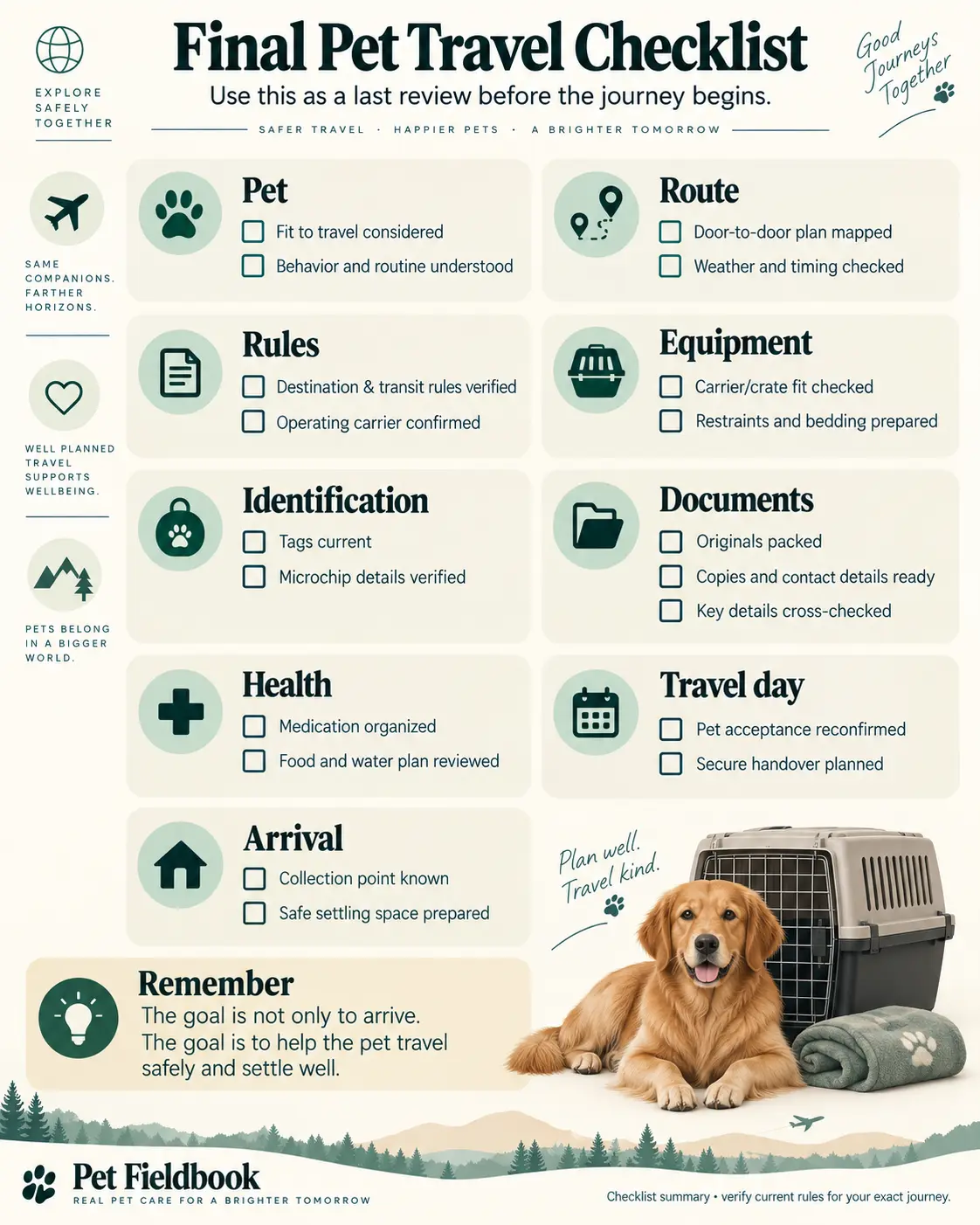
21. Final pet travel document checklist
Before departure, verify:
- The destination authority’s current requirements have been checked for the exact species and origin.
- Transit-country requirements have been checked.
- Return-entry requirements have been checked before leaving home.
- The pet’s microchip scans correctly where identification is required.
- The microchip number matches every relevant record.
- Vaccinations meet the destination’s sequence and validity rules.
- Required laboratory tests were performed by acceptable laboratories in the correct window.
- Required treatments were given and recorded in the correct window.
- Any import permit, licence, NOC or advance approval is valid for the travel date.
- The correct route-specific health certificate was used.
- The certificate was completed by the correct category of veterinarian.
- Required government endorsement is complete.
- Airline-required forms are complete separately from government paperwork.
- Original/printed/digital format requirements have been checked.
- Names, chip numbers, dates, test results and document reference numbers match.
- The actual operating carrier has confirmed the pet.
- Arrival inspection, customs, quarantine or cargo-clearance procedures are known.
- Physical documents are accessible during travel.
- Secure digital backups exist.
For the broader departure process, see Pet Travel Checklist: What to Prepare Before You Go. For air-specific planning, use Flying With a Dog or Flying With a Cat. For carrier and crate standards, see How to Choose a Pet Travel Carrier or Crate.
FAQ
Does every pet need a health certificate to travel?
No universal rule applies to every domestic or international movement. Many international routes and many airlines require some form of health certification, but the exact certificate and timing depend on the destination, origin, species and transport operator. Check the destination authority and carrier for the actual itinerary.
Is a pet health certificate always valid for 10 days?
No. Ten days is a common validity window in some travel systems, but it is not a worldwide rule. The correct validity period depends on the specific certificate, route and authority.
What is the difference between a health certificate and a fit-to-fly certificate?
A government or destination health certificate documents compliance with animal-health requirements for a particular movement. A “fit-to-fly” letter or airline form may be a transport requirement. Sometimes one document can satisfy both purposes; sometimes separate documents are needed.
What is a pet passport?
A pet passport can be a legally defined official document, such as an EU pet passport. The term is also used informally by some commercial websites for a bundle of travel records. Verify which meaning applies to the destination.
Does the microchip have to come before the rabies vaccination?
For some major travel schemes, yes. Great Britain and EU-related rules are examples where identification and rabies-vaccination sequence matters. Other destinations have their own rules. Check the exact route before relying on an existing vaccination.
What is government endorsement?
It is the validation or countersignature of a travel certificate by the exporting country’s competent veterinary authority when the destination requires that additional official certification.
Can my regular veterinarian complete the travel certificate?
Sometimes. Other routes require an accredited, authorised or official veterinarian, and some require government endorsement after the private veterinarian completes the form. Check the destination’s instructions.
Do I need an import permit as well as a health certificate?
Some destinations do. The permit and health certificate perform different functions: the permit authorises import under stated conditions, while the certificate documents compliance with health requirements.
Can I show pet travel documents on my phone?
Do not assume so. Some systems accept electronic or digitally endorsed documents, while others require printed or original documents. Verify the format for each document.
Do transit countries matter if I stay airside?
They can. Transit requirements depend on the country, airport, transfer process and destination rules. Verify the specific connection rather than assuming international transit is exempt.
Should I prepare return paperwork before leaving?
Yes. Some return requirements depend on where the pet travels and may require documents or veterinary actions before the outbound journey. Check home-country re-entry rules before departure.
What if the microchip number is wrong on one document?
Do not alter the official document yourself. Contact the issuing veterinarian, laboratory or competent authority and ask how the error must be corrected. Identity mismatches can prevent officials from linking the paperwork to the animal.
Can several pets be included on one certificate?
Sometimes, under specific legal conditions. Airlines can still impose different transport rules. Verify both the government certificate rules and the carrier’s pet-booking requirements.
Sources and further reading
- International Air Transport Association (IATA). Traveling with Pets. Official source
- International Air Transport Association (IATA). Traveler’s Pet Corner. Official source
- International Air Transport Association (IATA). Guidance for Passengers Traveling with their Dog or Cat in the Cabin. Official source
- USDA APHIS. Pet Travel Process Overview. Official source
- USDA APHIS. Frequently Asked Questions About Traveling With Your Pet. Official source
- USDA APHIS. Veterinary Export Health Certification System (VEHCS). Official source
- USDA APHIS. FAQ About Pet Travel for Accredited Veterinarians. Official source
- European Commission. Bringing a pet into the EU from a non-EU country. Official source
- European Commission. Travelling with a pet within the EU. Official source
- GOV.UK. Bringing your pet dog, cat or ferret to Great Britain. Official source
- GOV.UK. Microchip. Official source
- GOV.UK. Great Britain pet health certificate. Official source
- Australian Department of Agriculture, Fisheries and Forestry. Step-by-step guides to bring your cat or dog to Australia. Official source
- New Zealand Ministry for Primary Industries. Requirement documents for bringing pets to New Zealand. Official source
- U.S. Centers for Disease Control and Prevention (CDC). CDC Dog Import Form and Instructions. Official source
- U.S. Centers for Disease Control and Prevention (CDC). Entry Requirements for U.S.-Vaccinated Dogs from High-Risk Countries. Official source
Pet Fieldbook reviewed current official aviation, veterinary-export, animal-health and biosecurity sources alongside live search results and recurring traveller questions. The evergreen core explains document functions and dependencies rather than reproducing country-specific validity windows that can change. Route-specific examples are identified as examples, and official requirements should be rechecked for the actual itinerary before travel.