Key takeaways
- Check the actual operating carrier for every flight sector.
- Identify whether the pet would travel in cabin, as checked/accompanied baggage where offered, or through cargo/air freight.
- A passenger ticket does not automatically confirm pet space.
- Cabin eligibility can depend on pet fit, carrier size, aircraft, seat and cabin—not only a weight limit.
- Partner-airline and connection rules can break an itinerary that looks valid on a passenger booking site.
- Airline permission and government entry/transit permission are separate.
- Fees, dimensions, routes and cargo availability can change. Use the dated airline guide and then verify the official airline page.
An airline saying that it “allows pets” does not tell you enough to book a journey. The same airline may accept a small dog or cat in the cabin on one route, use checked or accompanied-baggage transport on another, require cargo for a different journey, or refuse standard pet transport entirely on certain aircraft, cabins or destinations.
Pet Fieldbook therefore treats airline pet policies as route-specific operating rules, not permanent yes-or-no labels. For the broader air-travel process, see Flying With a Dog, Flying With a Cat, and How to Choose a Pet Travel Carrier or Crate.
1. Why airline pet policies are difficult to compare
Many of the details readers care about are operational rather than universal. An airline may publish a cabin carrier limit but also say under-seat space varies by aircraft. Another may allow pets in the hold but exclude certain transfer airports. Some airlines offer no standard cabin-pet service at all.
The useful questionDoes this airline accept this pet, in this transport mode, on these exact operating flights, under the conditions of this route?
2. Start with the operating carrier, not the logo on the ticket
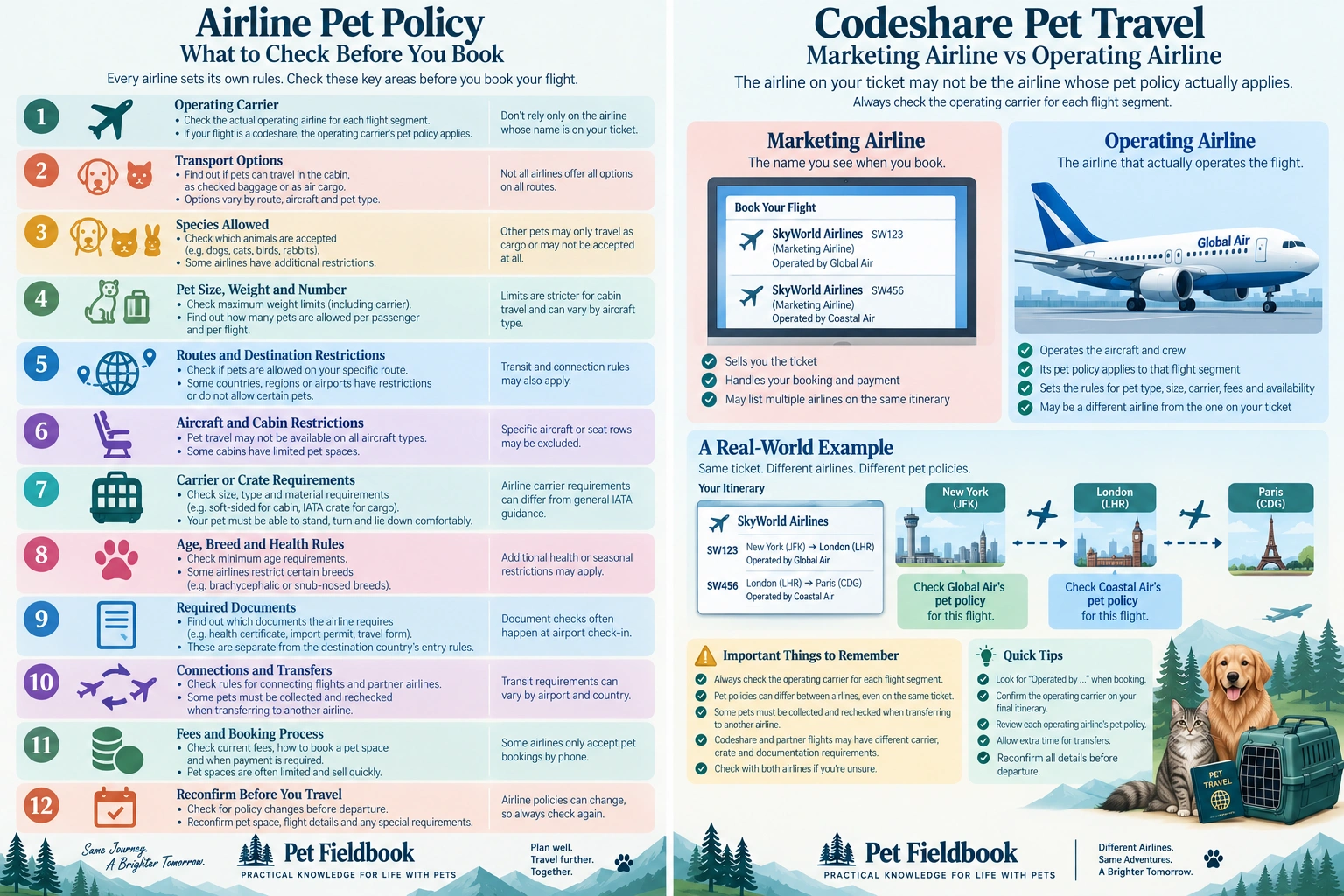
Codeshare flights allow one airline to sell a flight that another airline actually operates. Pet rules frequently follow the carrier physically transporting the animal, and partner-operated sectors can have a different booking process or no compatible pet service at all.
For a multi-flight itinerary, identify who operates every sector, whether each carrier accepts the pet in the same transport category, and whether the connection airport and airlines support the live-animal transfer.
3. Identify how the pet would actually travel
In cabin
A small dog or cat may travel in a closed carrier in the passenger cabin where the airline, aircraft, route and destination permit it. Under-seat stowage is common, but airlines can impose additional seat and cabin-class restrictions.
Checked or accompanied baggage
Some airlines accept a dog or cat in a rigid container in the aircraft hold as part of the passenger journey. Pet Fieldbook uses this term only where the airline actually offers that arrangement.
Cargo / air freight
The pet is booked through a cargo or live-animal process rather than simply added to the passenger reservation. Cargo can involve a separate booking reference, cargo terminal, earlier acceptance time and different collection facility.
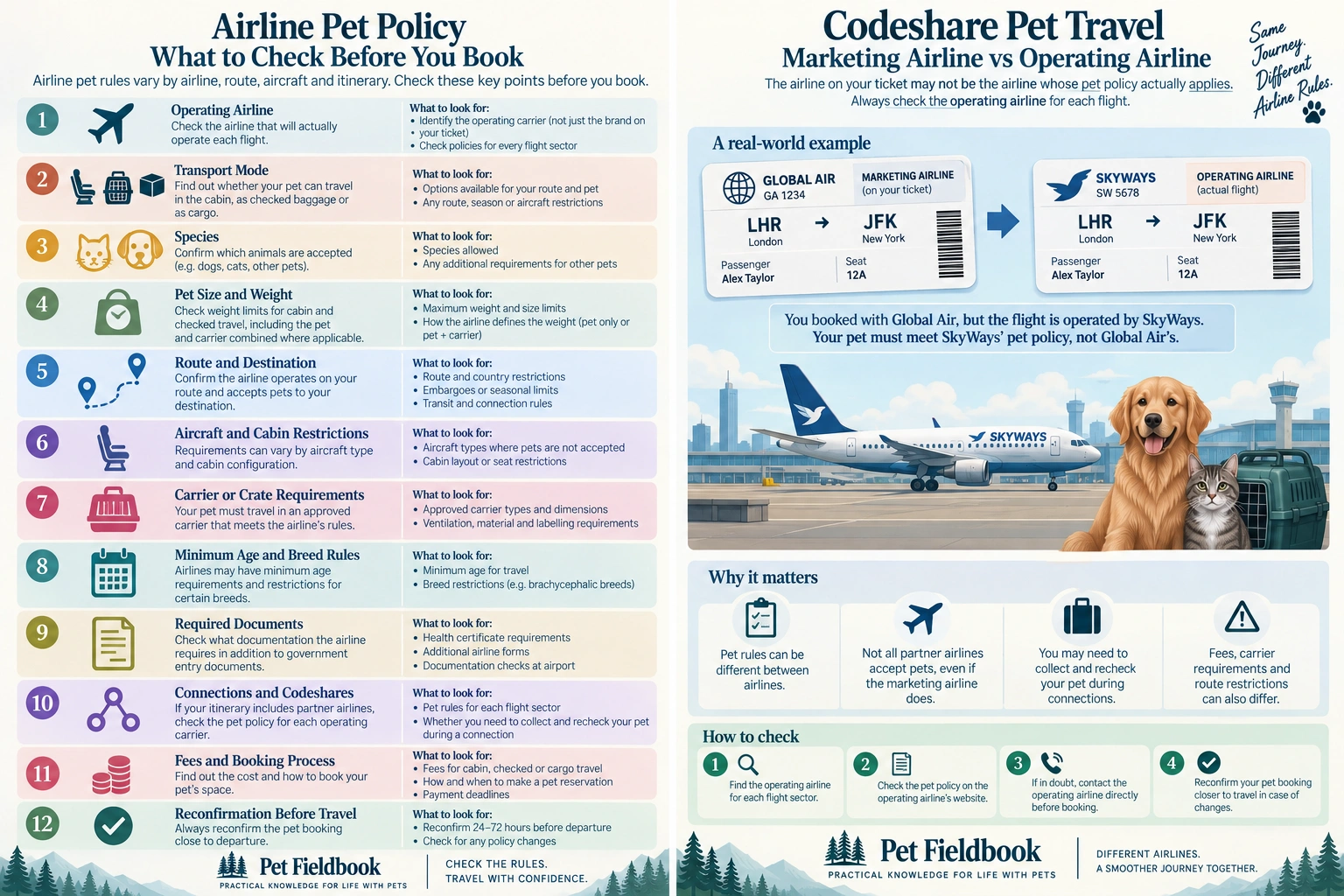
4. The 12 checks to make before you book
Use these checks for every airline and every itinerary. The point is not to memorize an airline’s current limits; it is to identify the fields that can make the journey workable—or impossible.
5. Cabin rules: fit, aircraft and seat configuration
Cabin pet travel looks simple because the carrier usually stays with the passenger, but the practical constraint is the space around the seat. Airlines can publish different carrier limits by aircraft and can exclude pets from premium cabins, bulkheads, exit rows or other seat types where safe stowage is not available.
Use the two-fit test: the carrier must fit the individual pet, and the complete carrier must fit the permitted stowage space on the actual aircraft without compromising ventilation.
6. Hold and cargo rules can involve a completely different journey
A pet that cannot travel in the cabin does not simply get “checked like a suitcase.” Where checked/accompanied-baggage transport exists, the animal still travels under live-animal procedures. Cargo can be even more distinct, with a separate booking, cargo facility, acceptance time and collection process.
That is why Pet Fieldbook keeps checked/accompanied baggage and cargo/air freight separate rather than collapsing both into “the hold.”
7. Codeshares, partner airlines and connections
A workable passenger connection is not automatically a workable pet connection. Confirm whether the animal can remain in the same transport category, whether the airlines transfer live animals between one another, whether collection and recheck is required, and whether the transfer airport supports the process.
8. Route, destination, age, breed and weather restrictions
Country law, airport capability, aircraft limitations and airline policy can each create route-specific exclusions. Minimum age, brachycephalic restrictions, regulated breeds and weather rules are also carrier-specific and can change the answer even when the route otherwise works.
Use the airline page for transport acceptance and the relevant government source for legal entry or transit. For the broader framework, see International Pet Travel and Pet Travel Documents & Health Certificates.
9. Airline documents are separate from legal entry documents
An airline may ask for transport paperwork in addition to the documents required by a government. Those airline documents can include a transport health certificate, declaration, feeding instructions, labels, live-animal acceptance checklist or cargo paperwork.
Do not use a universal health-certificate validity window. The timing depends on the airline, journey and destination.
10. Confirm the pet separately from the passenger
A purchased passenger ticket is not the same as confirmed pet acceptance. Airlines may cap pet numbers or require a separate pet reservation, approval, form or cargo booking.
Where possible, establish whether pet space is available, how the pet reservation is confirmed, what happens if approval fails, and whether every operating sector has been checked.
11. Recheck after itinerary changes
A schedule change that looks minor to a passenger can invalidate the pet plan. Recheck the pet if the flight number, operating carrier, aircraft, airport, connection, travel date, destination or cabin changes—and reconfirm again close to departure.
12. Pet Fieldbook airline policy directory
Each airline page will show a prominent Last checked date and link to the airline’s official pet-policy source. Planned internal links remain in this hub while the priority pages are built for simultaneous launch.
India / South Asia
- Air India Pet PolicyCabin dogs/cats up to 10 kg; checked-pet pathway up to 32 kg where eligible; larger animals use Cargo.
- Akasa Air Pet PolicyDomestic India pet service; cats/dogs, 10 kg cabin threshold, cargo-compartment pathway and advance booking rules.
- IndiGo Pet PolicyOrdinary pets are not accepted on IndiGo-operated passenger flights or through IndiGo CarGo; service dogs are separate.
North America
- American Airlines Pet PolicyCabin pets; checked pets limited to eligible military/Foreign Service travellers; PetEmbark cargo is separate.
- Delta Air Lines Pet PolicyCabin pets; checked pets limited to eligible military/Foreign Service travellers; current household-pet Cargo embargo.
- United Airlines Pet PolicyCabin cats/dogs; no general checked-pet service or civilian PetSafe cargo pathway; route and aircraft limits apply.
- Alaska / Hawaiian Pet PolicyCabin, baggage-compartment and Pet Connect cargo options, with Hawaii-specific route and document rules.
- Air Canada Pet PolicyCabin cats/dogs, baggage-compartment travel and AC Animals cargo, with aircraft and seasonal restrictions.
- Southwest Airlines Pet PolicyCabin cats/dogs only; no ordinary checked/cargo pets; separate mainland and inter-island Hawaii fare rules.
- JetBlue Pet PolicyCabin cats/dogs only; no ordinary checked/cargo pathway; carrier, Mint and international restrictions apply.
Europe
- Lufthansa Pet PolicyCabin up to 8 kg, passenger-hold travel for eligible pets and separate Lufthansa Cargo freight.
- KLM Pet PolicyCabin up to 8 kg, passenger hold under 75 kg and separate Air France KLM Martinair Cargo.
- Air France Pet PolicyCabin up to 8 kg, passenger hold up to 75 kg and separate Air France KLM Martinair Cargo.
- British Airways Pet PolicyOrdinary pets use manifest cargo through PetAir UK/IAG Cargo; assistance dogs are a separate cabin category.
Middle East
- Emirates Pet PolicyNo ordinary cabin pets; eligible checked-baggage routes from Dubai; SkyCargo for Dubai arrivals and cargo-trigger cases.
- Qatar Airways Pet PolicyChecked-baggage dogs/cats/birds with a general 75 kg ceiling; Cargo, falcons and service dogs use separate rules.
- Etihad Airways Pet PolicySmall cats/dogs in cabin up to 8 kg; larger pets use Etihad Cargo; Abu Dhabi document rules apply.
- Turkish Airlines Pet PolicyPETC cabin up to 8 kg; AVIH passenger hold up to 50 kg; Turkish Cargo TK LIVE handles freight.
Asia-Pacific
- Singapore Airlines Pet PolicyNo ordinary cabin pets; eligible cats/dogs checked up to 32 kg; Cargo above the threshold or on route-forced cases.
- Qantas Pet PolicyOrdinary pets are booked through Qantas Freight: domestic direct booking, international specialist cargo and Australia biosecurity.
13. How Pet Fieldbook maintains airline-policy pages
Airline policies are among the most changeable pages in the Pet Travel cluster. Pet Fieldbook therefore separates them from evergreen planning guides.
- Every airline guide displays the date it was last checked.
- Official airline sources are linked directly.
- Cabin, checked/accompanied-baggage and cargo arrangements remain distinct.
- Route, aircraft and operating-carrier caveats are called out.
- Government requirements are labelled separately from airline rules.
- No retail container is described as “IATA approved.”
- No universal health-certificate timing is presented.
- Material policy changes are recorded when they affect travellers.
FAQ
Which airlines allow pets in the cabin?
Many airlines allow small dogs and/or cats in the cabin, but availability depends on carrier, route, aircraft, cabin class, pet size and destination rules. Some airlines do not offer standard pet-in-cabin travel at all.
Which airlines allow large dogs?
Large-dog options depend on whether the airline offers checked/accompanied-baggage transport or cargo on the intended route. There is no worldwide list that remains correct for every route and date.
Is there one standard airline pet-carrier size?
No. Cabin dimensions vary by airline and sometimes by aircraft. The carrier also needs adequate usable space for the individual pet.
Does buying my ticket reserve a place for my pet?
Not necessarily. Airlines can cap pet numbers or require a separate pet reservation, approval or cargo booking.
Whose pet policy applies on a codeshare flight?
Start with the actual operating carrier for each sector. Partner-airline processes differ, and some airlines do not accept standard pet bookings on partner-operated flights.
Can my pet transfer automatically between airlines?
Do not assume so. Some airlines do not interline live animals or require collection and recheck.
Are service animals covered by ordinary pet policies?
No. Service-animal rules are a separate accessibility category and vary by jurisdiction.
Does IATA approve pet carriers or crates?
No. IATA publishes live-animal transport standards but does not certify or approve retail pet-container brands or models.
Sources and further reading
- IATA. Traveling with Pets / Traveler’s Pet Corner. Used for the principle that airline-specific requirements must be checked directly and pet acceptance should be confirmed for the intended flight.
- IATA. Operational Guidelines for In-Cabin Pet Transport, first edition, July 2026. Used for the journey-wide framework from booking through arrival and irregular operations.
- FAA. Flying with Pets. Used for the U.S. framework that airlines decide their own in-cabin pet policies.
- U.S. DOT. Flying With a Pet. Used for the principle that carrier restrictions vary.
- Official airline sources. Current passenger pet-policy pages, conditions of carriage, cargo/live-animal pages and relevant government guidance were reviewed across all 20 airlines in the directory.
Pet Fieldbook separates volatile airline-specific rules from evergreen planning guidance. Each airline guide should display a last-checked date, link to the official carrier source, identify material route or aircraft caveats and tell readers what must still be reconfirmed for the actual flight.