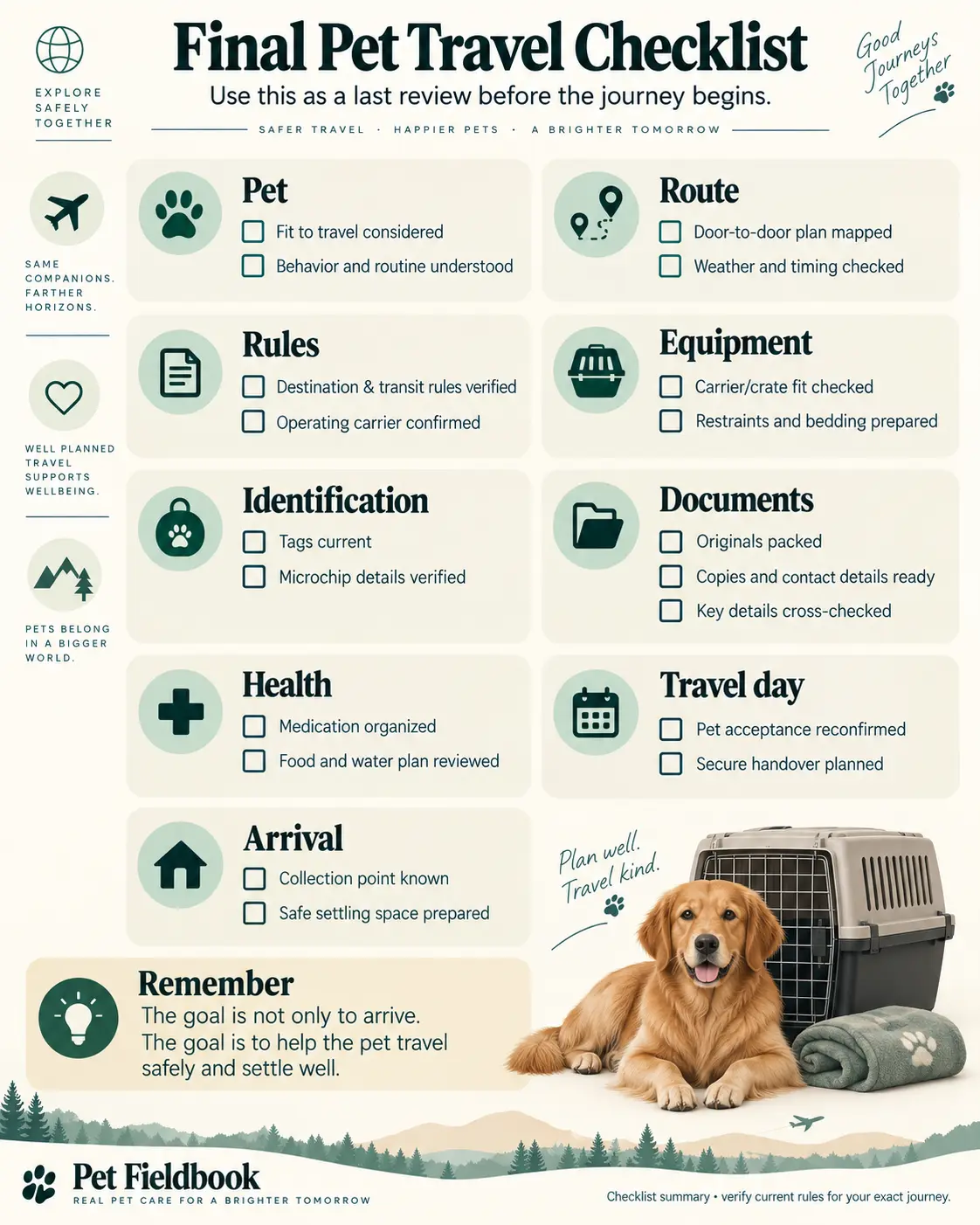
Taking a dog or cat across an international border is not simply a longer version of a domestic trip. The pet may need to satisfy animal-health rules set by the destination country, export requirements in the country of departure, conditions imposed by transit countries, airline or cargo acceptance rules, and separate requirements for returning home.
Those systems do not always use the same terminology or timetable. A veterinarian may need to complete a health certificate only after earlier requirements have been satisfied. A government authority may then need to endorse that certificate. An import permit may need to be issued before a flight is accepted. A transit stop that looks insignificant on a passenger itinerary can create another regulatory or handling question. And a return journey can require paperwork that must be prepared before the outbound trip begins.
The safest way to plan international pet travel is therefore to treat it as a route-specific project with dependencies, not as a generic packing checklist.
This guide explains that planning framework for dogs and cats. It does not reproduce changing country-by-country import rules or airline weight limits. Use Pet Fieldbook's planned country guides and Airline Pet Policies, together with the current official government and operating-carrier sources for your exact route.
Quick answer: Start with the destination and the exact route. Check whether the pet is eligible to enter, what the origin country requires for export, what every transit point requires, and what your transport provider accepts. Then put microchip, vaccination, testing, permits, veterinary certification and government endorsement into the correct sequence. Confirm the pet separately from the passenger booking, and plan arrival clearance and the return journey before departure.
Key takeaways
- International pet travel is governed by the actual route, not just the final country name.
- Check five layers: origin/export, transit, destination/import, transport-provider, and return/re-entry requirements.
- Airline acceptance and legal border entry are separate approvals.
- Do not assume an airside layover is automatically exempt from pet rules.
- Microchip, vaccination, testing and document steps can depend on one another; complete them in the order required by the applicable authority.
- There is no universal “10-day health certificate” rule.
- Quarantine is not universal, but some destinations use strict approved-country, permit and quarantine systems.
- A passenger ticket does not confirm the pet. Confirm the animal with every actual operating carrier involved.
- Plan the total journey through inspection, customs/biosecurity clearance and collection—not only the flight.
- Check return requirements before leaving home; some re-entry documents must be prepared in advance.
1. First decide whether the international journey is realistic
Before working through forms and airline schedules, decide whether this particular trip is workable for this particular pet.
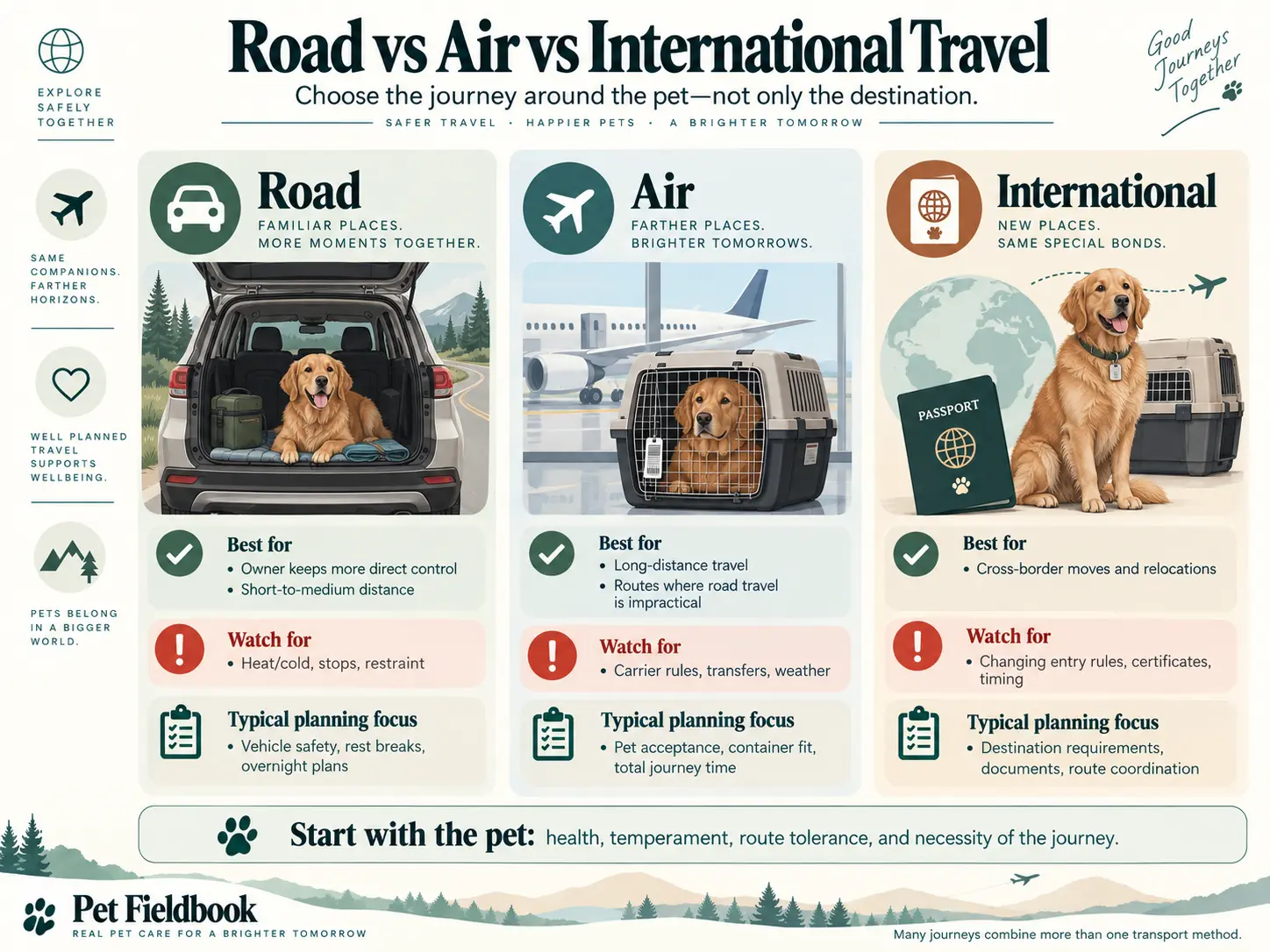
International travel can involve prolonged confinement, multiple vehicle transfers, unfamiliar handlers, busy terminals, inspections and a very different environment at the destination. Some routes also involve mandatory quarantine. A pet that tolerates a short domestic journey may not automatically be a good candidate for a twenty-hour international itinerary with a connection and border processing.
Consider:
- the pet's age and general health;
- respiratory anatomy and any chronic medical conditions;
- tolerance of confinement and previous travel experience;
- anxiety, escape risk and behaviour in unfamiliar environments;
- the expected door-to-door journey time;
- climate and seasonal conditions;
- whether quarantine is required;
- whether the pet is legally eligible to enter the destination; and
- whether a realistic alternative exists, such as ground transport on part of the route or leaving the pet with an appropriate caregiver for a short trip.
If the pet has significant health concerns or you are unsure how it may cope, discuss the proposed journey with a veterinarian before building expensive, non-refundable arrangements around it.
International travel can also be legally impossible for some animals on some routes. Destinations may restrict certain species, dog breeds or types, hybrid animals, very young pets, pregnant animals, animals from unapproved countries or movements that do not meet their definition of non-commercial pet travel.
The first question is therefore not “Which airline should I book?” It is “Can this pet legally and realistically complete this route?”
2. Understand the five rule layers
One of the easiest ways to make an international pet journey confusing is to treat every instruction as though it comes from the same authority.
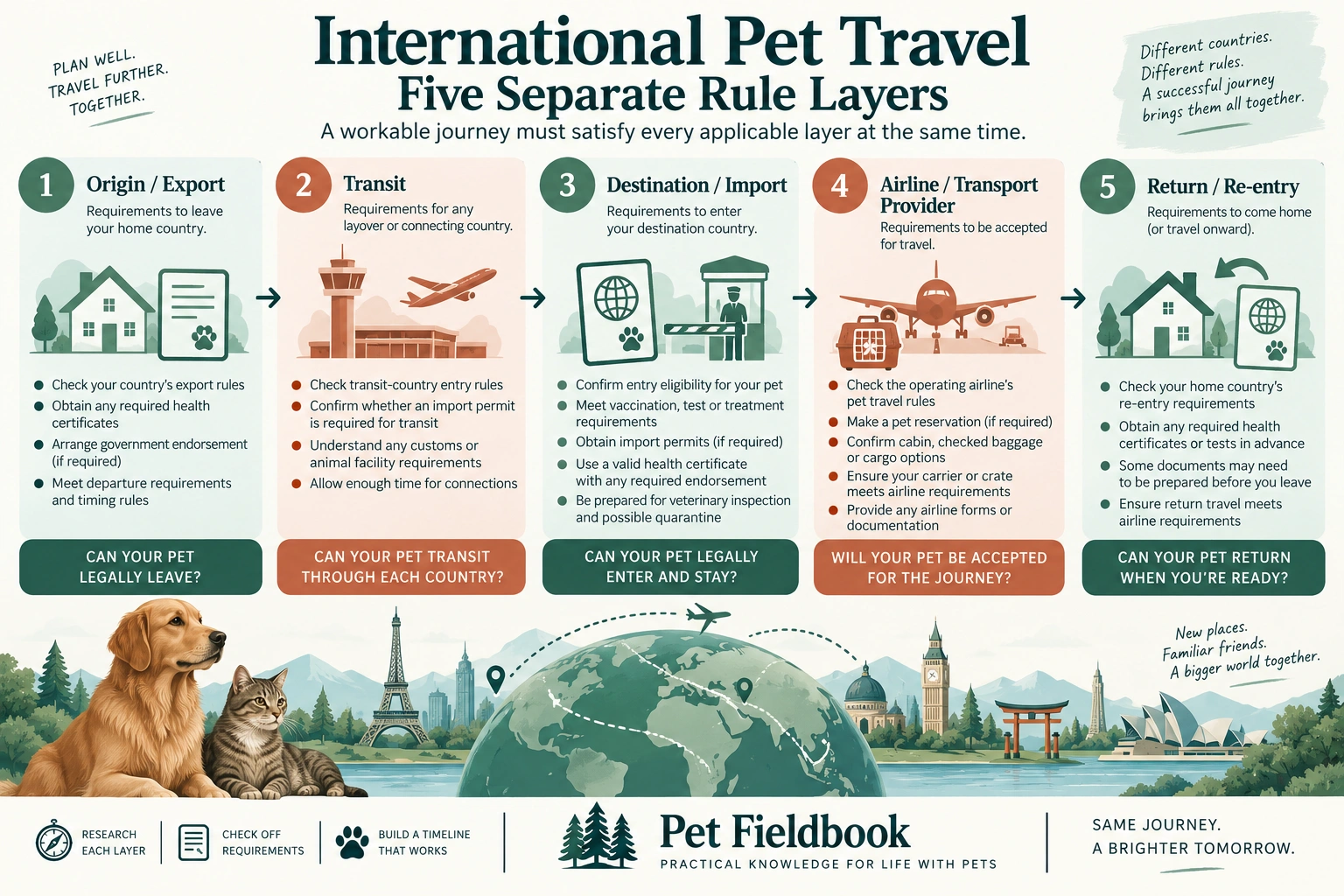
It does not.
A useful planning model is to separate five layers.
Origin or export requirements
The country the pet is leaving may require export certification, government endorsement, an inspection, an export permit or other formalities. These can exist even when the destination has its own separate import certificate.
Transit requirements
A connection country can have rules that depend on whether the pet remains on the same aircraft, changes aircraft, enters an animal facility, clears customs, leaves the secure international zone or is collected and rechecked.
Do not infer the pet's transit status from the passenger's experience alone.
Destination or import requirements
The destination controls whether the pet can enter. Requirements may include identification, vaccinations, laboratory tests, parasite treatment, an import permit, health certification, government endorsement, advance notification, approved entry points, inspections or quarantine.
Airline or transport-provider requirements
Airlines decide whether and how they will carry the pet. Their rules can concern cabin eligibility, crate/container specifications, pet reservation limits, health documentation, seasonal restrictions, breed policies, cargo booking and the use of approved animal shippers.
An airline can refuse to carry a pet that would legally be allowed into the destination. Conversely, an airline accepting the pet does not prove that the animal satisfies border requirements.
Return or re-entry requirements
The home country may impose different requirements when the pet comes back, especially if the animal has visited a country with a different disease-risk status. Those return requirements sometimes need action before the outbound journey.
Keeping these layers separate prevents one of the most common planning failures: satisfying one authority and assuming everyone else has been satisfied too.
3. Research the exact route before booking
Start with the full proposed itinerary rather than a cheap passenger fare.
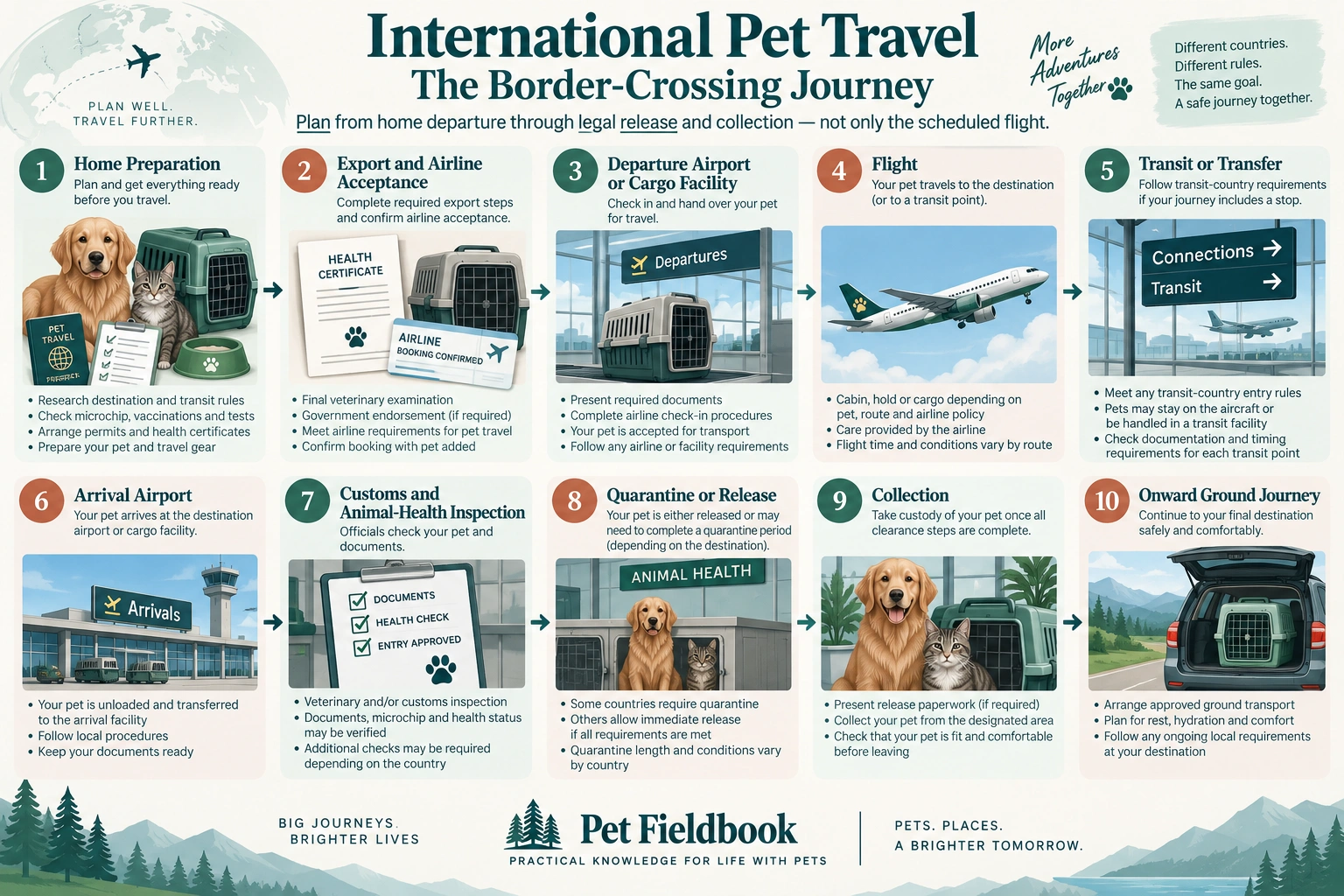
Write down:
- origin country;
- departure airport or port;
- each transit country;
- whether each connection is a through connection, transhipment or self-transfer;
- every operating airline or transport company;
- destination country;
- arrival airport or port;
- where customs or animal-health clearance occurs;
- onward domestic transport; and
- the return route, if known.
Then research the pet requirements against that actual chain.
IATA's current guidance explicitly tells travellers to consider intermediate stations and final destination, and its 2026 in-cabin operational guidance says airline policy should be aligned with the requirements of origin, transit and destination states.[1][2]
Do not rely only on the marketing airline
A flight can carry one airline's flight number while being operated by another carrier. The actual operating airline may have different pet rules, aircraft limitations or live-animal handling arrangements.
For multi-carrier itineraries, IATA's 2026 guidance says advance arrangements should ensure that all participating airlines accept the pet and can provide consistent handling.[2]
Check the entry point, not just the country
Some countries restrict which airports, seaports, routes or companies can be used for pet entry. Great Britain, for example, uses approved routes and transport companies for many pet arrivals.[3] New Zealand's current 2026 dog-and-cat import guidance specifies Auckland or Christchurch for air arrivals under that process.[4]
This means “pets are allowed into the country” is not enough information. You need to know whether your actual arrival point and mode are allowed.
4. Check whether the pet is legally eligible
Before booking, look for eligibility rules that sit above the document checklist.
Depending on the destination, these can concern:
- species;
- breed or type;
- hybrid status;
- minimum age;
- pregnancy;
- country of origin or recent residence;
- disease-risk classification of countries visited;
- whether the animal is travelling for sale or transfer of ownership;
- whether the owner accompanies the animal within a specified time window;
- the number of pets moving together; or
- whether the animal qualifies as a pet under that jurisdiction's rules at all.
Australia provides a useful example of why eligibility must be checked early. Its current system groups exporting countries, does not permit direct import from every country, and can require an animal from a non-approved country to move to an approved country and satisfy residence/preparation conditions there before export to Australia.[5]
New Zealand's 2026 import system likewise uses categories of eligible countries and has separate restrictions covering matters such as breed/type and pregnancy.[4]
These are examples, not universal rules. The editorial lesson is broader: check eligibility before spending money on the rest of the process.
5. Build a dependency timeline
International pet paperwork is often described as a list, but a list hides the most important fact: some steps only count if an earlier step was done correctly.
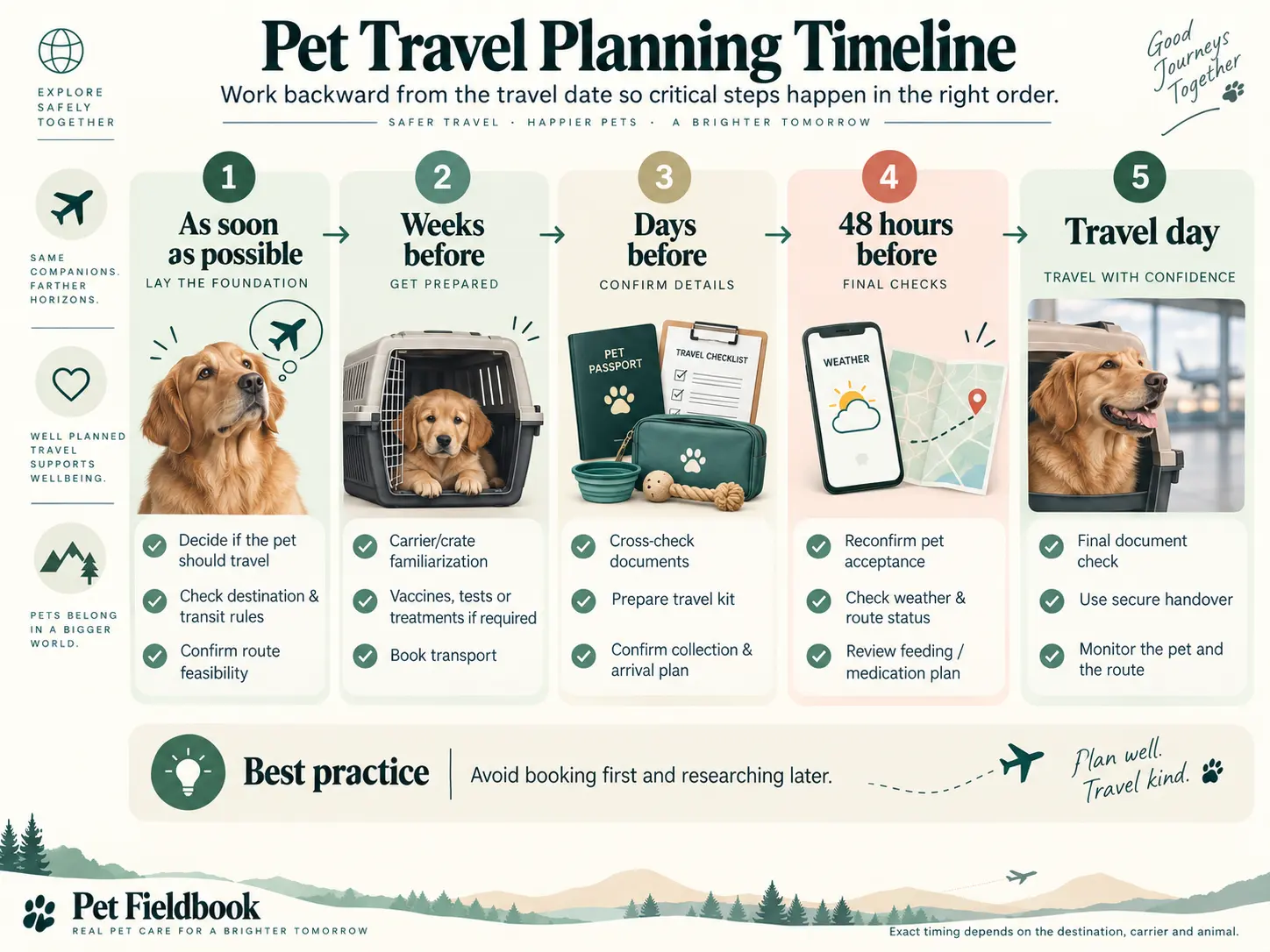
A route might require a sequence such as:
- confirm the exact destination and transit requirements;
- identify or microchip the pet;
- give or verify a required vaccination;
- wait a specified interval;
- collect a laboratory sample;
- wait for a test result or waiting period;
- apply for an import permit;
- book quarantine or obtain pre-approval;
- complete the final veterinary examination;
- issue the destination-specific health certificate;
- obtain government endorsement where required;
- complete airline forms or final treatments; and
- travel within the certificate's validity window.
Your route may require only some of these steps, or may require them in another order.
USDA APHIS recommends building a schedule because destination requirements can include vaccinations, tests and treatments that must happen within defined windows, and notes that international preparation may take a few weeks to many months.[6]
Start with the longest dependency
The most useful planning question is not “How many forms are there?” It is “Which requirement starts the clock?”
A rabies antibody test, minimum residence period, quarantine reservation, import permit or official identity check can create a long lead time. The final health certificate may actually be one of the last steps.
Australia currently tells many dog/cat importers to allow at least six months to complete its import process.[5] New Zealand's revised 2026 framework introduces an official identification check at least six months before export for animals using the new process, with full implementation from April 2027.[4]
Those timelines should not be copied onto simpler routes. They demonstrate why the correct timeline comes from the destination's current official process, not a generic blog calendar.
6. Identification and microchips
Many international dog-and-cat routes use a microchip as the identity anchor connecting the animal to vaccination records, laboratory results and certificates. But the exact technical standard and sequencing requirements are jurisdiction-specific.
Great Britain provides a clear example: the pet must be microchipped before, or at the same time as, the rabies vaccination used for travel. If the required order is wrong, the vaccination may have to be repeated.[7]
That does not mean every country applies the same rule.
Practical document control
Whatever the route requires, check the microchip number character by character across:
- the chip record;
- rabies certificate;
- laboratory report;
- import permit;
- health certificate;
- government endorsement; and
- airline paperwork where the number appears.
A correctly implanted chip does not solve a paperwork mismatch.
If the chip cannot be read reliably, resolve the problem early enough that any required revaccination or testing sequence can be repeated if necessary.
7. Vaccinations, tests and treatments
Rabies is the most common international dog-and-cat travel requirement, but there is no universal rabies protocol that applies to every border.
The destination may care about:
- minimum age at vaccination;
- whether the vaccination occurred after identification;
- waiting time after a primary vaccination;
- continuity of booster coverage;
- vaccine validity at entry;
- origin-country rabies status;
- rabies antibody titre testing;
- which laboratory performs the test; or
- a waiting period after blood sampling.
Other requirements can include parasite treatments, examinations for specified diseases, laboratory tests or route-specific declarations.
The European Union, for example, applies different rabies-related conditions to dogs, cats and ferrets entering from different non-EU origins, and its current framework can require an antibody titration test depending on origin.[8]
Great Britain has its own rabies vaccination and, for some origins, blood-test requirements.[9]
The correct editorial wording is therefore “your route may require…”, not “international travel requires…”.
Do not add unnecessary treatment “just in case”
A travel requirement should come from the official destination/transit authority or the veterinarian working from that requirement. Adding treatments or altering dates without understanding the certificate can create inconsistencies rather than safety.
8. Import permits, health certificates and government endorsement
These are different steps.
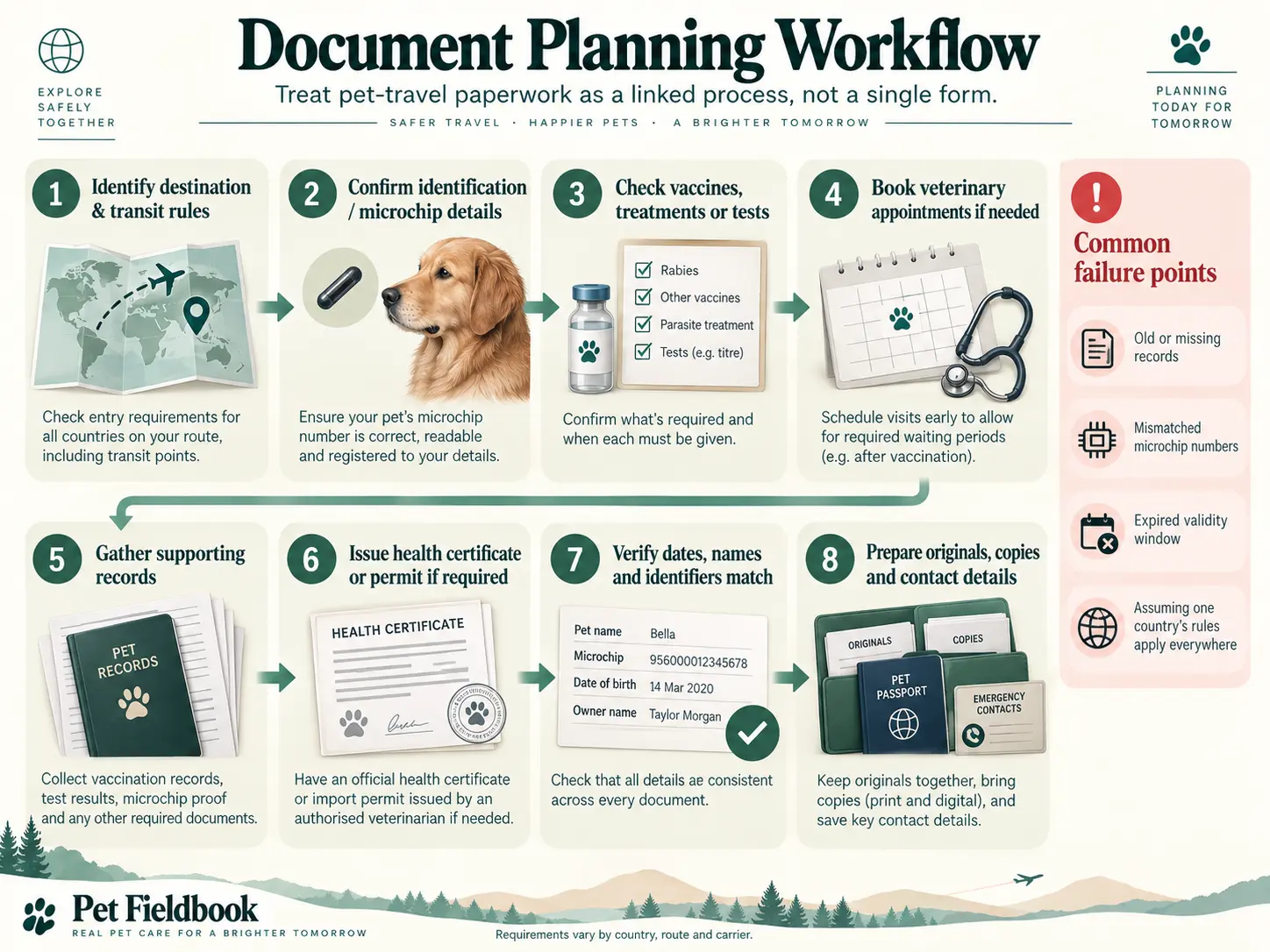
Import permit
An import permit is permission from the destination authority to bring the animal into the country under specified conditions. Not every destination requires one.
When it is required, the permit may need to be obtained well before the final veterinary certificate. It can also contain route-specific instructions that must be followed exactly.
Veterinary examination
This is the clinical assessment performed by a veterinarian. It may be required within a particular time window before travel.
Health certificate
The health certificate records that the animal meets the destination's stated health requirements. Its exact form and content are normally set by the relevant authority; there is no single global health certificate.
USDA APHIS explicitly says each country establishes its own requirements and that one health certificate does not work for all countries.[10]
Government endorsement
Some destinations require the certificate issued by the veterinarian to be endorsed, countersigned or otherwise validated by the exporting country's competent authority.
That endorsement is not the same as the veterinarian examining the animal.
Certificate timing
Never rely on a universal “10-day certificate” rule.
The European Union's current non-commercial framework, for example, generally gives its animal health certificate a 10-day window from issue to documentary/identity checks at the designated entry point, with an additional allowance for sea travel.[8] Great Britain's current pet health certificate also uses a 10-day entry window.[11]
Other routes can use different windows or documents entirely.
The correct question is: What document must be issued, by whom, endorsed by whom, and valid on which exact date in my itinerary?
For a deeper document-by-document framework, see Pet Fieldbook's Pet Travel Documents & Health Certificates guide.
9. Airline acceptance is a separate approval
Once the legal route looks workable, confirm how the pet can actually be transported.
Depending on airline, route, aircraft and animal size, transport may be:
- in cabin;
- as checked/accompanied baggage where the airline offers it; or
- through an air cargo / air freight process.
Not every airline offers every option.
IATA advises travellers to contact the selected airline and confirm that it accepts the pet on the preferred day and flight. It also notes that airlines can limit the number of animals and may have their own health-certificate requirements.[1]
Passenger ticket ≠ pet booking
Do not buy a passenger itinerary and assume the animal is automatically included.
Ask how pet acceptance is recorded and obtain the relevant pet reservation, service request, cargo booking or written confirmation for each sector.
Codeshares and multiple carriers
Confirm the actual operating carrier on every flight. A marketing carrier's pet page may not govern a codeshare operated by another airline.
If the pet changes airlines, ask specifically whether the animal can transfer between those carriers at that airport. Passenger baggage interlining does not prove live-animal interlining.
Carrier or crate
Check the pet's actual fit and the airline's current container requirements. For hold/cargo transport, use current IATA Container Requirement 1 and the carrier's additional rules where applicable. IATA publishes standards; it does not certify commercial crate brands as “IATA approved.”
See Pet Fieldbook's Pet Travel Carriers & Crates guide for the full carrier/crate framework.
10. Transit countries and connections
Transit is one of the most underestimated parts of international pet travel.
A passenger may describe a three-hour airport stop as “just a layover.” For the animal, the operational reality could be very different.
Ask:
- Does the pet remain on the same aircraft?
- Does it change aircraft?
- Does it change airlines?
- Is it moved through a live-animal facility?
- Does the passenger need to collect and recheck it?
- Does anyone clear customs?
- Does the pet leave the international transit zone?
- Is an overnight stay possible if the connection fails?
New Zealand's 2026 framework, for example, explicitly distinguishes transit/transhipment and requires permission for relevant pet transit movements; some longer transhipments require a reservation at an approved quarantine facility.[12]
CDC's current dog-import layover guidance provides another useful example: U.S. requirements can depend on where a dog has been, where a layover occurs, whether customs is cleared and how the animal is transported.[13]
The correct rule is therefore not “airside transit never counts.” It is “check how the relevant authority defines your exact transit.”
Self-transfers are especially important
A passenger self-transfer can require baggage collection, immigration, terminal changes or a fresh airline check-in. With a pet, that may transform a simple-looking connection into a formal entry and re-export process.
Avoid assuming that a self-transfer works until both the legal and airline-handling sides have been confirmed.
11. Quarantine and controlled-entry systems
Many international pet journeys do not involve quarantine. Some destinations, however, use quarantine as part of a wider biosecurity system.
Australia is a prominent example. Its current dog/cat import framework uses approved-country categories, permits and post-entry quarantine at the Mickleham facility. Depending on the export-country group and whether specified identity-verification conditions have been met, current guidance can involve minimum stays of 10 or 30 days.[5][14]
New Zealand's 2026 Import Health Standard likewise uses eligible country categories, permits and quarantine for many cats and dogs, with a transition between its 2021 and 2026 systems extending to April 2027.[4]
These systems illustrate several planning lessons:
- quarantine can require an advance booking;
- an import permit may depend on that booking;
- eligibility can depend on where the animal has lived;
- only particular ports may accept the animal; and
- document errors can extend quarantine or prevent release.
Do not describe “quarantine countries” with a fixed global list. Policies and preparation pathways change.
12. Prepare the departure document pack
By the final week, the goal should be verification rather than discovering new requirements.
Create one controlled document set containing whatever applies to the route, such as:
- microchip/identification record;
- vaccination certificates;
- laboratory reports;
- parasite-treatment records;
- import permit;
- destination-specific health certificate;
- government endorsement;
- airline forms and pet booking confirmation;
- cargo air waybill or shipper documents where applicable;
- quarantine booking confirmation;
- owner declaration;
- arrival/pre-notification confirmation;
- return documents; and
- emergency contact information.
Match every identifier
Check:
- pet name;
- microchip number;
- owner/exporter name;
- destination address where required;
- dates;
- flight details where relevant; and
- certificate/permit numbers.
Originals versus digital documents
Do not assume a PDF on your phone is legally equivalent to an original document.
Some systems accept digital endorsement; others require original paper documents to accompany the animal. USDA APHIS, for example, notes that destination acceptance of digitally endorsed documents varies and that paper originals remain necessary for destinations that do not accept digital endorsement.[6]
Follow the rule of the authority that will inspect the document.
13. Departure-day acceptance
Know where the pet is actually accepted.
For an in-cabin pet, this may be the passenger check-in desk followed by security screening. A hold animal may have an earlier acceptance process. Cargo can involve an entirely separate live-animal or freight terminal.
Confirm:
- acceptance location;
- required arrival/check-in time;
- documents staff will inspect;
- container/crate inspection requirements;
- who has custody of the pet after handover;
- how to contact the airline or cargo facility if the flight is delayed; and
- whether cargo facility operating hours affect acceptance.
IATA advises air-freight travellers to check that the destination freight facility will be open when the animal needs to be claimed.[1]
For species-specific flight preparation, see:
14. Arrival, customs and veterinary clearance
Landing is not the end of the pet's journey.
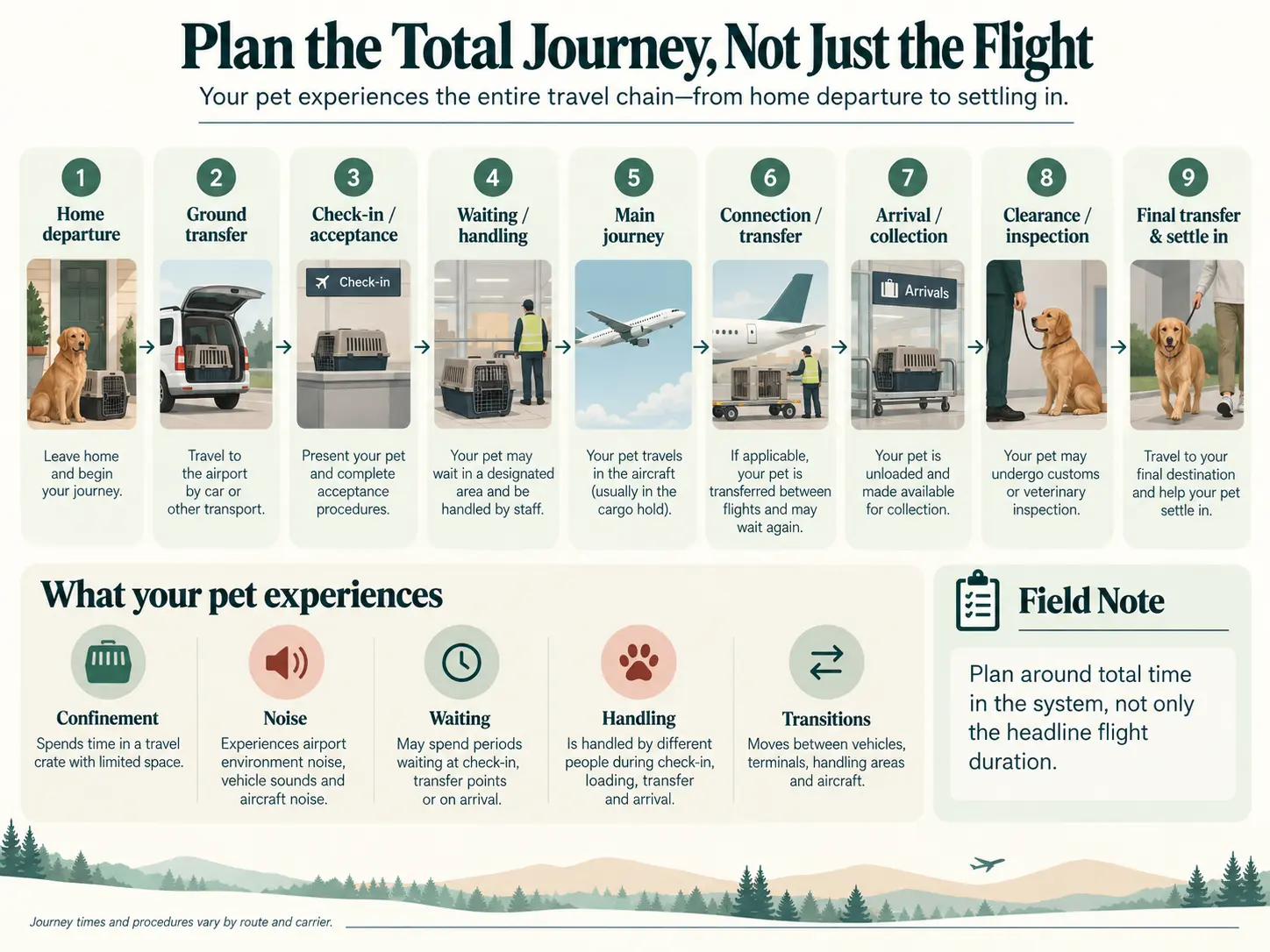
Depending on the country and transport method, the animal may go through:
- document review;
- microchip/identity check;
- veterinary or biosecurity inspection;
- customs clearance;
- import-permit verification;
- quarantine transfer; or
- release at a cargo or animal-reception facility.
Before departure, know:
- where the pet will physically arrive;
- who presents the documents;
- whether an agent is required;
- inspection hours;
- facility opening hours;
- quarantine transfer arrangements;
- fees/payment arrangements; and
- who is legally permitted to collect the animal.
If an animal arrives outside an inspection window, release may be delayed even when the documents are correct. New Zealand's current guidance, for example, publishes specific inspection arrangements for relevant arrivals and notes that non-compliant or unavailable-for-inspection pets may need to move into an approved quarantine facility.[4]
Treat arrival as a planned operational stage, not an afterthought.
15. Plan onward ground transport and the first hours after arrival
After a long journey, the pet still needs to travel from the airport, port or quarantine facility to the final destination.
Plan:
- a secure vehicle setup;
- suitable temperature control;
- water;
- an appropriate toileting opportunity;
- medication already prescribed for ongoing conditions;
- a quiet destination space; and
- a plan for urgent veterinary care if the pet appears unwell.
For cats, prepare a quiet room with litter, water, familiar food and hiding options. For dogs, plan a secure toileting break in an appropriate location before adding social activity or sightseeing.
Do not open a carrier in an unsecured airport, car park or unfamiliar outdoor location simply because the border process is over.
16. Plan the return before you leave home
A surprisingly important international-travel question is: What must be done now so the pet can come back later?
The answer depends on the home country and where the pet travels.
CDC provides a strong current example. A U.S.-vaccinated dog returning after being in a high-risk country for dog rabies may need a specific Certification of U.S.-issued Rabies Vaccination form, and CDC says that form must be completed before the dog leaves the United States.[15]
Australia also advises residents planning travel with pets to consider return requirements before leaving, particularly if the animal may visit a Group 3 or non-approved country.[16]
This is why the return route belongs in the initial planning file.
Check:
- re-entry identification requirements;
- vaccination continuity;
- tests or treatments triggered by countries visited;
- forms that can only be completed at home;
- export documents needed from the temporary destination;
- approved return ports; and
- whether the original outbound certificate has any continuing validity.
Never assume that reversing the outbound journey reverses the paperwork.
17. Delays, cancellations and rerouting
International pet itineraries need a disruption plan because a changed passenger route can create a changed legal route.
If the flight is cancelled or rerouted, ask:
- Is the pet accepted on the replacement flight and aircraft?
- Is the actual operating carrier different?
- Does the new connection introduce another country?
- Does the pet need to clear customs because of an overnight stay?
- Will a health certificate or permit remain valid on the new arrival date?
- Is the arrival inspection or cargo facility open at the new time?
- Does a quarantine booking need to change?
- Is live-animal transfer available at the replacement airport?
IATA's 2026 in-cabin guidelines explicitly treat irregular operations as part of the pet journey.[2]
Avoid casual rerouting
For a passenger travelling alone, a different connection may be a minor inconvenience. With an animal, changing from Country A → Country B to Country A → Country C → Country B can introduce a new transit jurisdiction, airline policy, border-health question or handling arrangement.
Revalidate the pet itinerary before accepting the reroute where practical.
18. When a professional pet shipper may be useful
Many international journeys can be organised directly by the owner. Others are complex enough that professional help can be valuable—or the airline may require it.
IATA notes that some airlines will only accept animals handled through an animal shipper.[1]
A specialist may be particularly useful when:
- the pet must travel as manifest cargo;
- multiple airlines or countries are involved;
- the destination has quarantine and permit dependencies;
- an in-country agent is required;
- the owner cannot attend the cargo terminal or clearance process;
- the route involves unusual species or regulated wildlife; or
- the paperwork is too complex to coordinate confidently.
Use a shipper as an operational service, not as a substitute for understanding the route. Ask which authority each requirement comes from and request written confirmation of critical rules.
Pet Fieldbook is an editorial resource, not a pet-relocation lead-generation service, and does not treat hiring a relocation company as the default solution.
19. International pet travel checklist
Before booking
- Confirm the pet is healthy and behaviourally suited to the proposed journey.
- Confirm the species/breed/type/age is eligible for the destination.
- Check origin/export rules.
- Check every transit country's rules for the actual connection type.
- Check destination/import rules.
- Check return/re-entry rules.
- Confirm eligible entry airport/port or approved route if required.
- Identify the actual operating carrier on every sector.
Build the regulatory timeline
- Complete identification/microchip requirements in the required order.
- Complete required vaccinations.
- Schedule laboratory tests and mandatory waiting periods.
- Complete required parasite treatments or other health measures.
- Apply for import permit/pre-approval where required.
- Reserve quarantine where required.
- Schedule the final veterinary examination.
- Obtain the correct destination-specific health certificate.
- Obtain government endorsement where required.
- Complete final airline forms and travel confirmation.
Transport planning
- Cabin / accompanied baggage / cargo process confirmed.
- Pet booking confirmed separately from passenger ticketing.
- Multi-carrier transfer confirmed for the animal.
- Carrier or crate fit verified.
- Pet acclimated to the secured travel setup.
- Cargo/animal-facility acceptance and collection hours checked.
Final document audit
- Microchip number matches every record.
- Vaccination dates and validity match the travel date.
- Laboratory reports match the same animal.
- Permit and certificate details are accurate.
- Correct originals/paper copies/digital versions prepared.
- Arrival and quarantine confirmations packed.
- Return documents packed or arranged.
Journey and arrival
- Connection/transit process reconfirmed.
- Disruption plan prepared.
- Arrival inspection/clearance location known.
- Collection authority and fees known.
- Secure onward ground transport arranged.
- Quiet recovery setup ready at destination.
For a reusable broader checklist, see the Pet Travel Checklist.
20. Frequently asked questions
What documents does a pet need to travel internationally?
There is no universal document set. Depending on the route, a dog or cat may need identification records, vaccination evidence, laboratory results, an import permit, a destination-specific veterinary health certificate, government endorsement, airline forms, quarantine confirmation and return documents. The destination and transit authorities determine the legal requirements; the transport provider can add separate acceptance requirements.
Does every pet need a passport?
No. “Pet passport” has a specific legal meaning in systems that issue one, such as the EU pet-passport framework. Many countries do not issue a general international pet passport. Do not substitute a home-made folder or ordinary vaccination booklet for an official travel document where a particular certificate is required.
Does every international pet need a microchip?
No universal rule can be stated for every species and route, although microchipping is common in dog-and-cat travel systems. Check the required microchip standard and sequencing for the actual destination and transit rules.
Does the microchip always have to come before rabies vaccination?
No universal rule should be assumed. Some jurisdictions explicitly require that sequence. Great Britain is one example: the microchip must be implanted before, or at the same time as, the rabies vaccination used for travel.[7] Check the rule that applies to your route.
Does every pet need a rabies titre test?
No. Titre testing depends on the destination, species, origin-country classification and travel history. Some routes require it; others do not.
Is a health certificate always valid for 10 days?
No. Validity depends on the destination and document type. Some current EU and Great Britain certificates use a 10-day entry window, but that is not a global standard.[8][11]
If my airline accepts my pet, does that mean the country will let it in?
No. Airline acceptance concerns transportation. Border entry is controlled by the relevant government authority. Both must be satisfied.
Do transit-country rules apply if I stay airside?
Sometimes they can, depending on the jurisdiction and how the pet is transported. Some authorities distinguish between remaining on the same aircraft, transhipping to another aircraft, clearing customs and remaining securely confined in an international zone. Check the specific transit rule rather than assuming an airside stop is exempt.[12][13]
Will my pet have to quarantine?
It depends on the destination, origin and preparation pathway. Many routes have no post-arrival quarantine when requirements are met; others, including some Australian and New Zealand dog/cat import pathways, use mandatory quarantine.[4][14]
Can I use the same paperwork to return home?
Do not assume so. Re-entry requirements can be different and can depend on the countries visited. Some documents or certifications may need to be completed before the outbound journey.[15]
What happens if my flight is rerouted through another country?
The new route may introduce a new transit jurisdiction, airline, animal facility or document-validity problem. Reconfirm pet acceptance and legal transit requirements before treating the passenger reroute as suitable for the animal.
Do I need a pet relocation company?
Not necessarily. Many owners can manage straightforward routes themselves. A professional animal shipper can be useful for manifest cargo, quarantine systems, multi-country logistics or routes where the airline requires an approved shipper.[1]
Sources and further reading
- International Air Transport Association (IATA). Traveler's Pet Corner. Current page accessed September 20, 2026. Official source
- International Air Transport Association (IATA). Operational Guidelines for In-Cabin Pet Transport, Edition 1, released July 15, 2026. Official source
- UK Government. Bringing your pet dog, cat or ferret to Great Britain — Travel routes for pets. Official source
- New Zealand Ministry for Primary Industries (MPI). Bringing cats and dogs to New Zealand / 2026 Import Health Standard guidance. Official source 1 Official source 2
- Australian Government Department of Agriculture, Fisheries and Forestry (DAFF). Step-by-step guides to bring your cat or dog to Australia. Official source
- USDA Animal and Plant Health Inspection Service (APHIS). Pet Travel Process Overview. Last modified June 18, 2026. Official source
- UK Government. Bringing your pet dog, cat or ferret to Great Britain — Microchip. Official source
- European Commission. Bringing a pet into the EU from a non-EU country. Official source
- UK Government. Bringing your pet dog, cat or ferret to Great Britain — Rabies vaccination and boosters. Official source
- USDA APHIS. Frequently Asked Questions About Traveling With Your Pet. Last modified January 12, 2026. Official source
- UK Government. Great Britain pet health certificate. Official source
- New Zealand MPI. Cats and dogs in transit — 2026 process. Official source
- U.S. Centers for Disease Control and Prevention (CDC). Layovers — Dog Importation. Updated April 29, 2026. Official source
- Australian Government DAFF. Quarantine in Australia / Group 2 and Group 3 dog/cat import guidance. Official source 1 Official source 2
- CDC. Entry Requirements for U.S.-Vaccinated Dogs from High-Risk Countries. Updated April 28, 2026. Official source
- Australian Government DAFF. Cats and dogs returning to Australia. ### Reader-intent/community references used only to identify questions - Recent r/pettravel and r/TravelWithPets discussions about airside transit, EU layovers, multiple pets on certificates, India–Europe/U.S. routes and return paperwork. These were not used as regulatory authority. --- Official source
Pet Fieldbook reviewed current official government, aviation and animal-health sources alongside live search results and reader questions, then completed an internal international-travel logistics review. Country-specific requirements, airline restrictions and certificate models are deliberately treated as route-specific and should be rechecked against the current official source before travel.