Key takeaways
- Start with the individual animal: health, age, temperament, previous travel experience and tolerance of confinement all matter.
- Plan the journey door to door. The animal experiences check-in, waiting, transfers, handling and arrival—not only the scheduled flight or driving time.
- Road, air and international travel create different risks, equipment needs and planning timelines; there is no single best method for every pet.
- Introduce crates and carriers before departure whenever possible so the enclosure is not completely unfamiliar on travel day.
- Airline policies and country-entry rules can change. Verify them with the operating carrier and the competent government authority for the actual journey.
- Medication, significant anxiety, chronic disease, brachycephalic anatomy and doubts about fitness to travel belong in a conversation with your veterinarian.
- Build a contingency plan for delays, weather, missed connections, document problems and the first hours after arrival.
Travelling with a dog or cat is not one decision. It is a chain of decisions about the animal, the route, the transport method, equipment, health, documents, timing and what happens if the plan changes.
That is why the most useful place to begin is not with a flight search, a hotel list or a new carrier. Begin with the pet. Ask whether this particular animal is suited to this particular journey, then work outward: choose the route, check the rules, prepare the equipment, build familiarity and plan the journey from the moment you leave home until the animal is settled at the destination.
This guide is deliberately broad. It gives you the framework for road, air and international travel with dogs and cats. Detailed procedures—such as choosing an airline crate, flying with a cat, interpreting a country’s import requirements or comparing airline policies—belong in dedicated Pet Fieldbook guides because those answers can be species-specific, route-specific or time-sensitive.
Pet-travel regulations are not universal. Government requirements, airline policies, permitted routes and document validity can change. Use this guide for planning principles, then verify the current requirements for your exact origin, destination, transit points and operating carrier before you travel.
1. Start with the most important question: should your pet travel?
Travel can be necessary, useful or enjoyable, but taking the pet along is not automatically the best choice. A relocation is different from a short holiday. A healthy, confident adult dog that regularly rides in a car presents a different planning problem from an elderly cat with chronic disease that rarely leaves home.
The World Small Animal Veterinary Association and World Veterinary Association recommend considering both physical and emotional fitness for transport, including age, existing illness, chronic medication, pain, gastrointestinal problems, anxiety, sensitivity to noise and the animal’s ability to tolerate a carrier or separation from its caregiver.[4] IATA likewise advises travellers to consider whether a dog or cat is in suitable health for air travel.[2]
Look at the individual animal
Before committing to a journey, consider:
- Health: Does the pet have a current illness, chronic condition, breathing problem, pain or medication schedule that could complicate transport?
- Age and life stage: Very young, elderly, pregnant or medically vulnerable animals may need additional assessment or may not be appropriate for a particular route.
- Temperament: How does the animal respond to unfamiliar people, noise, confinement, vehicles and separation?
- Previous experience: Has the pet travelled comfortably before, or would nearly every part of the journey be new?
- Journey conditions: Consider total duration, weather, transfers, waiting periods, handling and what will happen if the itinerary is disrupted.
- Necessity: For a short leisure trip, would suitable care in a familiar environment be kinder than taking the animal along?
Speak with your veterinarian before firm arrangements if you have doubts about fitness to travel, or if your pet has a medical condition, significant anxiety, breathing difficulty, chronic medication needs, motion sickness or a history of struggling during transport. Short-nosed dogs and cats deserve particular attention because respiratory anatomy can affect travel risk and some carriers impose additional restrictions.[4]
The goal is not to create an impossible standard where only perfectly calm, perfectly healthy animals may travel. It is to identify the factors that change the planning. Sometimes the answer is “yes, with preparation.” Sometimes the route needs to change. And sometimes postponing or avoiding the journey is the better decision.
2. Choose the journey around the animal—not only the destination
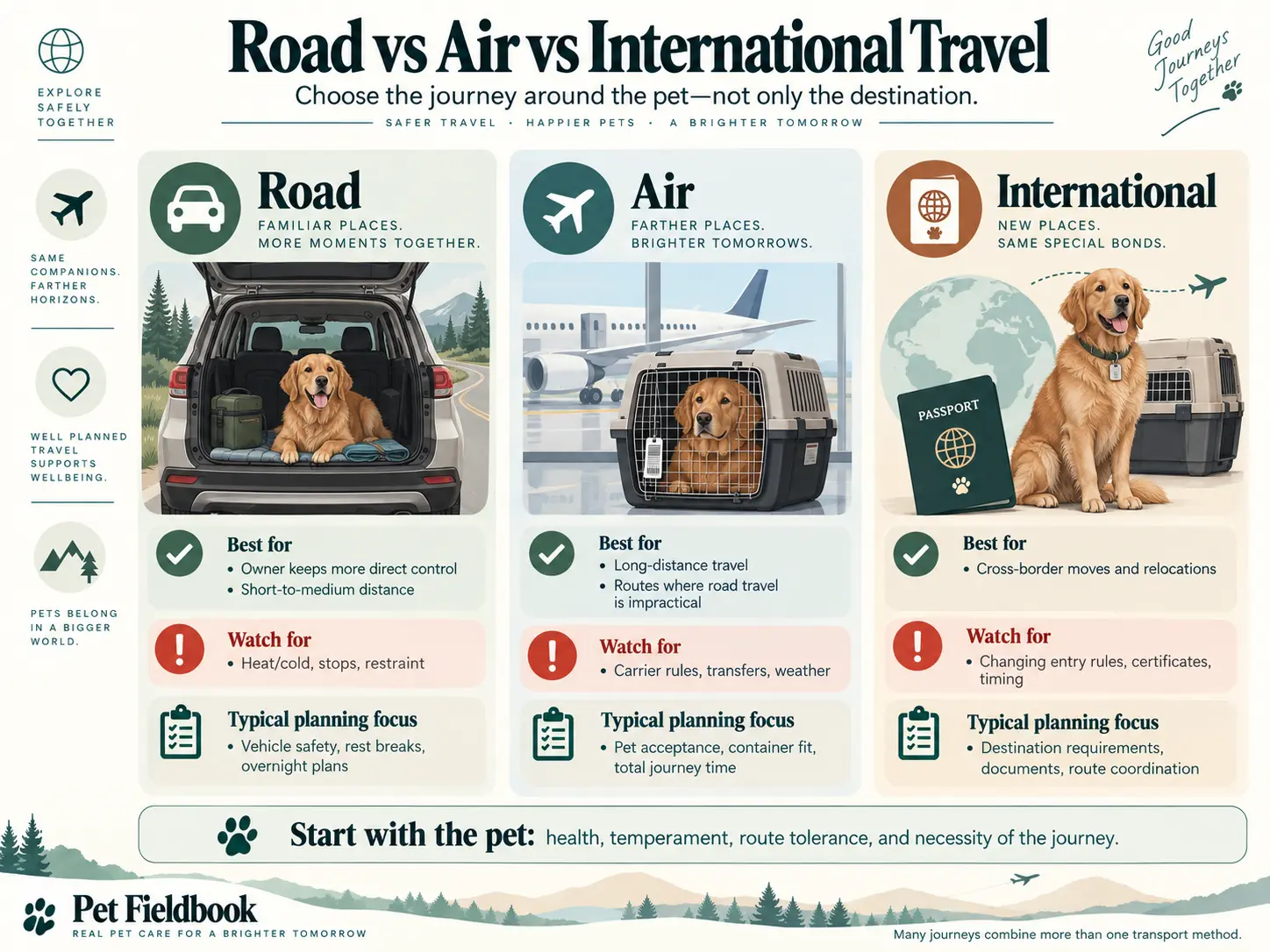
Once travel is appropriate, decide how the pet will move. Road and air travel create very different environments. International travel adds regulatory requirements on top of whichever transport method you use.
| Journey | What you control | What needs early attention |
|---|---|---|
| Road | Stops, route, timing, access to the animal, much of the temperature management | Safe restraint, vehicle familiarity, rest breaks, overnight plans and heat/cold |
| Air | Choice of carrier/route and much of the preparation, but less control once the pet is accepted for transport | Operating-airline policy, pet booking, aircraft/route constraints, container, weather and transfers |
| International | Planning sequence and document preparation | Destination and transit requirements, veterinary steps, certificates, permits and timing |
Road travel
Driving gives the owner more direct control over the route and opportunities to stop, but that does not make a long road journey automatically easy. Restraint, temperature, hydration, toilet breaks, motion sickness, overnight accommodation and safe loading/unloading all need thought. The CDC recommends building familiarity with shorter drives before longer road trips and securing the animal or its crate rather than allowing a pet to move freely around the vehicle.[1]
For cats, secure carrier travel is particularly important. The Feline Veterinary Medical Association recommends appropriate carrier selection, carrier acclimation and secure placement in the vehicle as part of reducing distress and improving safety.[7]
Many practical problems happen while moving between secure spaces rather than during the drive itself. Before opening a vehicle door, carrier or crate, know how the animal will remain restrained. Hotel car parks, fuel stops, airport kerbs and unfamiliar arrival areas deserve the same escape-prevention planning as the main journey.
Explore the Pet Fieldbook road-travel guides.
Air travel
Air travel may reduce the time spent moving over very long distances, but it introduces airline rules, airport procedures and periods when the owner has less direct control. Cabin eligibility is not universal. The FAA notes that airlines decide whether pets are accepted in the passenger cabin and can impose their own restrictions, while IATA advises travellers to check the specific procedures that apply to the airline and journey.[6][2]
Do not reduce the decision to “cabin good, cargo bad” or the reverse. Airlines may describe and handle pet transport in different ways. Depending on the carrier and route, a pet may travel in the passenger cabin, as checked or accompanied baggage in the aircraft hold where that service is offered, or through an air-cargo/air-freight process. Not every airline offers every option, and the booking, handover, collection point and documentation workflow can differ between them.
The practical question is whether the transport arrangement actually available for your route is appropriate for the individual animal. Consider the pet’s size and health, the container, total journey duration, transfers, climate, airline restrictions and how the animal tolerates confinement.
Explore air travel, including dedicated guides to flying with a dog and flying with a cat.
International travel
“International” is not a transport method; it is a regulatory layer. You might drive across a border, take a short cabin flight or use a multi-sector air route. In every case, entry and transit rules can add identification, vaccination, testing, treatment, certification, permit or inspection requirements.
USDA APHIS, for example, tells US-based travellers that each destination country sets its own health requirements and that those requirements can change frequently. It recommends starting early and building a schedule around required vaccinations, tests or treatments.[5] The same planning principle applies globally: identify the competent authority for your destination and verify the current process rather than relying on an old checklist.
Start with International Pet Travel and then use the relevant country guide.
3. Start planning earlier than the booking
Pet travel often works backward from fixed dates. A flight may be bookable today, while a vaccination, laboratory test, permit or veterinary certificate may have its own validity window. That means booking first and researching later can leave you with an itinerary that the animal cannot legally or practically follow.
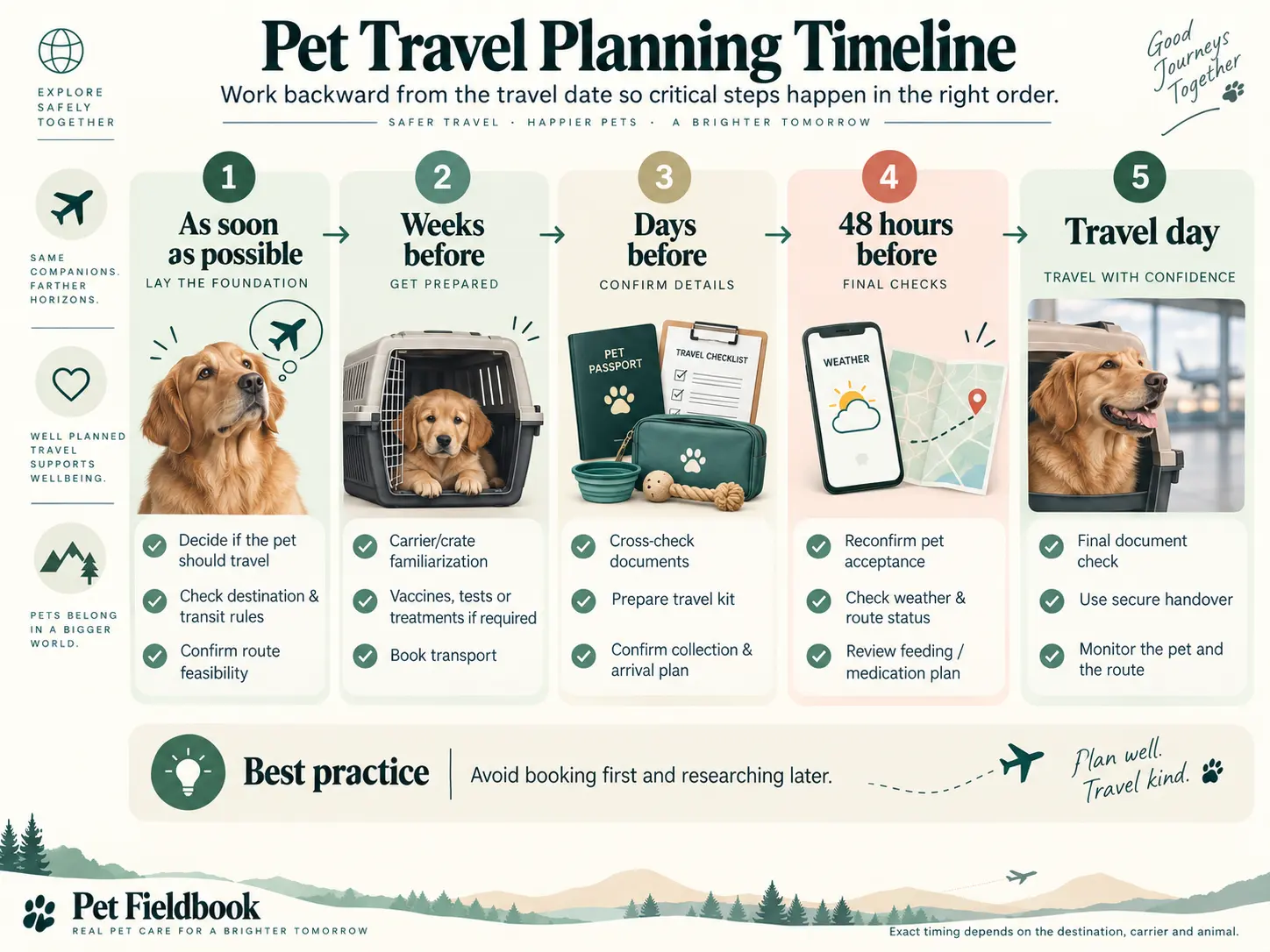
Build the journey in four layers:
- The pet: fitness, temperament, medication needs and experience.
- The legal route: destination requirements plus any transit-country rules.
- The transport route: airline or road plan, connections, weather and acceptance conditions.
- The preparation route: carrier/crate familiarity, equipment, veterinary appointments and final documents.
For international travel, some requirements can take weeks or months to complete. IATA’s passenger guidance notes that international documents can require substantial lead time, while USDA APHIS recommends determining the destination country’s requirements as soon as the trip is being planned.[2][5]
Before locking in an inflexible itinerary, confirm that the route is workable for the pet as well as the passenger. Check animal acceptance on the intended sectors, connection handling, destination/transit rules and any timing constraints that could make the booking unusable for the pet even though the passenger ticket is valid.
A common planning mistake is to treat the travel date as the start of the process. For regulated journeys, the better approach is to create a backwards timeline: arrival date → permitted entry window → certificate timing → tests/treatments → vaccinations/identification → booking and equipment preparation.
4. Prepare your pet before travel day
A carrier, crate or vehicle should not ideally become familiar for the first time on the morning of departure. IATA recommends introducing dogs and cats to their travel container well before air travel, and feline veterinary guidance likewise emphasizes acclimating cats to carriers.[2][7]
Build familiarity gradually
Keep preparation appropriate to the animal rather than forcing a rigid programme. Useful steps may include leaving the carrier available in a familiar space, allowing voluntary exploration, using bedding that the pet already knows, feeding or rewarding calmly around the carrier, and gradually increasing the duration of comfortable confinement. For an animal that will travel in a closed crate or carrier, familiarity with the closed and secured setup matters too; simply sleeping in an open crate does not reproduce the travel condition.
For road travel, the CDC recommends beginning with shorter drives and gradually increasing time in the vehicle.[1] The point is not to guarantee that the pet will love travel; it is to reduce the number of completely unfamiliar experiences arriving all at once.
Keep identification current
Good identification matters even when a microchip is not a legal travel requirement. The CDC recommends microchipping pets and keeping contact information current before travel.[1] Depending on the destination, a particular microchip standard or sequencing requirement may also form part of the legal entry process, which is why international travellers should check the destination authority rather than assuming every microchip is interchangeable.
Handle anxiety and motion sickness individually
Some animals become anxious or nauseated in vehicles or carriers. These are health and welfare questions, not problems to solve by casually trying a sedative on departure day. WSAVA/WVA transport guidance specifically includes emotional health, motion sickness and individualized anxiety management in fitness-to-travel assessment.[4]
IATA advises against sedation or tranquilization specifically for dogs and cats transported by air because of potential adverse effects; if medication is medically justified, it should be under veterinary direction, and the airline may need to be informed.[2] Do not treat “sedation” and a veterinarian-designed anxiety plan as interchangeable concepts. Discuss the individual animal and journey with your veterinarian.
5. Choose equipment for the actual journey
The words pet carrier and travel crate cover very different products. The right equipment depends on the animal, travel mode, route and the rules that apply.
Fit matters more than a marketing label
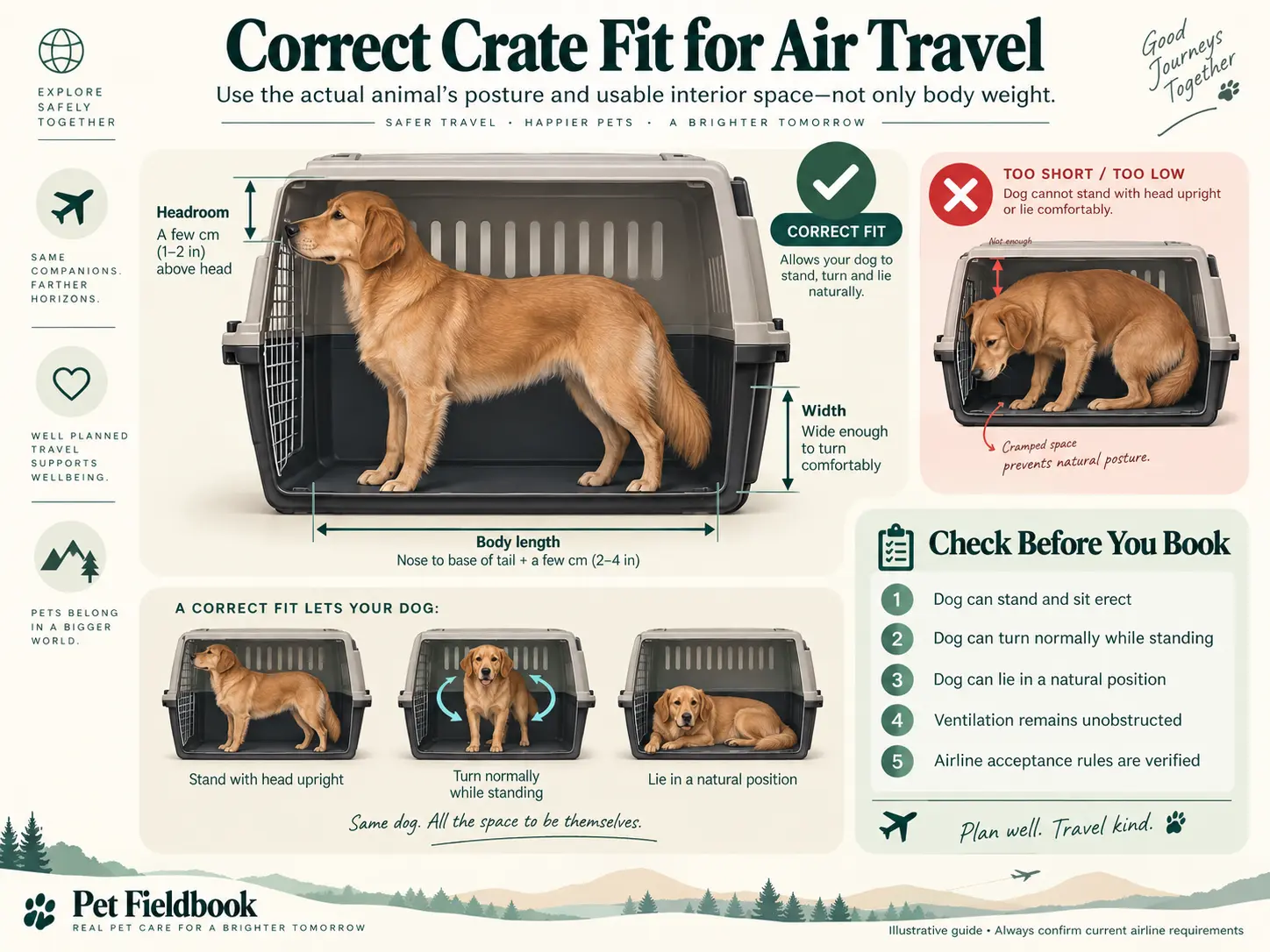
For air transport, IATA container guidance requires enough space for the animal to stand and sit erect, turn around and lie in a natural position, together with appropriate construction and ventilation.[3] Airlines may impose additional requirements.
One terminology point is worth getting right: there is no commercial crate brand or model that IATA itself “approves.” IATA states that it develops standards and does not certify, approve, endorse or sell particular pet containers.[3] A more accurate description is a container that meets the applicable IATA requirements and the operating airline’s requirements.
Meeting a published container standard also does not replace carrier acceptance. Airlines can apply route- or service-specific requirements covering construction, fasteners, doors, ventilation, water equipment, wheels or other details. Treat the operating carrier’s current acceptance instructions as part of the equipment check rather than assuming a product label guarantees acceptance.
A crate can look acceptable on a product page and still be a poor fit for the actual animal. Check real posture—not only weight. Observe the pet standing, sitting, turning and lying down, and look at usable interior space, ventilation, door security and how bedding affects that space.
Use the dedicated dog travel-crate guide or cat travel-carrier guide for detailed fitting and construction guidance.
Secure road-travel equipment
A carrier or crate should not become a loose object during sudden braking. The CDC advises securing crates so they cannot slide or shift and restraining pets rather than allowing them to roam around the vehicle.[1] Cat-specific veterinary guidance goes further on carrier placement and should be followed when planning cat road travel.[7]
Pack a practical travel kit
The exact kit will vary, but useful categories include identification and current contact details; required veterinary and travel documents; food and water appropriate to the journey; bowls or approved water equipment; prescribed medication with instructions; leash, harness and backup restraint where appropriate; absorbent bedding or cleaning supplies; waste bags or litter arrangements; a small first-aid kit; and destination veterinary/emergency contact information.
The CDC recommends keeping basic first-aid supplies and accessible veterinary/emergency contacts when travelling.[1]
6. Treat rules and documents as a separate workstream
It helps to separate legal permission from transport permission. A pet may satisfy the destination country’s import rules but still fail an airline’s acceptance requirements. Or an airline may accept the animal while the owner has not completed the destination’s entry process.
For international travel, identify the competent authority
Depending on the country, the relevant authority may be an agriculture department, veterinary service, food safety authority, biosecurity agency or another government body. That authority—not a forum, old blog post or generic pet-travel checklist—should be the final reference for current import requirements.
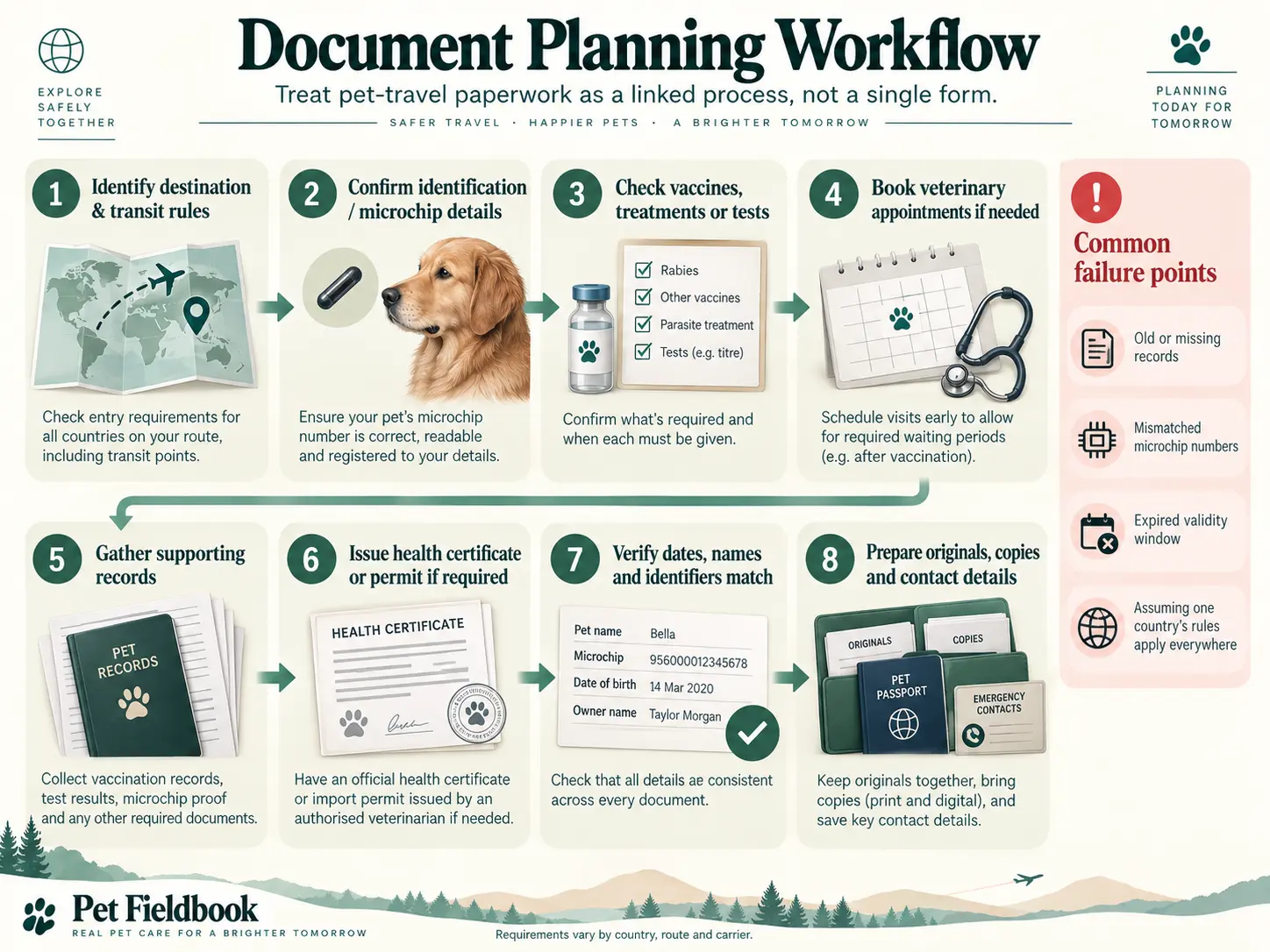
Possible requirements include a microchip, vaccinations, laboratory tests, parasite treatments, a veterinary health certificate, an import permit, advance notification, quarantine or arrival inspection. They are possibilities, not a universal checklist. USDA APHIS illustrates this clearly by stating that each destination country has its own health requirements and that the requirements can change frequently.[5]
Certificate timing is not universal
A common mistake is to memorize a single number such as “the health certificate must be issued within 10 days.” Certificate validity depends on the destination, the document type and sometimes the carrier. USDA APHIS notes that travellers may have only a limited period after a certificate is issued or endorsed and tells owners to follow the destination country’s required timeframe.[5]
This is why Pet Fieldbook country pages will show a visible Last verified date and link to the official authority rather than turning one jurisdiction’s rule into global advice.
Pet-travel paperwork is a chain of linked records. Names, microchip numbers, vaccination dates, laboratory results, certificate details and permit information should be checked against one another before the final travel day. A document can be genuine and still create a problem if a key identifier or date does not match the rest of the file.
For air travel, verify the operating carrier
Airline policy is also separate from government entry permission. The FAA explicitly notes that airlines set their own in-cabin pet policies, and IATA advises travellers to check the airline’s specific procedures.[6][2]
On codeshare itineraries, the airline name on the booking may not be the airline physically operating every flight. Confirm which carrier operates each sector, which carrier’s animal-transport rules apply, and that the animal itself is accepted on the intended date and flight. IATA currently advises travellers to contact the airline to confirm pet acceptance and to reconfirm before departure.[2] A passenger ticket by itself is not evidence that the pet booking is complete.
Use Pet Fieldbook’s airline policy guides as a planning aid, but reconfirm the policy directly with the operating carrier before travel.
7. Plan the whole journey—not just the main segment
A scheduled eight-hour flight is not an eight-hour pet journey. A six-hour drive may become much longer once rest stops and traffic are included. The animal experiences everything from departure at home to the time it is released, hydrated, toileted and settled at the destination.
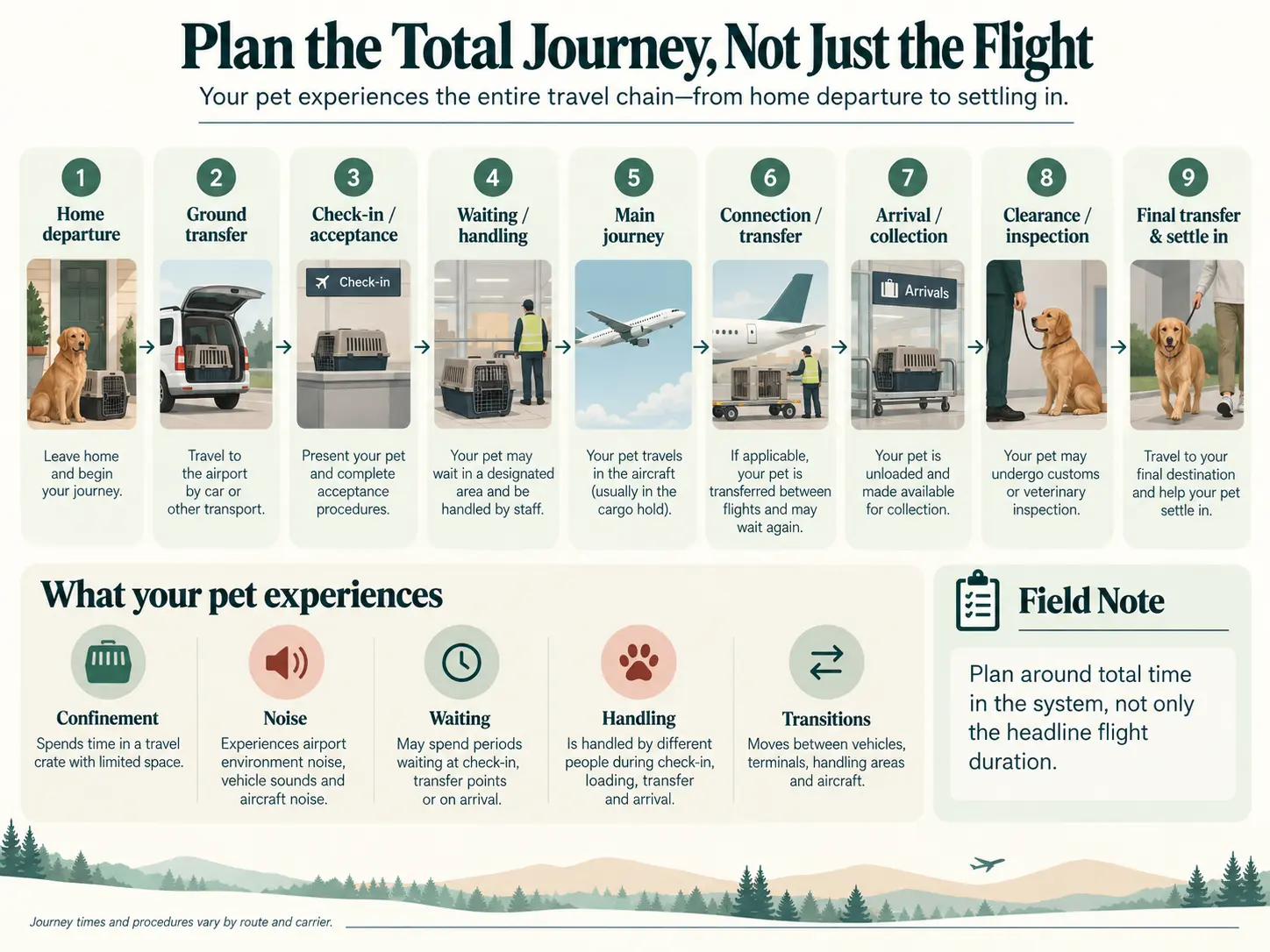
Map the journey in sequence:
- Leaving home and reaching the terminal, border or first stop.
- Check-in or animal acceptance.
- Waiting before departure.
- The main transport segment.
- Connections, border formalities or transfers.
- Collection or release.
- Customs, inspection or document clearance where applicable.
- Onward travel to the final destination.
- The first hours of recovery and settling in.
Owners naturally focus on scheduled flight time, but practical planning should focus on total time in the travel system. Check-in, acceptance, loading, connections, unloading, clearance and ground transfers can materially extend the animal’s day. Use the total journey—not the headline flight duration—when thinking about crate familiarity, hydration, toileting, route choice and whether a connection is sensible.
Connections deserve their own plan
IATA specifically tells travellers to consider intermediate stations and participating airlines when arranging pet transport.[2] Ask what happens to the animal during the connection, who is responsible, whether documents or additional acceptance procedures apply, and what happens if the inbound flight is late.
Do not judge a connection only by the passenger minimum-connection time. A live animal may have a different transfer process, facility, handling sequence or station capability. For air-freight journeys, IATA also tells travellers to check that the destination air-freight facility is open so the animal can be claimed by the consignee.[2]
For cargo or regulated arrivals, check the operating hours of cargo terminals, animal-handling facilities, quarantine/inspection offices and any agents needed for release. A flight that arrives successfully can still create an avoidable wait if the office needed for collection or clearance is closed.
Weather can change the plan
Temperature matters in vehicles, terminals and animal-handling environments. Never leave a pet unattended in a parked vehicle where dangerous heat or cold can develop; the CDC warns that parked-car temperatures can quickly become fatal in hot weather and dangerously cold in winter.[1]
Airlines can also impose weather-related restrictions or operational limits. Treat these as route-specific and current: verify the airline rather than relying on a general article.
Build a contingency plan
WSAVA/WVA transport guidance specifically asks whether contingency plans are in place for problems during transport.[4] Think through what happens if the flight is cancelled or the road closes; where the animal can safely wait; whether you have extra food, water or medication; who can help if you are separated from the pet; what to do if documents are questioned; and where suitable veterinary care is available at the destination.
8. Keep journey day simple and predictable
Journey day is usually a poor time to experiment. Use equipment the pet already knows where possible, keep important documents accessible and allow enough time that a minor delay does not immediately become a crisis.
Food and water: avoid one universal rule
Feeding advice depends on the transport method and the individual animal. This is a good example of why generic “pet travel tips” can mislead: current CDC road guidance and IATA air guidance do not give the same pre-travel feeding interval.[1][2] Follow the guidance appropriate to the journey and discuss feeding with your veterinarian if the animal has a medical condition, is very young, has a history of vomiting or has special dietary needs.
Hydration should remain part of the plan throughout the journey. The practical method will differ between a road trip, a pet travelling in cabin and an animal transported under an airline’s live-animal procedures.
Give dogs appropriate toilet opportunities
For road travel, plan regular safe stops for toileting, movement and water. At airports, the available opportunity depends on the pet, terminal and airline procedure. Avoid putting yourself in a situation where reopening a secure travel container conflicts with airline rules or creates an escape risk.
If a carrier or crate must be opened during the journey, first identify a genuinely secure environment and use an appropriate secondary restraint where practical. Never assume an unfamiliar terminal, car park, roadside stop or hotel corridor is secure simply because the pet is usually reliable at home.
Do a final document and equipment check
- Is the pet behaving normally?
- Is identification current?
- Is the carrier/crate secure and correctly assembled?
- Are required originals and copies accessible?
- Is the pet booking confirmed?
- Have weather or operational conditions changed?
- Do you have the contact details needed if something goes wrong?
9. Arrival is part of the travel plan
Reaching the destination does not mean the journey is finished. Depending on the route, the pet may still need collection from a separate facility, document review, customs or animal-health clearance and onward ground transport. Plan who is responsible for each step and where the pet can be safely released.
Once safely released, give the pet an appropriate opportunity to drink, toilet and settle in a secure environment. Keep the first period predictable and avoid overwhelming an already tired or stressed animal with unnecessary activity.
Observe appetite, breathing, movement, toileting, alertness and behaviour. WSAVA/WVA recommends post-travel assessment for signs of stress or health problems and veterinary follow-up when concerns arise.[4] The CDC similarly recommends monitoring physical and behavioural changes while away and contacting a veterinarian if you have concerns.[1]
Do not use an online guide to diagnose an unwell pet after travel. Breathing difficulty, collapse, severe weakness, repeated vomiting, suspected heat illness, injury or any other urgent change warrants prompt professional veterinary assessment.
10. Common pet-travel mistakes
- Booking before checking whether the pet is suitable for the journey.
- Starting international paperwork too late. A requirement may depend on an earlier step or a particular timing window.
- Assuming one airline’s rules apply to another. Pet acceptance is carrier- and route-specific.
- Buying equipment by weight alone. Actual posture, usable interior space and construction matter.
- Introducing the crate or carrier on departure day.
- Using “IATA approved” as if it were a product certification. IATA publishes container standards; it does not approve individual commercial products.[3]
- Planning the flight but not the connection.
- Planning airport-to-airport instead of door-to-door.
- Using old screenshots, forum posts or generic blogs for current country requirements.
- Assuming the passenger booking automatically confirms the pet.
- Ignoring cargo-terminal, inspection or collection-office hours. Arrival time and release time are not always the same thing.
- Failing to cross-check identifiers across the paperwork. A microchip number or date mismatch can become an operational problem even when the underlying documents are genuine.
- Trying an unfamiliar medication without veterinary direction.
- Ignoring arrival. The pet still needs clearance where applicable, safe onward transport, recovery time and monitoring.
11. When professional help can make sense
Many straightforward journeys can be arranged directly by informed owners. Professional help becomes more useful as complexity increases.
Speak with a veterinarian when:
- you are unsure whether the animal is fit to travel;
- the pet has a chronic condition, respiratory issue, significant anxiety or motion sickness;
- medication may be needed;
- the destination requires veterinary procedures or certificates; or
- the animal seems unwell before or after travel.
Consider an experienced pet-transport professional when:
- the journey involves several airlines or complex transfers;
- the import process is difficult to coordinate;
- the animal is travelling separately from the owner;
- you are unsure how live-animal acceptance works on the route; or
- the airline requires the animal to be handled through a shipper or specialized cargo process.
IATA notes that some airlines will not accept animals unless they are handled by a shipper, while other journeys can be arranged directly by the owner.[2] The role of a professional should be to make the process clearer and correctly coordinated—not to replace the owner’s responsibility to understand the animal’s welfare needs or to replace official government and airline requirements.
12. A practical pet-travel checklist
Use this as a final overview, then open the dedicated Pet Travel Checklist for a printable version.
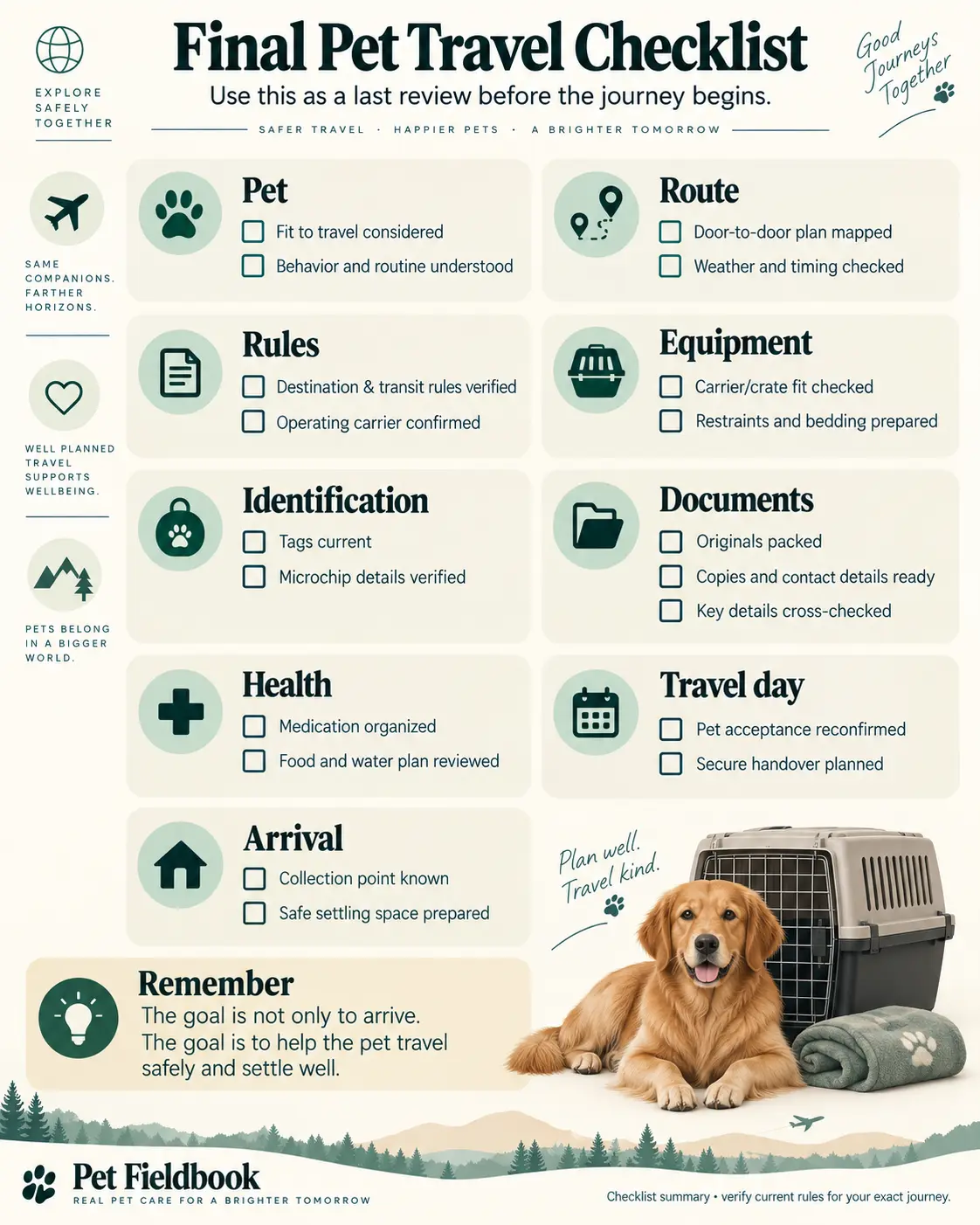
- Pet: fitness to travel considered; veterinary advice obtained where appropriate.
- Route: total journey mapped from home to final destination.
- Rules: destination and transit requirements checked with competent authorities.
- Transport: operating airline or road plan confirmed; pet acceptance recorded separately from the passenger booking.
- Handover & collection: check-in/acceptance location, collection point and relevant facility/office hours confirmed.
- Equipment: crate, carrier or restraint appropriate, familiar to the pet and checked against the carrier’s current acceptance rules.
- Identification: tags/microchip details current; legal identification requirements checked.
- Documents: required originals and copies prepared; key identifiers and dates cross-checked across records.
- Health: medication, food and veterinary instructions organized.
- Weather: conditions and carrier restrictions checked close to departure.
- Contingency: plan for delays, missed connections or document problems.
- Arrival: safe collection/onward transport, water, toileting and a settling space planned.
The best pet-travel plan is not the one with the fewest steps. It is the one in which each step has been considered from the animal’s point of view.
Sources and further reading
- Centers for Disease Control and Prevention (CDC). “Pet Travel Safety.” Updated April 15, 2026. Official source.
- International Air Transport Association (IATA). “Traveler’s Pet Corner,” current pet-transport guidance, and passenger guidance for dogs and cats travelling in cabin. Official source.
- International Air Transport Association (IATA). Live Animals Regulations, Container Requirement 1, Edition 52 (January 2026; current edition verified September 19, 2026). IATA states that it publishes container standards but does not certify or approve commercial pet-container brands/models. Official source.
- World Small Animal Veterinary Association (WSAVA) & World Veterinary Association (WVA). “Dog and Cat Welfare During Transport.” 2025. Professional guidance.
- USDA Animal and Plant Health Inspection Service (APHIS). “Pet Travel Process Overview.” Last modified June 18, 2026. Used as a jurisdiction-specific example of international planning and timing—not as a global rule. Official source.
- U.S. Federal Aviation Administration (FAA). “Flying with Pets.” Last updated December 4, 2025. Used for the principle that airlines establish their own in-cabin pet policies. Official source.
- Feline Veterinary Medical Association (FelineVMA). “2025 Transportation of Cats in Motor Vehicles Position Statement.” Professional guidance.
This article was researched and its cited source set re-verified against current official transport, government and veterinary/professional guidance on September 19, 2026. Evergreen planning guidance is separated from airline- and country-specific requirements that can change. Practical observations are labelled as Field Notes rather than presented as regulation or veterinary science. Health-related information is general educational guidance based on the cited professional sources and is not individualized veterinary advice.