Pet air travel is confusing partly because several different ideas are often compressed into one word. A traveller hears that a dog is “going in the hold” and assumes that means cargo. Another airline calls a similar-looking journey “checked baggage.” A cargo booking may place the animal on the very same passenger aircraft as its owner. A small pet may physically fit in a cabin carrier but still be required to enter a country through a cargo process.
The clearest way to understand the system is to separate where the animal is physically carried from how the animal is booked, accepted, documented, transferred and released.
For most ordinary pet journeys, that creates three operational pathways: in-cabin travel, passenger-associated checked or accompanied baggage, and manifest air cargo / freight. The exact names vary by airline and country, but the workflows are meaningfully different.
This guide explains those differences without hard-coding airline fees, weight thresholds or route exceptions that can change quickly. For current carrier-specific limits, use the Airline Pet Policies Hub and the relevant airline page. For the wider planning framework, start with The Complete Guide to Travelling With Pets.
Quick answer: “Cabin” and “hold” describe location. “Checked/accompanied baggage” and “manifest cargo” describe different booking and handling systems. A pet below the passenger cabin may be checked baggage or cargo. The difference affects who books the animal, where you hand it over, what documents travel with it, how connections work, and where you collect it at the destination.
Key takeaways
- A pet in the hold is not automatically cargo. Passenger-associated baggage and manifest cargo can use similar aircraft compartments while remaining different transport products.
- A passenger ticket does not confirm the pet. The animal needs its own reservation, registration or cargo booking, depending on the pathway.
- The actual operating carrier matters. Codeshares, aircraft changes and partner airlines can change whether a pet is accepted.
- There is no universal cabin/hold/cargo weight line. Airlines and aircraft apply their own limits, and governments can impose a different transport method.
- Cabin carriers and hold/cargo crates solve different problems. Container fit and construction must match the actual pathway.
- Airline permission and government entry permission are separate. Either can prevent the journey even when the other is satisfied.
- Connections are live-animal transfers, not just passenger layovers. Station capability, handlers, operating carriers and transit rules all matter.
- Arrival can be completely different by mode. A cargo pet may need cargo-terminal release, customs or veterinary clearance before collection.
- Plan door to door. Acceptance, waiting, transfers, clearance and collection are part of the pet’s journey just as much as the flight.
1. Start with the language: cabin, hold, baggage and cargo are not synonyms
Airline pet terminology is inconsistent. Some carriers use “checked baggage,” others use “accompanied baggage,” “AVIH” or a local equivalent. Cargo departments may use “manifest cargo,” “air freight” or “live-animal shipment.” The aircraft compartment itself may be called the hold, baggage compartment or cargo compartment.
For practical planning, separate the terms into two layers:
| Layer | What it describes | Examples |
|---|---|---|
| Physical location | Where the animal is carried on the aircraft | Passenger cabin; lower-deck/hold compartment |
| Commercial / handling pathway | How the animal is booked, accepted, documented, transferred and released | Passenger-associated baggage; manifest cargo / freight |
This distinction matters because two animals can be carried in a similar live-animal-capable aircraft compartment but enter and leave the airline’s system through different channels. IATA publishes separate live-animal acceptance material for in-cabin, excess-baggage and cargo processes, reflecting that operational distinction.[1]
When an airline says a pet “travels in the hold,” ask what product that means on your itinerary. Is the animal linked to the passenger as checked/accompanied baggage, or booked as a separate cargo shipment? The answer changes the handover point, documents, transfer process and collection procedure.
2. The three main pet-air-travel pathways
The three pathways are easiest to compare as complete journeys rather than as aircraft positions.
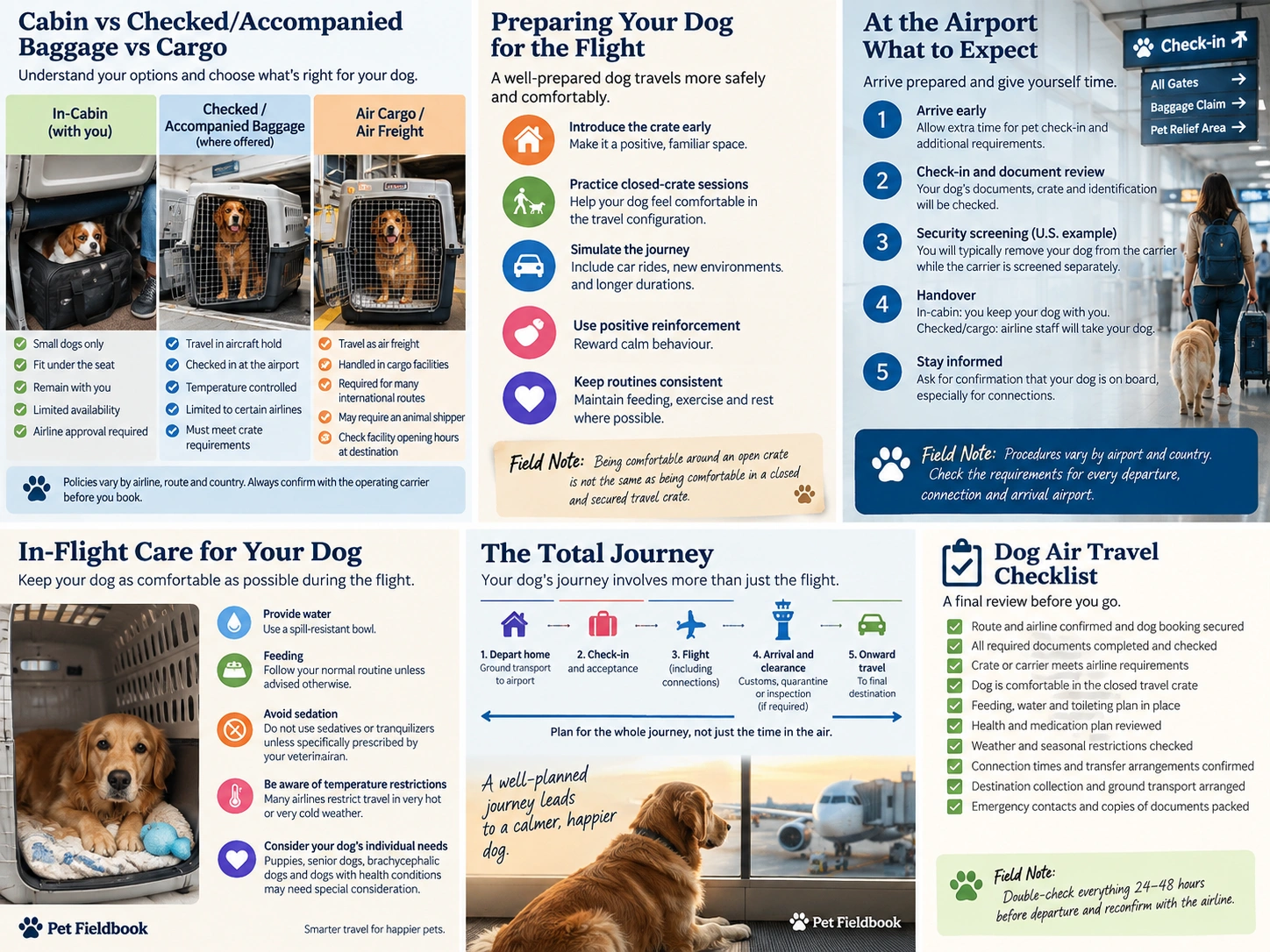
The important differences are booking, handover, responsibility and release—not simply whether the animal is above or below the cabin floor.
Terminology varies. Always confirm the operating carrier’s own name for the service and the exact acceptance procedure for the booked route.
| Question | In cabin | Checked / accompanied baggage | Manifest cargo |
|---|---|---|---|
| Is the pet linked to the passenger journey? | Yes | Yes | Not necessarily |
| Typical booking channel | Passenger airline reservation / pet registration | Passenger airline reservation / pet registration | Cargo department, freight booking or approved shipper |
| Typical acceptance point | Passenger terminal check-in | Passenger terminal or airline-designated baggage acceptance | Cargo terminal / live-animal acceptance facility |
| Where the pet travels | Passenger cabin | Suitable aircraft hold | Suitable aircraft hold or cargo aircraft, depending on routing |
| Shipment paperwork | Passenger-pet records plus required health/entry documents | Passenger-pet records plus required health/entry documents | Cargo shipment paperwork, including an air waybill, plus required live-animal and government documents |
| Typical collection | Pet stays with passenger | Airline/airport baggage or designated pet-return procedure | Cargo terminal / animal reception facility after release and required clearance |
3. How in-cabin pet travel works
In-cabin travel keeps the animal physically with the passenger, but it is still an airline-controlled transport arrangement. Airlines decide whether ordinary pets are accepted in the cabin, which routes and aircraft are eligible, how many pets can be accepted, what carrier is permitted and where that carrier must be stowed. IATA tells travellers to check the specific airline procedure and confirm pet acceptance in advance.[2]
Who handles the animal?
The passenger generally retains custody of the carrier through the terminal, security process, boarding, flight and connection. That does not mean the traveller is free to handle the pet however they wish. Airport-security procedures, airline rules and destination requirements can determine when the animal may leave the carrier, if at all.
How is it booked?
Cabin pet space is usually limited and must be registered separately from the passenger seat. A valid passenger itinerary is therefore only the first layer. The airline still needs to confirm the animal on the relevant sector or sectors. KLM, for example, currently requires advance pet reservation and notes that aircraft and destination can affect availability.[5]
What happens at check-in?
The passenger normally checks in through the passenger terminal. Staff may review the reservation, carrier, animal, required documents and route conditions before accepting the pet. Procedures vary, and some airports or destinations add their own inspection steps.
What container is used?
The carrier has to work both for the animal and for the permitted cabin stowage space. That creates a two-part fit problem: the pet must be appropriately contained inside the carrier, and the carrier must fit the airline’s permitted location without unsafe compression or blocked ventilation. Use How to Choose a Pet Travel Carrier or Crate for the detailed fit and construction framework.
What happens on arrival?
The carrier remains with the passenger, but border entry may still require veterinary inspection, customs/biosecurity procedures or presentation of documents. “The pet stayed with me” does not bypass government entry rules.
4. How checked or accompanied-baggage pet travel works
In this pathway, the animal travels in a suitable part of the aircraft hold while remaining operationally linked to a passenger travelling on the flight. Airlines may call the product checked baggage, accompanied baggage, excess baggage or another term.
The passenger normally books or registers the pet through the passenger airline rather than creating a separate freight shipment. The animal is then handed over under the airline’s passenger-pet acceptance process. Current Air India material is a useful example of an airline that explicitly distinguishes cabin, checked-baggage and cargo pathways rather than treating everything below the cabin as one category.[4]
Who handles the animal after handover?
Once accepted, the animal enters the airline/airport ground-handling process. It may pass through live-animal staging and loading procedures rather than following an ordinary suitcase in every operational detail. The aircraft must have a compartment suitable for the live-animal movement planned on that flight.
Does the pet travel “with the baggage”?
The label can be misleading. “Checked baggage” describes the commercial relationship to the passenger more than it describes the animal being treated like an ordinary suitcase. Live animals require specific acceptance and handling considerations. The pet may be loaded in a temperature- and ventilation-controlled compartment intended to support live-animal carriage, subject to the aircraft and airline’s procedures.
What container is used?
A rigid live-animal transport container is commonly required for hold travel. The exact construction standard depends on the animal and the airline. IATA publishes live-animal container requirements used across the industry, but it does not certify retail products as “IATA approved.”[1]
How is the pet collected?
The return point varies by airport. The animal may be delivered through a designated baggage or oversize area, a separate live-animal point, or another local procedure after any required inspection. Ask the operating carrier for the exact collection location before departure rather than assuming the pet will appear beside ordinary luggage.
5. How manifest air cargo works
Manifest cargo is a freight movement. The pet is booked as a live-animal shipment rather than as an item attached to the passenger’s baggage allowance. This remains true even if the owner happens to be on the same flight.
IATA’s cargo guidance describes live-animal shipments as cargo movements with their own booking, acceptance checks and shipment documentation, including an air waybill.[3]
The booking usually starts outside the passenger reservation
The booking may be made through the airline’s cargo division, a freight forwarder or a specialist pet shipper, depending on the airline and route. Some airlines allow private owners to arrange cargo directly; others require an approved agent or shipper. IATA advises travellers to confirm the airline’s process because those arrangements are not universal.[2]
Acceptance happens through the cargo system
Instead of simply arriving at the passenger check-in desk, the shipper or owner may report to a cargo terminal or live-animal acceptance facility within a specified window. Staff can check the booking, routing, container, animal, required labels and documents before the shipment is accepted.
The animal may still fly on a passenger aircraft
“Cargo” does not mean “cargo-only plane.” Airlines carry freight in the lower deck of many passenger aircraft, so a manifest-cargo pet can sometimes travel on a passenger flight. The operational distinction is the cargo booking and handling chain, not necessarily the aircraft type.
For the full freight workflow—from cargo reservation and air waybill through terminal acceptance, customs or veterinary clearance and final release—see How Pet Cargo Works.
Exact facilities and steps vary, but the cargo pathway usually includes more formal hand-offs and shipment release than passenger-associated pet travel.
Collection is a freight-release process
The receiving person may need shipment references, identity documents, cargo-release paperwork and evidence of government clearance. IATA specifically advises travellers using air freight to check that the destination freight facility will be open when the pet is due to be claimed.[2]
6. The same aircraft hold can support two different systems
This is the point that resolves much of the terminology confusion.
A pet travelling as checked/accompanied baggage and a pet travelling as manifest cargo may both be placed in a suitable lower-deck aircraft compartment. Their physical environment can therefore overlap. Yet the commercial and operational chain can remain completely different.
| Stage | Passenger-associated hold pet | Manifest-cargo pet |
|---|---|---|
| Reservation | Linked to passenger booking / pet registration | Separate cargo shipment booking |
| Handover | Passenger-side acceptance procedure | Cargo terminal / live-animal acceptance |
| Shipment reference | Passenger reservation and pet-service record | Air waybill / cargo shipment reference |
| Transfer | Airline passenger-pet transfer rules | Cargo-routing and live-animal station handling |
| Destination release | Airport/airline pet-return procedure | Cargo release, potentially after customs/veterinary clearance |
That is why “Will my pet be in the hold?” is not enough to understand the journey. You also need to know which transport product is being sold.
7. A passenger ticket is not a pet booking
This deserves its own section because it is one of the easiest planning mistakes to make.
A passenger can hold a valid ticket while the airline has no confirmed capacity, compatible aircraft or permitted pet product for the animal. Current airline guidance commonly requires advance pet registration or confirmation; KLM, for example, tells passengers to reserve a pet in advance and notes that aircraft type and destination can affect whether the booking is possible.[5]
For cargo, the separation is even clearer: the passenger reservation and cargo shipment are different bookings. The cargo movement may have its own routing, cut-off time, acceptance point and shipment reference.
Confirm the animal itself on every relevant flight sector. Record the booking or shipment reference, the transport mode, the actual operating carrier, the required acceptance location and time, and what happens if the aircraft or itinerary changes.
Codeshares create an extra check
The airline shown most prominently on the passenger ticket can be the marketing carrier rather than the airline physically operating the flight. Pet rules may depend on the operating carrier and aircraft. Always identify the actual operator for each sector before assuming that a policy applies.
8. Size, weight and aircraft availability do not create one universal ladder
It is tempting to imagine a simple rule: small pets go in cabin, medium pets go as checked baggage and large pets go as cargo. Real airline operations are more complicated.
Airlines can apply combined pet-and-carrier weight limits, maximum carrier dimensions, crate-size limits, species or breed restrictions, route restrictions and aircraft-specific constraints. A destination can also require cargo entry even when the animal would otherwise meet an airline’s cabin limit.
A better decision sequence is:
- Can the destination and any transit country legally receive the animal through the proposed pathway?
- Does the actual operating carrier offer that pathway on the exact route?
- Can the individual pet fit appropriately in the required carrier or crate?
- Can the aircraft and ground stations physically and operationally handle that container?
- Is live-animal space actually confirmed on every relevant sector?
Why an aircraft can change the answer
Not every hold on every aircraft is configured for live animals. Compartment environment, ventilation, temperature management, door dimensions, loading constraints and airline procedures can all affect acceptance. That is why an airline can accept a pet on one flight number or aircraft type but not on another, even on the same city pair.
Keep the changing numerical rules on the airline pages. The evergreen lesson is that route + operating carrier + aircraft + pet + container must work together.
9. Carrier versus crate: the equipment changes with the pathway
Container choice follows the transport mode. An under-seat cabin carrier, a rigid hold/cargo container and a road-travel restraint are not interchangeable categories.
Cabin carriers
Cabin carriers must work inside the passenger seating environment. The animal needs appropriate usable space and ventilation while the carrier also fits the airline-designated stowage location. Soft-sided construction may provide useful flexibility on some airlines, but “flexible” does not mean the carrier can be crushed around the animal or have ventilation blocked.
Hold and cargo crates
Hold and manifest-cargo transport generally call for a more rigid live-animal container. Construction, ventilation, escape resistance, fasteners, doors, handles, absorbent material and food/water arrangements can all matter. IATA’s Live Animals Regulations provide industry standards for live-animal transport and container requirements.[1]
Do not describe a retail product as “IATA approved.” IATA publishes standards but does not certify retail pet-crate models. The operating airline still decides whether the actual container presented is acceptable.
Use the dedicated Carrier/Crate Guide to measure the animal, evaluate cabin fit and inspect rigid-container construction.
10. Airline acceptance and government permission are separate
Every pet-air-travel plan has at least two rule systems: the transport provider’s acceptance rules and the government rules that allow the animal to enter, transit or leave a jurisdiction.
Airline / cargo documents can include
- pet reservation or cargo booking details;
- airline forms or declarations;
- health or vaccination records required by the carrier;
- container or live-animal acceptance information; and
- for cargo, shipment documents such as the air waybill and shipper certification where applicable.[3]
Government documents can separately include
- microchip identification;
- vaccination records;
- laboratory tests;
- parasite treatments;
- import permits;
- official veterinary health certificates;
- export endorsements;
- quarantine bookings; and
- transit or arrival notifications.
These are examples, not a universal checklist. Requirements differ by country and route. Do not rely on a universal “health certificate within X days” rule. Build the timeline from the competent authority’s current instructions for the actual journey.
Use Pet Travel Documents & Health Certificates for the document workflow, and International Pet Travel when borders, transit countries or return requirements are involved.
A pet can be fully compliant with the destination’s import rules and still be refused by the airline because the booked aircraft, crate, weather, route or live-animal capacity does not work. The reverse is also possible: an airline may be willing to carry the pet while the government paperwork is incomplete.
11. Connections and transfers are where the modes diverge fastest
A connection is not just extra time between flights. For a pet it can create another handling event, another aircraft, another ground station, another operating carrier and sometimes another legal jurisdiction.
Cabin connection
The passenger normally keeps custody of the carrier, but airport security, terminal access and transit-country rules can still matter. If the itinerary changes carrier, confirm cabin-pet acceptance with every actual operating airline. Do not assume a pet accepted on the first sector is automatically accepted on the second.
Checked/accompanied-baggage connection
Do not assume the pet transfers like an ordinary checked bag. Airlines may restrict live-animal connections, limit transfers to particular stations, require specific minimum or maximum connection windows, or reject itineraries involving a partner carrier. KLM’s current pet-reservation guidance is one example of an airline applying connection-related restrictions to hold pets.[5]
Manifest-cargo connection
The itinerary must work as a cargo routing. Participating cargo stations and carriers need to be able to accept, transfer and onward-book the live animal. The shipment documentation and transit requirements need to work across the routing, and some airlines or countries may require a specialist shipper.
Compare itineraries by the animal’s total journey, not only scheduled flight time. Ground transport, acceptance cut-offs, pre-flight holding, transfer handling, unloading, border clearance and collection can add many hours beyond the published flight duration.
For the detailed transfer workflow, use Pet Travel With Connections and Layovers. It separates cabin custody, checked/hold transfers, cargo transshipment, transit-country rules and disruption planning from the passenger connection.
12. Arrival, customs and veterinary clearance depend on how the pet travelled
Arrival is part of the transport mode, not an afterthought.
In cabin
The pet remains with the passenger while the traveller completes the airport arrival process. Government inspection or document presentation can still be required before the animal is legally released into the country.
Checked/accompanied baggage
The airline or airport returns the animal under its local passenger-pet procedure, potentially after required checks. Ask where the collection point is and whether the pet is released before or after customs, veterinary or biosecurity formalities.
Manifest cargo
The consignee may need to obtain cargo release documents, complete customs procedures, present permits or health records, attend a veterinary or animal-health inspection and then collect the pet from a cargo or animal reception facility. Hong Kong’s Agriculture, Fisheries and Conservation Department, for example, publishes a collection process for imported animals at Hong Kong International Airport that includes cargo-terminal and permit/inspection steps.[8]
This is why cargo travellers should know the exact destination facility, its operating hours, the shipment reference, who is authorized to collect, what clearance must happen first and what ground transport is planned after release.
A flight can arrive successfully while the animal still cannot be released immediately. Cargo terminals, veterinary inspection offices, quarantine facilities and customs/biosecurity services may have their own operating hours. Confirm them before the pet departs.
13. Why one travel mode may be unavailable
Availability is a chain of permissions. Any single link can remove a pathway:
- Destination rule: the country may require cargo or an approved route/entry point.
- Airline product: the carrier may offer cabin only, hold only, cargo only, a combination, or no ordinary pet carriage on the route.
- Aircraft limitation: the required container or live-animal compartment may not work on that aircraft.
- Operating carrier: a codeshare partner may use different rules.
- Connection limitation: the transfer station may not handle live animals or the onward carrier may not accept them.
- Animal-specific restriction: species, breed, age, health, pregnancy, behaviour or container suitability may affect acceptance.
- Weather / ground conditions: an airline may suspend or restrict live-animal transport when temperatures or handling conditions create unacceptable risk.
- Cargo-channel restriction: the airline or country may require an approved professional shipper or designated handling agent.
The correct response is not to force the pet into the “next” category. Re-evaluate the route, aircraft, airline, date and legal requirements as a complete system.
14. A destination can override the traveller’s preferred mode
Pet size does not always determine whether cabin travel is legally possible. Some governments regulate the arrival channel itself.
Great Britain currently requires ordinary pets arriving by plane to travel as cargo, subject to specified exceptions such as certain assistance dogs and private-charter arrangements.[6] Australia’s current import process likewise requires cats and dogs arriving on ordinary commercial flights to travel as manifested cargo under its biosecurity system.[7]
These examples are intentionally limited. They show the principle without turning this evergreen article into a country-rule table. Government requirements are volatile and must be rechecked against the official authority for the actual journey.
For short-faced dogs and cats, also review Brachycephalic Pets and Air Travel before treating any mode as available or appropriate.
15. Common misconceptions about cabin, hold and cargo
| Misconception | What is more accurate |
|---|---|
| “If my pet is below the cabin, it is cargo.” | Not necessarily. It may be travelling as passenger-associated checked/accompanied baggage. |
| “Cargo means a cargo-only aircraft.” | No. Manifest live-animal freight can sometimes travel in the lower deck of a passenger aircraft. |
| “If I am on the same flight, the pet is not cargo.” | The owner can be on the same flight while the animal remains a manifest-cargo shipment. |
| “My passenger ticket confirms my pet.” | No. The pet needs separate acceptance or a separate cargo booking. |
| “A small pet can always go in cabin.” | Destination rules, route, aircraft, operating carrier and capacity can remove the option. |
| “The airline said yes, so border entry is settled.” | Airline carriage and government entry permission are separate approvals. |
| “IATA approved” is a retail crate certification. | IATA publishes standards; it does not certify individual retail pet-crate models. |
| “Cargo is always unaccompanied.” | Cargo describes the freight pathway, not whether the owner happens to be travelling at the same time. |
16. A practical booking sequence
Use this order to avoid building a passenger itinerary that the pet cannot follow.
- Check destination and transit rules first. Determine whether the government requires a specific arrival mode, approved route, inspection point, permit or quarantine arrangement.
- Identify the actual operating carrier for every sector. Do not rely only on the marketing airline shown on a codeshare ticket.
- Find out which pet pathways exist on the exact route. Cabin, accompanied hold and cargo may not all be offered.
- Match the individual pet and container to the available pathway. Check real body dimensions, carrier/crate fit, construction and aircraft constraints.
- Build the document timeline. Separate airline forms from government identification, vaccination, testing, permit and certificate requirements.
- Get explicit pet confirmation. Keep the pet reservation or cargo shipment reference with the passenger itinerary.
- Map every hand-off. Record the passenger terminal or cargo terminal, reporting time, connection process, destination facility, inspection steps and collection procedure.
- Reconfirm close to departure. Aircraft, weather, route and policy changes can affect live-animal acceptance after the original booking.
Use the Pet Travel Checklist to turn those steps into a departure-ready review.
17. Use this page as the bridge to the rest of the Pet Travel cluster
This article explains the operating model. The next question should determine which guide you open:
- Planning the whole trip: The Complete Guide to Travelling With Pets.
- Dog-specific air-travel preparation: Flying With a Dog.
- Cat-specific air-travel preparation: Flying With a Cat.
- Choosing or measuring a carrier/crate: How to Choose a Pet Travel Carrier or Crate.
- Health certificates and paperwork: Pet Travel Documents & Health Certificates.
- Crossing borders: International Pet Travel.
- Current airline limits, fees and route exceptions: Airline Pet Policies.
For airline-specific examples, use the current policy pages rather than copying changing limits into this evergreen guide: Air India, KLM, Lufthansa, British Airways and Qantas.
Airline fees, weight limits, carrier dimensions, breed restrictions, seasonal embargoes, booking contacts and route exceptions can change. Pet Fieldbook keeps those details on the airline-policy pages with visible verification dates instead of duplicating them here.
18. Frequently asked questions
Is a pet in the aircraft hold always travelling as cargo?
No. A pet can travel in the hold as passenger-associated checked/accompanied baggage or as manifest cargo. The physical compartment can be similar while the booking and handling system is different.
Can my pet travel as cargo on the same flight as me?
Yes, in some routings. Cargo describes the freight booking and handling process, not whether the owner is also a passenger. The animal can sometimes be manifested as cargo on a passenger aircraft while the owner travels on that flight.
Does cargo mean my pet will be on a cargo-only plane?
No. Passenger aircraft also carry freight in suitable lower-deck compartments. The operating airline decides which aircraft and routes can carry live-animal cargo.
Should I buy my passenger ticket before the pet is confirmed?
A passenger ticket alone does not confirm live-animal space. Where practical, verify that the route can accept the pet and understand the booking process before committing to an inflexible itinerary. If you must ticket first, know the change/cancellation implications if the pet cannot be accepted.
Is checked-baggage pet travel the same as normal luggage handling?
No. The term describes the passenger-linked transport product. Live animals require their own acceptance and handling procedures, and the aircraft must be suitable for the journey.
What is an air waybill?
An air waybill is the core cargo-transport document associated with an air-freight shipment. A manifest-cargo pet can have an air waybill and cargo shipment reference in addition to health, import and other live-animal documents.[3]
Can a country force a small pet to travel as cargo?
Yes. Government entry rules can prescribe the arrival method regardless of the pet’s cabin eligibility under an airline’s normal policy. Great Britain and Australia currently provide examples of cargo-oriented entry requirements for ordinary commercial-air pet arrivals.[6][7]
Do the same crate rules apply to cabin and cargo travel?
No. Cabin carriers and hold/cargo containers are different equipment categories. The animal must fit appropriately, and the container must meet the requirements of the pathway, operating carrier and journey.
What happens to a cargo pet after landing?
The shipment normally goes through the destination cargo or animal-reception process. Customs, veterinary or biosecurity clearance may be required before the cargo handler releases the animal to the consignee.
Which mode is safest for my pet?
There is no universal answer based only on the labels “cabin,” “hold” or “cargo.” Suitability depends on the individual animal, route, aircraft, container, handling chain, weather, connections and legal requirements. Avoid treating the transport mode as a simple safety ranking.
Sources and further reading
- International Air Transport Association (IATA). Live Animals Regulations / live-animal handling and transport materials, current 2026 framework. Official source.
- International Air Transport Association (IATA). Traveller guidance for pets and live-animal air transport, including booking, shipper and destination-facility considerations. Official source.
- International Air Transport Association (IATA). “Questions and Answers for Shipping Live Animals by Air,” including cargo booking, acceptance and air-waybill context. Official source.
- Air India. “Travelling With Pets.” Used as a current airline example distinguishing cabin, checked-baggage and cargo pathways; volatile limits are intentionally not reproduced here. Official source.
- KLM. “Reservation for Pets.” Used for current examples of advance pet reservation, aircraft/destination availability and connection restrictions. Official source.
- GOV.UK. “Bringing your pet dog, cat or ferret to Great Britain: travel routes.” Used as a current example of a destination requiring ordinary commercial-air pet arrivals to use cargo, subject to stated exceptions. Official source.
- Australian Department of Agriculture, Fisheries and Forestry. Step-by-step guides for bringing cats and dogs to Australia. Used as a current example of manifested-cargo arrival requirements within Australia’s import system. Official source.
- Hong Kong Agriculture, Fisheries and Conservation Department. Collection of imported animals at Hong Kong International Airport. Used to illustrate that cargo arrival can include terminal release, permit/inspection and collection steps. Official source.
This article was researched and its cited source set checked on September 21, 2026. The editorial structure is intentionally evergreen: it explains the operational difference between cabin, passenger-associated baggage and manifest cargo while leaving changing airline fees, weight thresholds, dimensions, route restrictions and booking contacts on Pet Fieldbook’s airline-policy pages. Primary IATA, airline and government sources support the operational claims. Airline examples are used to illustrate systems, not to create a ranking. Government-entry examples are clearly identified as current examples rather than universal rules.